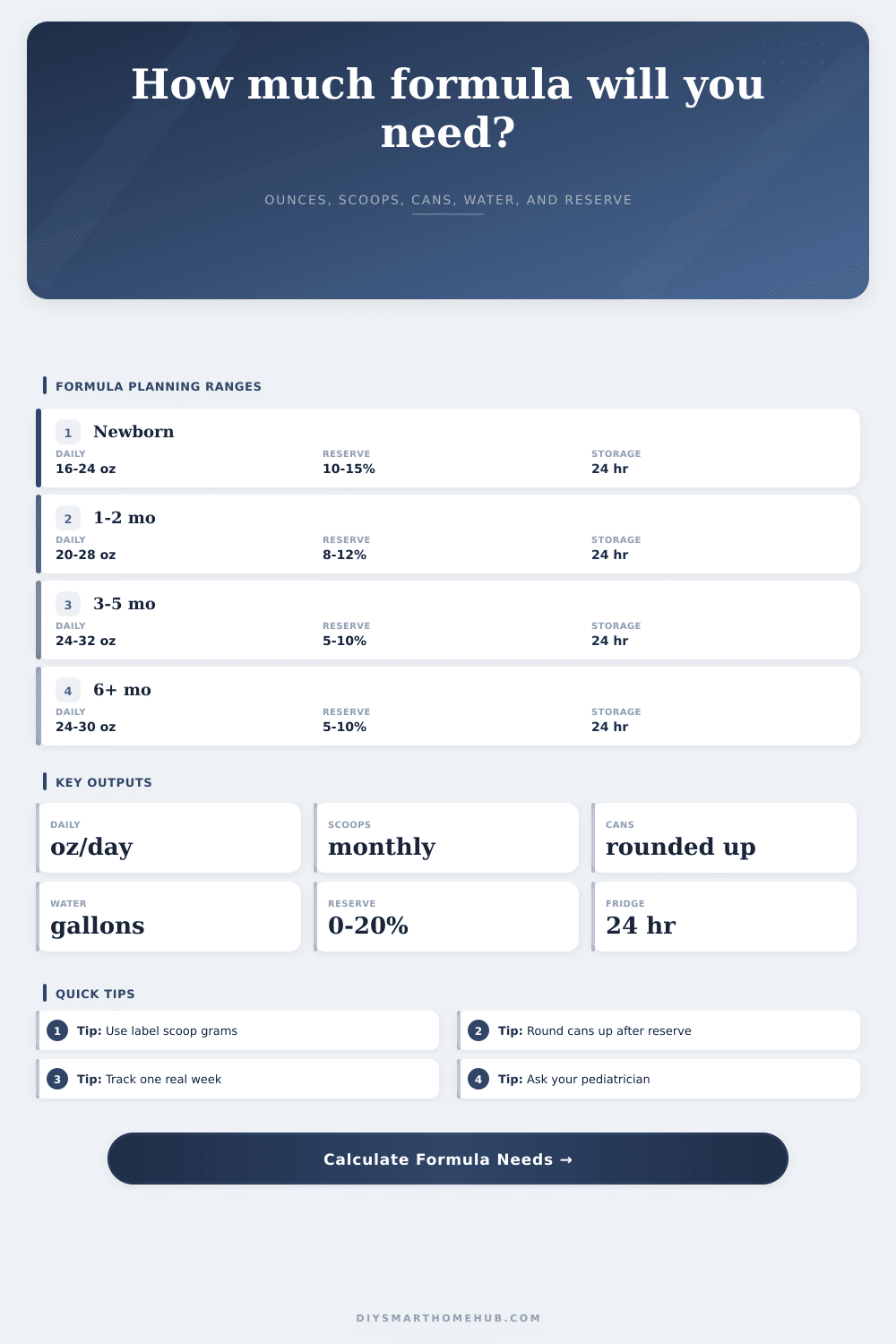
Formula Consumption Calculator
Estimate prepared ounces per day, powder scoops per month, cans to keep on hand, reserve allowance, water needed, and prepared formula storage limits from your baby's routine.
Calculation breakdown
| Age range | Typical feed pattern | Calculator cap | Planning note |
|---|---|---|---|
| 0 to 1 month | 8 to 12 feeds daily | 16 to 24 oz/day | Small bottles; higher waste buffer often helps. |
| 1 to 2 months | 6 to 8 feeds daily | 20 to 28 oz/day | Use weight estimate unless you track bottles closely. |
| 2 to 5 months | 5 to 7 feeds daily | 24 to 32 oz/day | Many planning totals cluster near the upper cap. |
| 6 months or older | 4 to 6 feeds daily | 20 to 32 oz/day | Solids can change intake; track actual ounces. |
| Prepared amount | Scoops at 2 oz/scoop | Water basis | Powder at 8.7 g/scoop |
|---|---|---|---|
| 16 oz/day | 8 scoops/day | 0.125 gal/day | 69.6 g/day |
| 24 oz/day | 12 scoops/day | 0.188 gal/day | 104.4 g/day |
| 28 oz/day | 14 scoops/day | 0.219 gal/day | 121.8 g/day |
| 32 oz/day | 16 scoops/day | 0.250 gal/day | 139.2 g/day |
| Situation | Limit used | Calculator impact | Use this setting |
|---|---|---|---|
| Freshly prepared at room temperature | 2 hours | Discarding late bottles adds waste | 8% to 15% waste |
| Feeding has started | 1 hour | Leftovers are not saved | 10% to 20% waste |
| Refrigerated before feeding starts | 24 hours | Batch prep can reduce waste | 5% to 10% waste |
| Pantry stock planning | Label specific | Opened powder dates matter | 3 to 14 days reserve |
When you wake up in the middle of the night, the formula container seems empty. Panic sets in. Why? Because you don’t know what’s going on.
Not because you’re hungry; your in charge of a supply chain. The calculator do the math for you. Instead of worrying about it in the middle of the night, it gives you a list of scoops and can.
How to Plan Your Baby Formula Supply
If you want to keep your mind at ease and your pantry stocked, then you has to understand the factors that drive numbers.
From the web: You find an online guide that guesses daily ounces by age bracket. That’s a decent place to begin, except that babies aren’t standardized. You can enter either your baby’s measured weight or her daily recorded intake.
Why does weight matter? Because it’s a better predictor of caloric need then a given calendar date. Whether she’s three months or six weeks, a bigger baby require more fuel. By using weight, the tool avoids vague generalization and turns a hunch into plan.
But when we shift from ounces to actualy stuff in real-life containers, things start to get complicated. Formula come as powder, measured out by the scoop, sold by weight, and kept inside cans that vary in size.
Some brands gives you two fluid ounces per scoop; some give you twice as much (twenty). Consumers screw this up frequently. They see a box that says it lasts for thirty days and think, “Okay, I’ll buy one can.” They don’t realize that their particular baby may consume more or less.
With the calculator, you have to tell it how many grams are contained within each scoop, along with how many fluid ounces result from every single scoop. Why? It connects the idea of feeding your child once a day with the physical act of pouring a scoop into a bottle.
Next, consider waste. Yes, we has to use the word ‘waste’ here. It’s a nice way of saying “formula that fell on the floor while I was mixing it” or “formula still in the bottle after baby fell asleep.” Because newborns tend to conk out midway through bottles, you’ll usually toss the remaining contents.
You can include that variability into your plan using waste allowance input. Choose a bigger number and you purchase more formula at once. Choose a smaller number and you give yourself a few hours of extra slumber.
A 20 percent buffer ensures you never run out during travel. A 5 percent buffer prevents you from having to get up in the middle of the night for a trip.
The other unknown variable is water. You need to prepare the formula with clean water (most often boiled or purified). The calculator will estimate the number of gallons that you’ll need during your planning period. It allows you to determine whether your existing water filtration system can handle it.
For example, if you’re planning on feeding for a month, and know you’ll need 3 gallons of prepped water, well, maybe that changes what you have in your kitchen.
Regarding storage: The tool will remind you that prepared formula can only be kept at room temperature for two hours before bacteria become a problem. Refrigerated, this extends to 24 hours. You don’t want to schedule your bulk prepping routine in such a way that you’ll break those rules. Better to prepare less and more frequently then run the risk of illness for the sake of convenience.
You round up the result to get a target for how many cans to purchase. And we round, because you don’t buy half a can.
If you run out halfway through day 28 of your plan, it’s not that you’re running out of love… It’s that something failed in logistics. That extra buffer is there to hedge your bets against a hiccup in the supply chain, or a sudden growth spurt. It is a small over-buy that staves off disaster.
A plan is not a prediction of exact outcomes. It means taking the guesswork out of the routine. If you know you have exactly enough scoops to last X number of days, there is no panic at 2 AM.
You feel no anxiety as you gingerly pick up the spoon. Everything is cool; we’ve got this covered.
The container feels light, but the plan feels right.