Gutter Capacity Calculator
Check whether a gutter run can handle roof runoff during a peak storm using pitch-adjusted roof area, rainfall intensity, gutter type and slope, downspout count, run length, and debris reduction.
Storm and Roof Presets
Calculator Inputs
Results
gutter capacity = base gutter gpm * sqrt(slope / 0.0625) * run length factor * (1 - debris factor)
downspout capacity = size gpm * count * (1 - debris factor)
overflow margin = (limiting capacity - runoff demand) / runoff demand * 100
Breakdown
Preset Comparison
| Preset | Effective area | Rain | Demand | Gutter | Downspouts | Margin | Status |
|---|
Gutter and Downspout Spec Grid
Base Gutter Capacity Table
| Gutter profile | 4 inch | 5 inch | 6 inch | 7 inch | Best use |
|---|---|---|---|---|---|
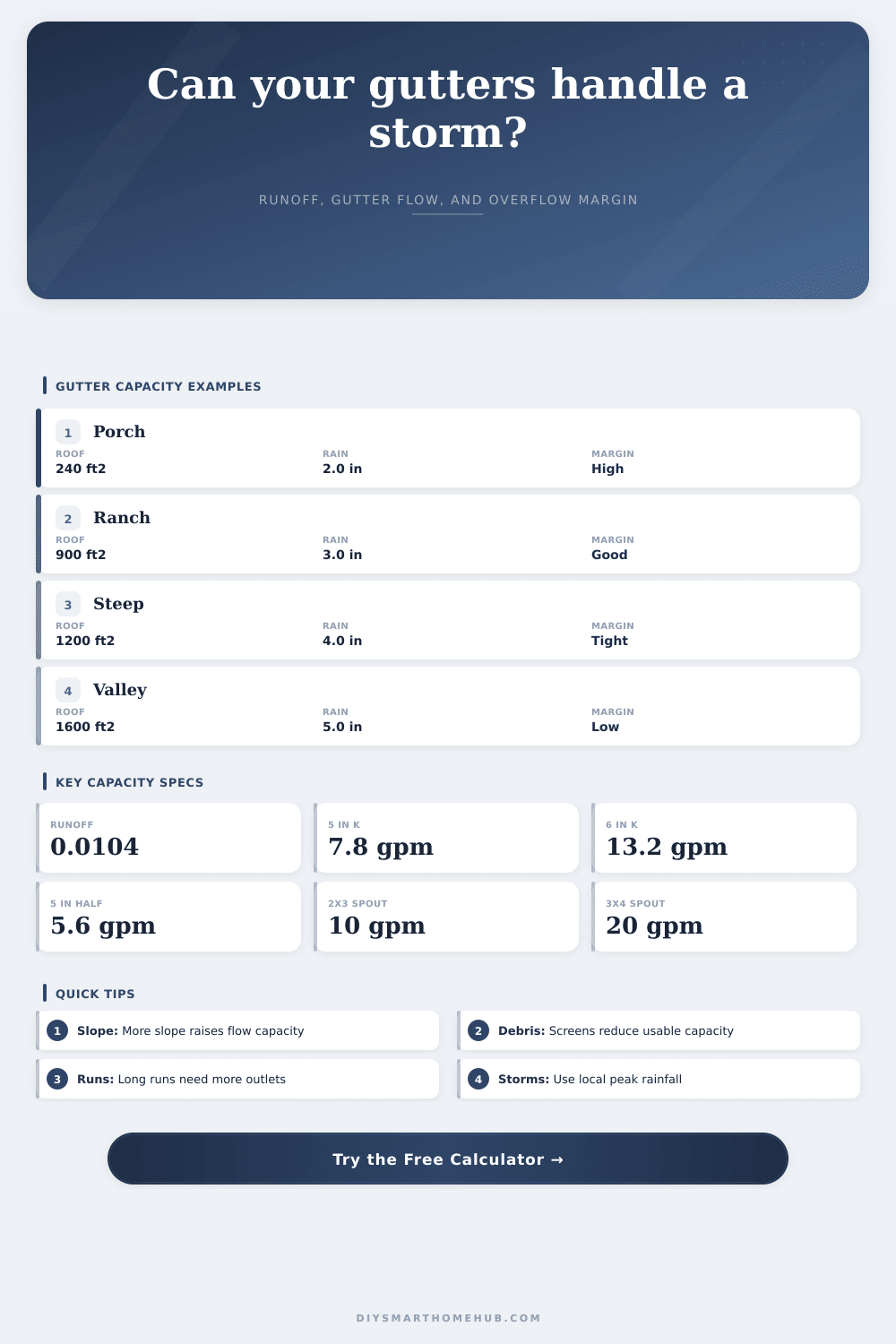
| K-style, 1/16 in per ft | 3.8 gpm | 7.8 gpm | 13.2 gpm | 21.0 gpm | Common residential eaves and larger fascia runs |
| K-style, 1/8 in per ft | 5.4 gpm | 11.0 gpm | 18.7 gpm | 29.7 gpm | High-rain sections when the outlet can keep up |
| Half-round, 1/16 in per ft | 2.6 gpm | 5.6 gpm | 9.6 gpm | 15.3 gpm | Traditional profiles with smoother but smaller section area |
| Half-round, 1/8 in per ft | 3.7 gpm | 7.9 gpm | 13.6 gpm | 21.6 gpm | Shorter runs or projects using larger outlets |
Downspout Capacity Table
| Downspout size | Base capacity | With 10% debris | With 25% debris | Typical pairing |
|---|---|---|---|---|
| 2 in round | 7 gpm | 6.3 gpm | 5.3 gpm | Small porch, short shed, light roof area |
| 2 x 3 in rectangle | 10 gpm | 9.0 gpm | 7.5 gpm | Standard 5 inch residential gutter |
| 3 in round | 12 gpm | 10.8 gpm | 9.0 gpm | Round systems with moderate roof area |
| 3 x 4 in rectangle | 20 gpm | 18.0 gpm | 15.0 gpm | 6 inch gutters, valleys, high-intensity storms |
| 4 in round | 22 gpm | 19.8 gpm | 16.5 gpm | High-flow round systems and large collection points |
Project Size Reference
| Roof section | Area | Pitch | Rain test | Typical gutter | Capacity note |
|---|---|---|---|---|---|
| Small porch or shed | 150-300 sq ft | Low | 1.5-2.5 in/hr | 4 or 5 in K-style | Usually downspout-limited only with tiny outlets |
| Single ranch side | 600-1000 sq ft | 4/12 to 6/12 | 2.5-3.5 in/hr | 5 or 6 in K-style | Good candidate for two outlets on long runs |
| Steep roof plane | 900-1400 sq ft | 8/12 to 12/12 | 3.0-4.5 in/hr | 6 in K-style | Pitch factor can push demand above a small gutter |
| Valley collection run | 1200-2000 sq ft | Mixed | 4.0-6.0 in/hr | 6 or 7 in K-style | Often needs larger downspouts and low debris loss |
Capacity Tips
The capacities here are planning estimates for clean, open gutters and unobstructed outlets. Field conditions, local code, roof geometry, valley discharge, and installation quality can change real performance.
Water is heavy and relentless when it decides to leave your house. Gutters aren’t just there for appearance; most home owners think of them as decoration but in fact they’re hydraulic engineering.
They must be able to move gallons per minute across some portion of the roof surface and direct it into a narrow gutter channel. That channel then funnels the water through a vertical pipe without dribbling onto the ground or over the gutter edge. If the math doesn’t work out right, you’re looking at erosion of your landscaping and damage to your foundation. And you’re smelling those damp basement odors that will never go away. With tool on this page you don’t need to read physics textbooks, the tool figures out the fluid dynamics for you.
How to Choose the Right Gutters for Your Roof
First: Consider each zone of your roof separately. Your entire roof may be considered in one fell swoop, but don’t. One long side of a ranch house could concentrate a huge amount into a single downspout. You’re asked how much area drains onto that particular run. That’s important, because changing pitch affects effective area.
For example, a steep roof offers a bigger vertical profile to the rain, more water falls on the gutters per square foot of horizontal measurement. The calc automatically adjusts the inputs for that. Oversize your system if you don’t account for pitch. I see that all the time; people only measure footprint, not considering the angle.
There are other variables that trip up the casual estimator. How hard does it rain? Rainfall intensity matters. Enter the annual average rainfall for your area, but don’t expect that value to size anything. A ten minute burst of intense rain will overwhelm your roof with more water than an entire year’s worth of gentle seasonal showers. Test the system against its worst case: severe thunderstorms. They dump water at rates far greater then your gentle seasonal showers. With this as your input, you’re testing the system against a worst case scenario, not some pleasant day.
The calculator then takes those inches-per-hour and converts them to gallons-per-minute. It simplifies the physics to a single demand figure using a standard runoff coefficient. Knowing the capacity requires knowing the demand.
You would of been surprised how important the profile of your gutter is. Because they have a larger surface area and a flat bottom, k style gutters moves more water than a half round design of the same width. For example, a five inch k style can actualy move a lot more water than a five inch half round. If you’re wondering what that looks like when comparing different profiles, the reference tables on the page will make that clear.
Performance is also related to slope. Steeper channels moves the water faster, which increases their volumetric capacity. But again, you don’t want to go too steep. Not only does it look crooked but it can send water shooting completely past the downspout. A gentle slope of one sixteenth inch per foot is the sweet spot that everyone settles into.
Gutters fail when they are filled with debris. A filled gutter (with leaves, pine needles, etc) is a dam, even on a gutter rated as “the widest.” There’s a debris factor in the calculator because yes, that happens, and even the widest gutter turn into a dam. If you live under large oaks, your effective capacity drops regardless of how wide the metal is. Your effective capacity is reduced anyway, no matter what the width of the metal. A little detail, but it makes a difference.
Maybe you go with a wider gutter (say, six inches) to help offset the weight of all those leaves falling down on you. Or maybe you spring for good screens that block out solid stuff yet allow water to flow through them. Good either way, but will require different maintenance habits.
The system’s bottleneck is the downspouts. Even though you may have a huge gutter with lots of water-carrying capacity, it won’t work if its only exit hole is tiny. Water will back up and overflow. The tool measures the total flow potential of your downspouts. A two by three inch rectangular spout is common, but a three by four inch option doubles the flow potential. The tool then compares this with the gutter’s capacity.
If your margin is narrow, it can often be more cost effective to add an extra downspout to a long run rather than upgrade to a bigger gutter profile altogether. Additional outlets are a wise investment on long runs longer than 50 feet, as they tend to concentrate the flow and sag.
What does this mean? It’s a margin of overflow. If you’re positive, you’ve got headroom for any unexpected squall. If you’re negative, then you’re already losing water at your selected storm conditions. So plug those numbers into your decision about where to spend some money. Changing from 4 inch to 5 inch gutters is a modest expense but the return in capacity is big. Installing a third downspout may be overkill for a small porch but on a steep two story roof, it would be necessary.
The idea is balance. You don’t want a system that spills during the peak flow. You also want to make sure your foundation doesn’t get wet and your landscape isn’t ruined. Water wants to find its way in so let it have a clear path out.