Seed Starting Date Calculator
Calculate indoor seed start dates, expected germination, hardening-off timing, transplant dates, direct sow windows, soil temperature targets, and succession sowing rounds from your last frost date.
Seed Starting Schedule
Calculation Breakdown
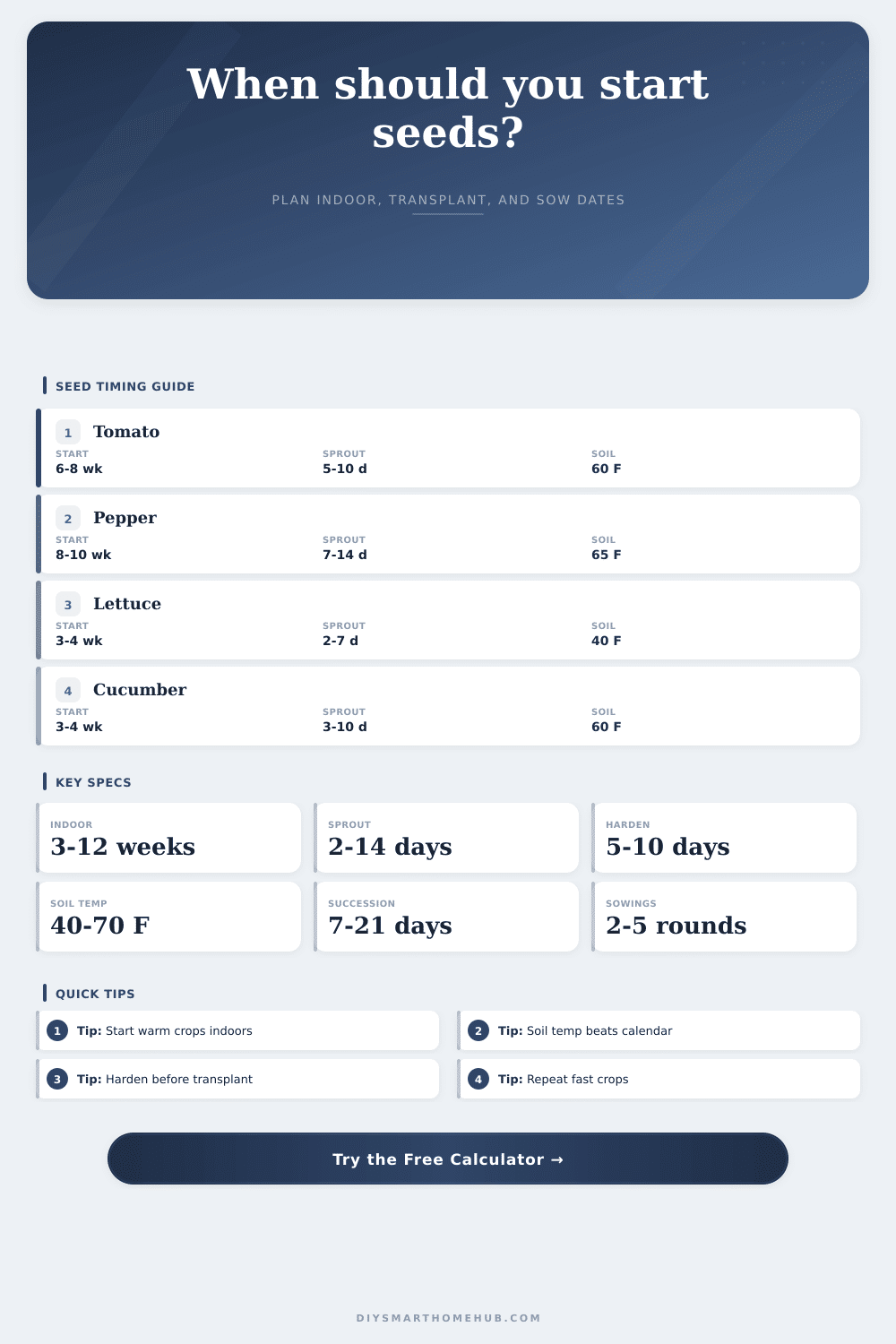
| Crop | Start indoors | Germination | Transplant timing |
|---|---|---|---|
| Tomato | 6-8 weeks | 5-10 days | 1-2 weeks after frost |
| Pepper | 8-10 weeks | 7-14 days | 2-3 weeks after frost |
| Broccoli | 4-6 weeks | 5-10 days | 2-3 weeks before frost |
| Basil | 5-7 weeks | 5-10 days | 1-2 weeks after frost |
| Crop | Window start | Window end | Best use |
|---|---|---|---|
| Lettuce | 4 weeks before frost | 6 weeks after frost | Spring succession |
| Carrot | 3 weeks before frost | 8 weeks after frost | Repeated root sowing |
| Bean | 1 week after frost | 8 weeks after frost | Warm soil rounds |
| Cucumber | 1 week after frost | 6 weeks after frost | Warm direct hills |
| Threshold | Crops | Timing meaning | Calculator use |
|---|---|---|---|
| 40-45 F | Lettuce, carrot | Cool-season germination | Allows early direct sow |
| 50-55 F | Broccoli, zinnia | Moderate spring soil | Good transplant check |
| 60-65 F | Tomato, cucumber | Warm-season start point | Direct sow caution |
| 65-70 F | Pepper, basil, bean | Warm germination range | Delay cold soil sowing |
| Interval | Typical crops | Window length | Planning result |
|---|---|---|---|
| 7 days | Radish, baby lettuce | 3-5 weeks | Frequent small harvests |
| 10-14 days | Lettuce, carrot, bean | 4-8 weeks | Balanced repeat sowing |
| 21 days | Basil, zinnia, cucumber | 6-10 weeks | Fewer larger plantings |
| 0 days | Tomato, pepper | One transplant batch | Single planned start |
You hold a bag of tomato seeds in the cold spring air, and that’s when you has to make up your mind. It’s March on the calendar, and things is still waiting in the ground. That difference between what the almanac dictates and what your garden want is where most plans go awry.
Seed starting can be treated like a strict timetable, like this… Or as an act of negotiation with the weather. You enter your specific frost date, and the calculator above do the math for you. No more guesswork conversions; now you’re free to concentrate on gardening.
How to Start Seeds Successfully
This all hinges on knowing your final frost date in spring. That’s not a starting gun; think of it more like the finish line. Count back from there, understanding that plants that love heat such as tomatoes and peppers opens their season about six to eight weeks earlier.
Sounds premature, but remember: Seedlings require time to develop a root system strong enough to withstand transplant shock in the great outdoors. Too early, and they’ll be leggy and want to lie down; requiring significant staking. Too late, and you’ll have spindly plants prone to bolting out of stress. The sweet spot is somewhere in between: large enough to move, but small enough that the roots doesn’t get crowded.
But there’s more, which is soil temperature. Why do people always skip over this? That’s the part that realy trips them up. The date may be right on your calendar, but you’ve got frosty ground, and it won’t matter how hard you try; what you put directly into the cold soil will go downhill fast.
With warm season crops (such as cucumbers and beans), you want to know when the soil is truly warm, not merely above freezing but in high 60s or even higher. With cool season ones (such as lettuce) you can get away with a still-chilly soil. They don’t mind starting life when things feel cool to you. To know who’s who on the thermal spectrum, check reference table on the page… It’s easy to read and nobody has to guess.
Between your home and the garden is A bridge called hardening off. No, a seedling won’t suddenly make it if you toss him out the door from his cozy spot on a heated windowsill facing a blast of breeze. The process called hardening off, which takes as long as a week or up to 10 days, is about slowly getting the plant used to rising temperatures, sun and even wind. Hardening off prevents shock, which can stunts a plant’s growth for weeks (or longer). A little investment of time bring big results: a stronger plant.
Gardening becomes a steady cycle, not a one-off. Succession planting makes one harvest last and last. With lettuce or with carrots, instead of sowing them all at once, for instance, you stagger the dates: sow a row every week or two, and never run out of fresh greens. You will no longer have a big glut followed by a barren stretch. The tool maps these rounds for you. It tells you when the next round goes in, so the momentum continues.
Other crops simply don’t want to be transplanted. Plants whose roots is particularly tender may be hurt by transplantation. You’re better off directly sowing them. These are marked in the calculator, too. And it doesn’t rely only on air temperatures; it takes into account soil warmth and presents clear windows for direct sow dates. It knows about the biology of the plant, and that sometimes it should of stayed put.
The bottom line on seed starting is to read the environment. Your seedlings will tell you the truth. I find it helpful to use the frost date as my base and adjust to match what I’m observing in my particular microclimate. Set yourself a baseline with the tool and make adjustments from there.
A south facing wall may get warmed up quicker then an open field. A shady corner may retain some winter longer. Believe the data, but also believe your eyes.
Make a good plan, keep things cozy in the soil, and let the seeds take it from there. You’ve got the dates; you’ve got the game plan; now all that’s left is watching it come alive.