Raised Bed Soil Volume Calculator
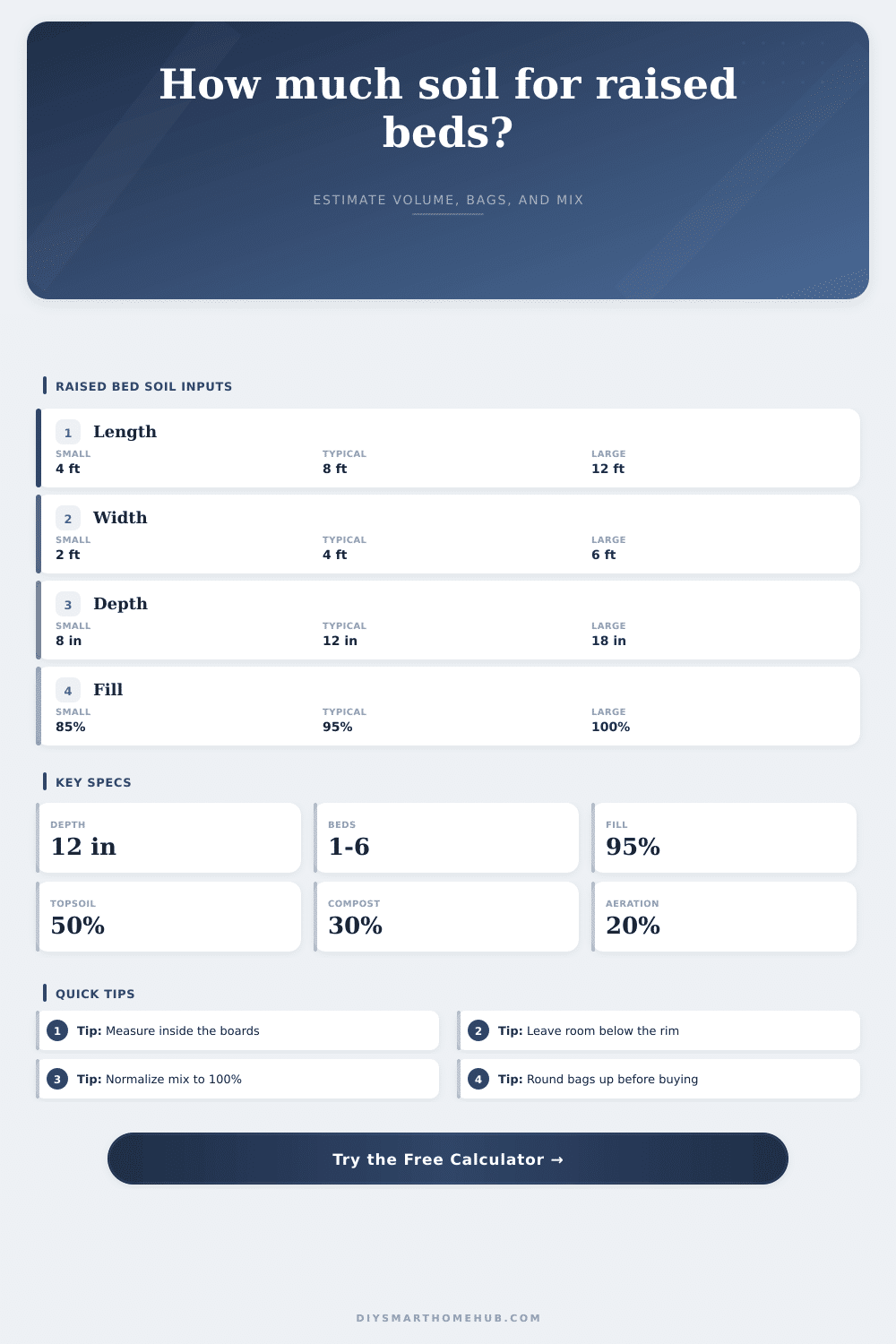
Calculate soil volume for rectangular raised beds, then split the total into topsoil, compost, and aeration material with cubic feet, cubic yards, liters, and bag counts.
Raised Bed Soil Results
Calculation Breakdown
| Step | Formula | Output | Use |
|---|---|---|---|
| Bed area | Length x width | Square feet | Inside footprint |
| Depth | Inches / 12 | Feet deep | Volume conversion |
| Soil volume | Area x depth x beds x fill | Cubic feet | Main result |
| Bulk volume | Cubic feet / 27 | Cubic yards | Bulk ordering |
| Metric volume | Cubic feet x 28.3168 | Liters | Metric bags |
| Bag count | Total / bag volume | Rounded bags | Bag planning |
| Bed size | Depth | Volume | Liter equivalent |
|---|---|---|---|
| 2 ft x 4 ft | 8 in | 5.3 cu ft | 151 L |
| 3 ft x 6 ft | 10 in | 15 cu ft | 425 L |
| 4 ft x 8 ft | 12 in | 32 cu ft | 906 L |
| 4 ft x 12 ft | 18 in | 72 cu ft | 2039 L |
| Mix style | Topsoil | Compost | Aeration |
|---|---|---|---|
| Balanced vegetable bed | 50% | 30% | 20% |
| Compost rich annuals | 45% | 35% | 20% |
| Deep root bed | 55% | 25% | 20% |
| High drainage box | 40% | 30% | 30% |
| Bag label | Cubic feet | Liters | Best use |
|---|---|---|---|
| Small bag | 0.75 cu ft | 21 L | Herbs and top-offs |
| Standard bag | 1.5 cu ft | 42 L | Single bed planning |
| Large bag | 2 cu ft | 57 L | Several small beds |
| Bulk yard | 27 cu ft | 765 L | Multiple beds |
When you stand in the garden center staring down a wall of bags of soil and try to fit them into your half-filled wheelbarrow, panic sets in. Did I buy enough? Enough of what? Perhaps you bought enough topsoil, but what about the compost?
That’s the way most beginners think of raised beds: magic boxes. Raised bed are neither magic nor boxes. To nourish plants well they need just the right recipe. And a certain volume of space to work within.
How to Calculate Soil for Your Raised Bed
The raised-bed recipe calculator above help you avoid worry. However, you must first imagine the bed as a three-dimensional puzzle. The first mistake is measuring the outer perimeter of wood framing. All you care about is what’s happening inside the frame, where the SOIL is. If your long bed have a two-inch-thick board on all sides, you’re losing several cubic feet of space. And it really starts to add up if you’re trying to figure out exactly how many bags you’ll need!
Measure the inside length and width, plus how much soil depth you want. Most vegetables has their sweet spot at about 12 inches deep (which gives them room to grow without bumping into compacted earth beneath). Deep-root crops such as tomatoes or carrots may requires more depth (but remember: It takes up volume).
How will you factor in the volume of a deeper bed? The tool do this conversion for you, translating raw measurements into cubic feet/liters/bulk yard estimates.
After entering the total volume, it’s time to choose what goes into the bed. A lot of gardeners think they can purchase a single bag of soil, but a good raised bed is a customized blend. It needs compost for nutrients, topsoil for structure, and something to let air in, like coarse sand or perlite, to make sure it drain well. Use the input fields to adjust those proportions according to your crop. More compost may be called for if you’re sowing something that grows quickly, like leafy greens. Root crops likes a looser, airier environment to avoid forked roots. And the system will normalize your numbers automatically if your totals doesn’t equal one hundred percent. That way you won’t end up with too much of one thing and no amount of another, an all-too-common mistake when buying bags of potting soil.
Another thing to watch out for is bag size. Local gardens may sell 2 cubic foot bags, for example; Home Depot bags are frequently 1.5 cubic feet. And then there’s buying bulk, cubic yards. Which is much less expensive than per cubic foot. Plug in your exact bag size into the calculator and it will tell you how many to get (or at least how many you’ll need). Always round up, cheaper to buy a little more soil than to return to the garden center, and also to avoid making a second trip altogether.
If you have the equipment to haul bulk, it should of been much less expensive than bags on a cubic-foot basis. Either way, the tool will show you both numbers, so you know what works for your wallet; and your back.
The difference between a successful garden and an exercise in frustration (a.k.a., wasted time and money) is knowing what kind of soil you have. And planning your soil strategy first, not last. Creating a place for your plants requires more than just digging a hole. Getting the volume correct help create the right growing environment, which leads to better plant health and less waste. Time to get growing.