Spa Cover Heat Loss Calculator
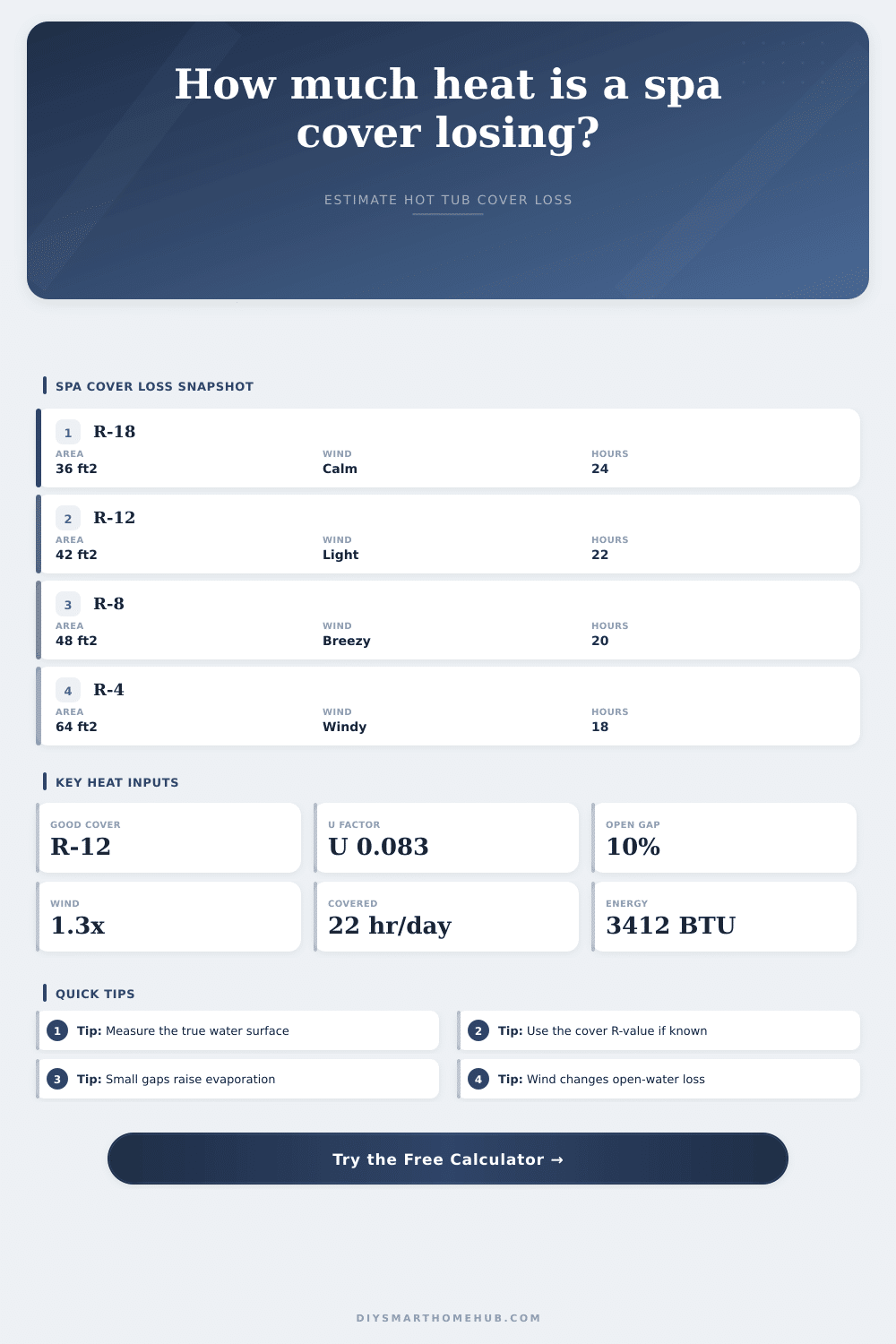
Estimate covered and uncovered hot tub surface heat loss from spa size, water-air temperature delta, cover R-value, wind exposure, open area, and covered hours per day.
♨Choose a Spa Cover Preset
🌡Enter Cover Heat Conditions
🔥Your Cover Loss Estimate
⚙Formula Constants
📊Cover Condition Comparison
High R-value cover
- Typical planning range is about R-14 to R-22.
- Conduction is low, so gaps and open time often dominate.
- Best modeled with a small uncovered percentage.
Standard insulated cover
- Typical planning range is about R-8 to R-13.
- Daily standby loss depends strongly on water-air delta.
- Light wind can make seams and lifted edges more important.
Aging or open cover
- Low R-values and water gaps raise heat loss quickly.
- Uncovered evaporation can exceed cover conduction.
- Use a higher wind factor for exposed patios or decks.
📐Heat Loss Formula Reference
| Formula | Inputs used | Calculator expression | Result role |
|---|---|---|---|
| Surface area | Shape and dimensions | Length x width, pi x r², or direct area | Defines the cover heat transfer area. |
| Water-air delta | Water temp, air temp | Max(water – air, 0) | Temperature difference driving heat flow. |
| Covered loss | Area, delta, U, wind | Area x deltaF x U x wind edge factor | BTU/hr through the insulated cover. |
| Uncovered loss | Open area, delta, wind | Area x open % x deltaF x evaporation factor | BTU/hr from exposed water and gaps. |
🌡R-Value And U-Factor Guide
| Cover profile | Planning R-value | U-factor | Best fit |
|---|---|---|---|
| Thermal blanket plus cover | R-18 to R-24 | 0.042 to 0.056 | Cold nights, long covered hours, tight water seal. |
| Good tapered foam cover | R-10 to R-16 | 0.063 to 0.100 | Typical acrylic spa with a fitted insulated lid. |
| Aging or waterlogged cover | R-4 to R-8 | 0.125 to 0.250 | Heavy covers, sagging foam, cracked vapor barrier. |
| Uninsulated soft lid | R-1 to R-3 | 0.333 to 1.000 | Temporary lids, thin vinyl caps, mild climates only. |
🌬Wind And Open-Water Factors
| Exposure | Wind factor | Open-water impact | Use in calculator |
|---|---|---|---|
| Indoor or still air | 0.85x | Lower evaporation from gaps. | Warm spa room or very sheltered enclosure. |
| Calm outdoor air | 1.00x | Base evaporation factor. | Default for covered tubs near walls or screens. |
| Light breeze | 1.20x | Higher seam and open-area loss. | Common patio or deck with occasional air movement. |
| Windy exposed tub | 1.80x | Open water dominates quickly. | Raised decks, exposed yards, coastal or ridge sites. |
📋Common Spa Size Examples
| Spa type | Water surface | Typical cover R | Planning note |
|---|---|---|---|
| Compact two-seat spa | 30 to 38 ft² | R-10 to R-18 | Small surface area keeps standby loss moderate. |
| Family square spa | 45 to 56 ft² | R-8 to R-16 | Most estimates are driven by air temperature and cover fit. |
| Large lounge spa | 56 to 72 ft² | R-8 to R-14 | Long seams and cover weight can create more gap loss. |
| Swim spa | 90 to 150 ft² | R-10 to R-18 | Large surface area makes covered hours especially important. |
💡Calculator Tips
Ever get in a hot tub and feel like you’re taking a lukewarm bath? It’s not normaly because of the heater itself.
A hot tub isn’t very efficient at retain heat. And the #1 obstacle between you and cold weather is your cover.
Why Hot Tub Covers Are Important for Saving Heat
If you think of it as simply something to keep the tub clean, you’re wrong. It’s a thermal seal; if the seal fails, you’re paying to heat air over your patio.
It’s all very simple science, but it doesn’t take long before you get punished by it. Energy flows from hot to cold. Water has far more energy than air. And as soon as you open up that surface area, evaporation will steal your heat much quicker then any conduction across the walls.
Just think how many thousands of BTUs escapes out of a standard sized hot tub over a few hours.
That’s why we run the numbers for you: The calculator above takes insulation values, temperature differences, and surface area, and converts them to a real daily energy cost.
R-value is the key input that throws people off their game. R-value is a measure of effectiveness of the cover at blocking heat flow. A really nice, thick, dry foam cover might be in the R-12 range, which isn’t bad. An older one that has sagged from its own weight or taken on water will probably be R-6 or less. Soggy foam conducts heat practically like water do. If you find the cover heavy and dense, there is a good chance it are taking on water. That water creates a bridge through the insulating gap and what was a shield becomes a heat radiator. Believing the manufacturer’s original spec is not as important than knowing the actual state of the foam.
The wind has a trickier effect than most believe. It not only blows the cold out but also rips the very thin cushion of warm, moist air that hugs the water surface. That is a natural insulator called the boundary layer. If it is disrupted then evaporation increases dramaticly. Wind can also increase heat loss even with a closed cover. This happens because of gaps in seams, where the hinge enters the cover, and small openings like light holes or jet holes. By allowing you to dial down for exposure, the tool factors that in and explains why a tub hidden behind a fence will lose less heat than one on a windy deck.
The silent killer of efficiency are gaps. Few covers fits perfectly. Even if they did initially, cabinets settle and most lids has a bit of lift so you can gain access for maintenance. The gap only measures inches around, yet it is large enough to let steam through easy. Evaporative cooling is very energy intensive. A gap an inch wide can offset the insulating benefit of multiple square feet of solid lid material. The percentage of uncovered area shows this.
Measure these gaps honest. A moderately tight seal with lower R-value may actualy outperform a sloppy seal with higher R-value.
The whole equation relies on temperature difference. The steeper the temperature differential between your water temp and the outside air, the quicker the heat will flee from your tub. On a 40 degree night, running your spa at 104 creates a large difference in temperature. Heat flees out to try and equalize itself. Lowering the thermostat when you are away reduces the driving force. This delta is what the calculator shows you the true cost of keeping the water hot all day long vs. You can just turn it down and cool the water off.
In short: How much you lose depends on how much you expose.
There is only so much you can do to reduce the loss. You can make sure the tub is covered as soon as possible after use, keep the lid dry, and seal any air gap. If you leave the door open, you’re fighting physics (and losing). With a good seal and reasonable expectations, though, you’ll get the best of both worlds by keeping the heat in and the bills low.
You should of kept it covered. The cover isn’t just a lid, it’s your first line of defense when it comes to wasting energy.