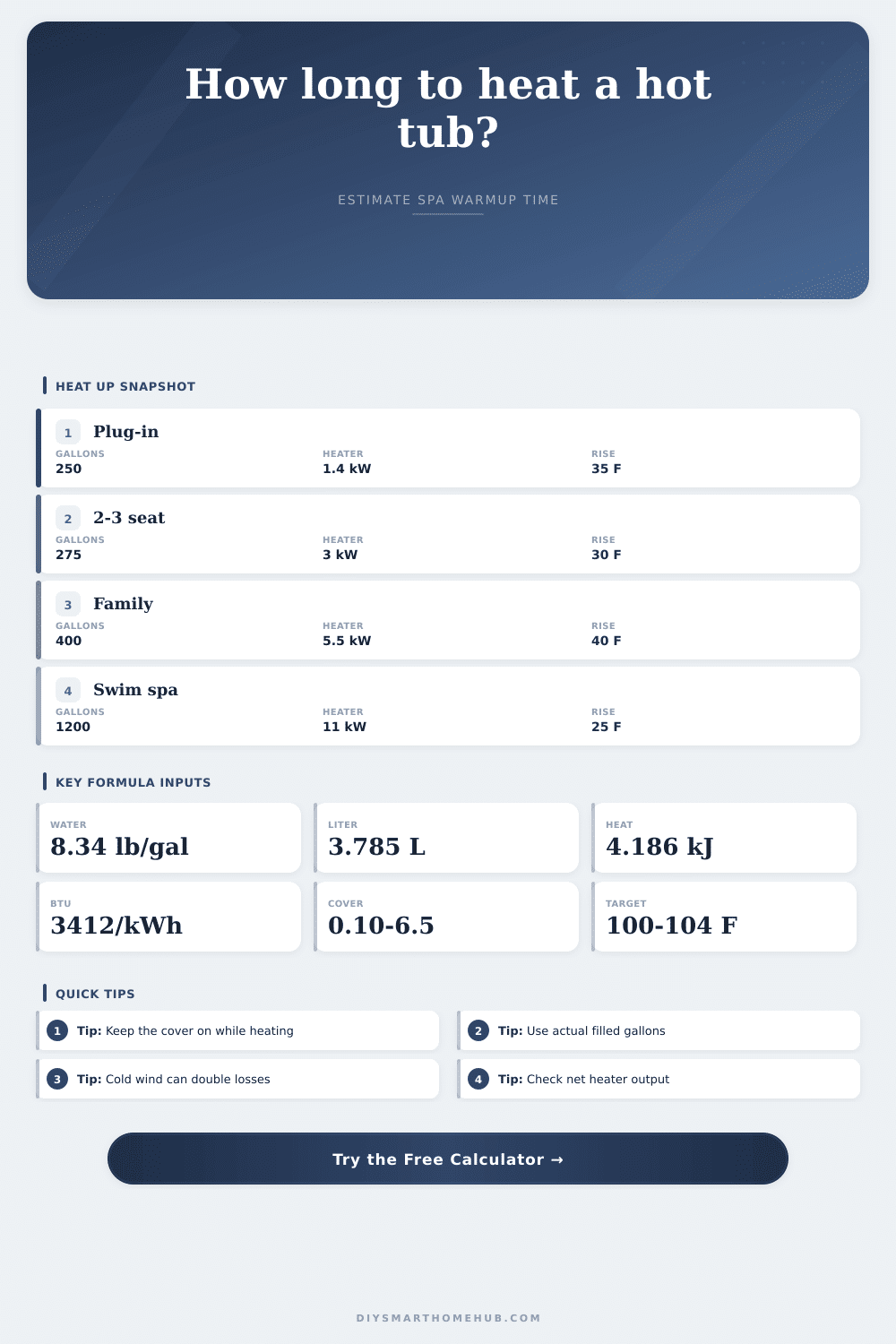
Hot Tub Heat Up Time Calculator
Estimate spa warmup time from gallons, starting temperature, target temperature, heater output, cover condition, ambient air, and exposure losses using BTU and kWh heat formulas.
♨Choose a Hot Tub Preset
🌡Enter Heat-Up Conditions
⏱Your Heat-Up Estimate
⚙Formula Constants
📊Heater Comparison Grid
120V plug-in heater
- Typical output is about 1.0 kW to 1.5 kW.
- Works best with a cover on and moderate temperature rise.
- Cold ambient air can consume a large share of the heater output.
240V standard heater
- Common output is 4 kW to 5.5 kW for portable spas.
- Usually recovers several degrees per hour when well covered.
- Large water volume still dominates the final time estimate.
Dual or swim spa heat
- Output can be 8 kW to 11 kW or more.
- Big water volume offsets the higher heater power.
- Insulated covers are critical because surface area is larger.
📐Heat Formula Reference
| Formula | Inputs used | Calculator expression | Result role |
|---|---|---|---|
| BTU required | Gallons, deltaF | Gallons x 8.34 x deltaF | Total heat energy in imperial units. |
| kWh required | Gallons, deltaC | Gallons x 3.785 x 4.186 x deltaC / 3600 | Total heat energy in electrical units. |
| Surface loss | Cover, air gap, area | Area x air delta x cover rate / 3412 | Estimated kW lost while heating. |
| Adjusted time | Energy, heater, loss | kWh / (heater kW - loss kW) | Final heat-up hours. |
🛁Typical Spa Heat-Up Ranges
| Spa type | Typical volume | Common heater | Approximate rise rate |
|---|---|---|---|
| Inflatable plug-in tub | 180 to 260 gal | 1.0 to 1.5 kW | 1°F to 3°F per hour when covered. |
| Small acrylic spa | 240 to 325 gal | 3 kW to 4 kW | 3°F to 6°F per hour in mild air. |
| Family portable spa | 350 to 500 gal | 4 kW to 5.5 kW | 4°F to 8°F per hour with a tight cover. |
| Swim spa | 900 to 1800 gal | 8 kW to 11 kW | 1°F to 4°F per hour depending on volume. |
🌡Cover And Exposure Multipliers
| Condition | Loss setting | Best use | Calculator effect |
|---|---|---|---|
| Thermal blanket plus cover | 0.10 BTU/ft²/hr/°F | Long warmups or cold nights. | Lowest surface loss in the model. |
| Excellent insulated cover | 0.14 BTU/ft²/hr/°F | Most efficient normal heating. | Preserves nearly all heater output. |
| Aging or loose cover | 0.38 BTU/ft²/hr/°F | Older covers with gaps or sag. | Subtracts more net heater power. |
| Cover off or open | 6.50 BTU/ft²/hr/°F | Short tests only, not warmup. | Can exceed small heater output. |
📋Preset Scenario Reference
| Preset | Volume | Temperature rise | Why it matters |
|---|---|---|---|
| 120V portable spa | 250 gal | 35°F | Small heater makes cover and ambient assumptions important. |
| Family 240V spa | 400 gal | 42°F | Typical refill warmup with a 5.5 kW heater. |
| Cold refill recovery | 425 gal | 55°F | Large deltaF makes total BTU dominate the estimate. |
| Swim spa warmup | 1200 gal | 28°F | High heater output still faces very large water mass. |
💡Calculator Tips
The Thermostat: Set the thermostat and fill the tub on a Tuesday night; go to sleep. Wake up Wednesday morning to find it’s barely warm, the heater couldn’t keep up with heat loss. There’s no mechanical issue here. Nothing wrong that you’re doing. But there’s physics happening, and you don’t have a map for this fight.
Plug in your heater specs and volume into the calculator, and let it do the math for you. You will no longer has to guess why the spa won’t warm up.
Why Your Hot Tub Takes So Long to Heat Up
Heat dissipates rapidy through water. If there’s a weak spot in your armor, it will let heat out just as fast as heat goes in. First off: Your heater’s rated for a best case scenario. It is not guaranteed. You can have a five kilowatt heater but half of its power could be leaking out the top of the tub. That’s why folks go wrong here, they base their results off the heater sticker, rather than the heater cover insulation.
The biggest factor in your heating equation is your cover. Hot water give off more heat into the air then it does on the bottom or sides. That means heat rises! When you enter your cover condition in the tool, you are telling it what percentage of your heater’s output is escaping. A good insulated cover keeps the bulk of that warmth in the water. It helps hold that steam in too. Old sagging covers or ones that has lost their foam will be as if you had left an open door during winter.
The temperature of the air outside matters too. If you want it to be a hundred and two but it’s only fifty outside, that’s a big gap. The bigger the gap, the quicker the heat will escape.
The size part is a bit unexpected. We imagine that a big swim spa will take hours longer to heat up than a little inflatable hot tub, but actualy, it has less water to heat up! An eleven kilowatt heater in a large swim spa sounds like industrial power, but it are only pumping thousands of pounds of water. The math doesn’t lie here. It is not the printed capacity on the box, but the actual gallons when it’s full. Plumbing, pumps, seat, all displace water and reduce the amount you’ll be trying to heat. Getting this wrong makes a huge difference to your energy estimate. It’s just a detail but it alters the time line by hours.
So what does the calculator tell us? First off it tells us our heat-up time. But it also shows us the net heat rate. How much power is realy getting into the water? That’s the net, with losses due to ambient air and cover. If your net rate is near zero, you’re not raising the temperature of the water, you’re simply maintaining it. That is why those endless winter warmups can seem like they’ll never end. The cover loss and the cold air fight back at you simultaneously. In summer, the ambient air is warmer, so there is less loss and the same heater seems twice as fast.
Don’t uncover to heat, The temptation to feel if the water is hot enough, or even peek in to see how warm it is, will cause you to undo the efforts you put into heating for every minute the cover is removed. You should of stayed covered. Steam, a.k.a. Evaporative cooling, is the enemy of spa efficiency. Water turning to steam takes energy with it, and that energy comes from your heater’s budget. That energy was paid for by your heater. The table at the bottom of the page describes the impact different conditions have on this loss, but the message is clear: Keep it covered! Keep it snug! Let the heater do its job without distractions.
The other part of the equation is patience. There’s no hurrying the water. All you can do is lessen the things slowing it down. When you realize you’re not just battling the volume but also the cover and the air, it all makes sense in terms of time. No more “What’s taking so long?” Instead, it becomes an opportunity to enjoy the slow and gradual rise to that just-so-soak-a-bunch temperature. Eventually, the heat arrive. But let it have its moment first.