Hot Tub Chemical Dose Calculator
Estimate sanitizer, shock, alkalinity, pH adjustment mode, bather-load demand, and safe split dosing from spa volume and current test readings.
Calculation breakdown
| Product type | Modeled strength | Typical spa use | Calculator conversion | Best result to watch |
|---|---|---|---|---|
| Dichlor granules | 56% to 62% available chlorine | Routine chlorine spa top-ups and chlorine shock. | Product ounces = chlorine-ounce need / strength. | Sanitizer ppm gap and split plan. |
| Liquid chlorine | 10% sodium hypochlorite by solution weight | Measured liquid additions where label strength is known. | Fluid ounce estimate uses active weight and solution density. | Fluid ounces plus final ppm target. |
| Cal hypo granules | 65% available chlorine | Chlorine dose planning where calcium impact is acceptable. | Dry ounces = chlorine-ounce need / 0.65. | Single-dose cap for smaller spas. |
| Bromine granules | 98% active bromine | Bromine spa sanitizer recovery and bromine shock target. | Product ounces = bromine-ounce need / 0.98. | Bromine ppm gap and shock target. |
| MPS oxidizer | 43% active oxygen model | Non-chlorine oxidation estimate after bather load. | Ounces scale from common 1 oz per 250 gal baseline. | Shock dose rather than sanitizer top-up. |
| Balance mode | Formula basis | Example conversion | Mode result | Split-dose reason |
|---|---|---|---|---|
| Alkalinity increaser | 1.4 oz sodium bicarbonate per 100 gal per 10 ppm TA rise | 350 gal, +20 ppm = 9.8 oz | Dry ounces of increaser. | Large TA jumps can push pH upward. |
| Alkalinity reducer | 1.2 oz dry acid per 100 gal per 10 ppm TA drop | 350 gal, -20 ppm = 8.4 oz | Dry ounces of reducer. | Acid additions should be staged and retested. |
| pH increaser | 0.4 oz soda ash per 100 gal per 0.2 pH rise | 350 gal, +0.4 pH = 2.8 oz | Small pH-up estimate. | pH response depends on alkalinity. |
| pH reducer | 0.35 oz dry acid per 100 gal per 0.2 pH drop | 350 gal, -0.4 pH = 2.5 oz | Small pH-down estimate. | Low alkalinity water can overshoot quickly. |
| Formula item | Formula | Example | Calculator use |
|---|---|---|---|
| Rectangular spa gallons | Length x width x depth x 7.48052 x fill factor | 7 x 7 x 2.5 x 7.48052 x 0.82 = 751 gal | Estimates volume when gallons are unknown. |
| Round spa gallons | Pi x radius squared x depth x 7.48052 x fill factor | 6 ft diameter, 2.4 ft deep, 0.82 factor = 416 gal | Supports round inflatable and cedar-style tubs. |
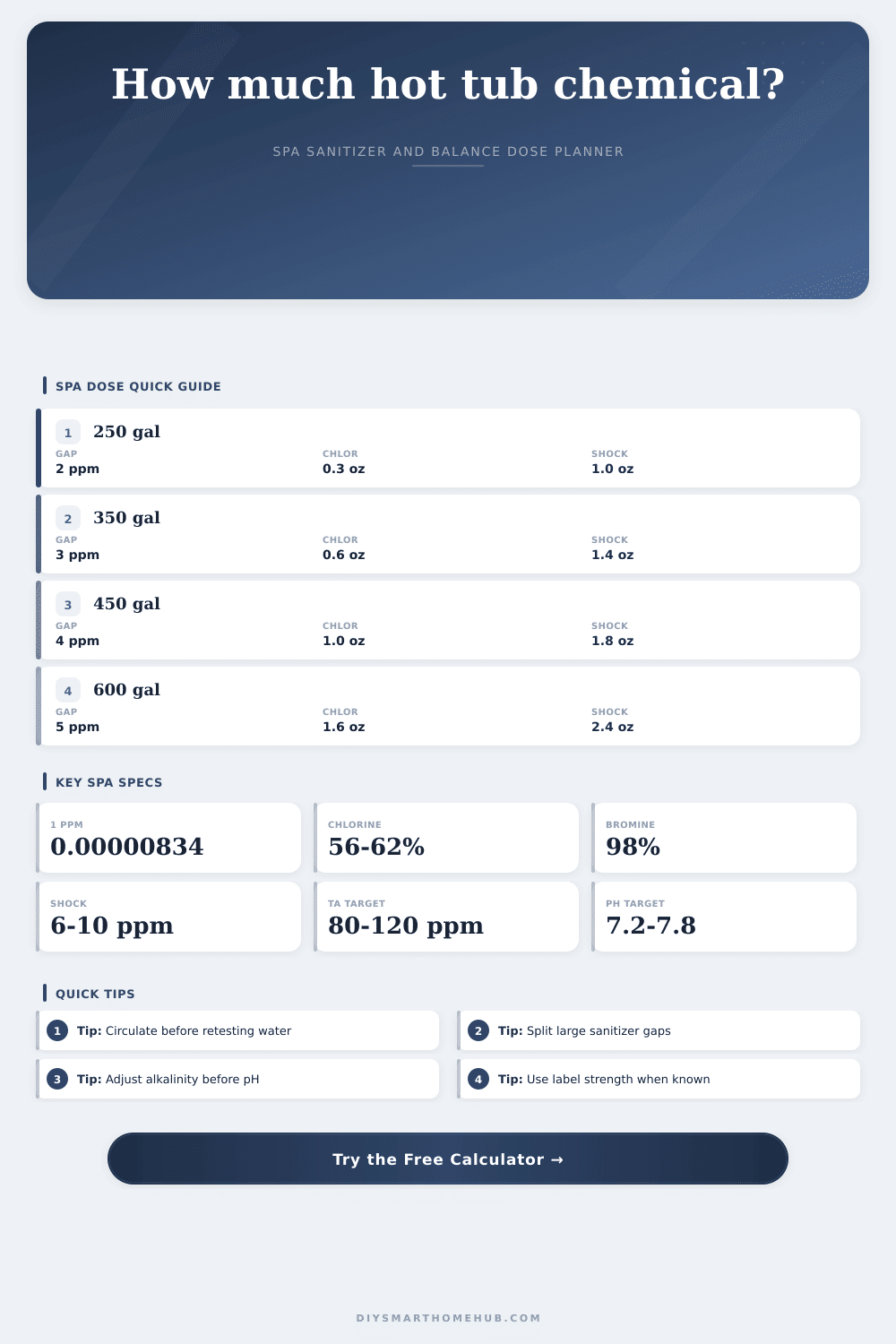
| 1 ppm sanitizer weight | Gallons x 8.34 / 1,000,000 | 350 gal = 0.00292 lb per ppm | Converts ppm gap into active sanitizer mass. |
| Product dose | Active sanitizer mass / product strength | 0.14 oz chlorine / 56% = 0.25 oz dichlor | Primary dry or liquid chemical estimate. |
| Example spa | Volume | 3 ppm dichlor top-up | 10 ppm chlorine shock | Small-volume split cap |
|---|---|---|---|---|
| Compact 2 person tub | 225 gal / 852 L | 0.36 oz 56% dichlor | 1.07 oz 56% dichlor | 0.50 oz per step |
| Typical family spa | 350 gal / 1,325 L | 0.56 oz 56% dichlor | 1.67 oz 56% dichlor | 0.75 oz per step |
| Large lounge spa | 500 gal / 1,893 L | 0.89 oz 56% dichlor | 2.38 oz 56% dichlor | 1.25 oz per step |
| Swim spa | 1,200 gal / 4,542 L | 2.23 oz 56% dichlor | 5.96 oz 56% dichlor | 2.50 oz per step |
Dichlor
Useful for chlorine spa ppm recovery because dry ounces scale cleanly from available chlorine strength.
Bromine
Best modeled with its own ppm target, since bromine operating ranges are usually higher than chlorine.
MPS shock
Works as an oxidizer estimate, so it is shown as a shock amount rather than a sanitizer residual.
Balance dose
Alkalinity and pH corrections use separate formulas because ppm sanitizer math does not apply.
When your hot tub water goes green and you start to panic. Then you purchase some chemicals. But do you know what you need? Is more better than? Or will that make it worse? If you aren’t certain… This is where many fail in their maintenance.
Most people has no shortage of product to apply. They just don’t know their starting point, so they don’t know which combination of product to add next to reach there goal. Applying something blindly is risky business. Sometimes you guess right and land on the mark. Other times you shoots off target and end up in Algae City or Acidity Town.
How to Use the Calculator
That’s what the calculator above does, it takes the hard work out of it. It doesn’t say “add this much sanitizer”. It says ‘you need X pounds of this chemical to get there’. It figures out exactly how far away from ‘there’ you are, and it factors in the chemical that’s actualy in your hand.
And here’s why that’s important: not all chemicals is created equal. Dichlor granulars only have around 56% available chlorine. Bleach is typically ten percent strength. If you forget that and don’t adjust the dosage accordingly, you’ll either overdo it and completely mess up the water balance, or underdose it and leave yourself open to some nasty bacteria. But the thing does math for you, so you never have to remember a table of conversions.
Another silent variable are volume. Most folks think they know how large their spa is because they remember the model name. However, the slopes, jets, and seats takes up a major part of available volume. For example, a three-hundred-gallon spa may be closer to two hundred and fifty gallons when full at the correct water line. Weak sanitation results from underestimating your volume. Wasting chemicals and money happens with overestimating.
To account for imperfect shapes, the input fields will let you calculate volume using a fill factor percent or by inputting measurements of shell. You won’t get it perfect but getting it close will form basis of everything else.
Maintain the invisible buffers that support stable water. PH has a shock absorber called alkalinity. When your total alkalinity are too low, any addition of either an acid or a base will cause your pH to go wild. There are separate modes in the calculator for adjusting both pH and alkalinity (this separation is key, adjust your alkalinity first then your pH). Why? Because when the alkalinity is off, fixing the pH won’t hold it there. It’ll be back out of range in hours. Once the buffer is fixed, everything stabilize.
The math does change in real time as well. Bathers bring sweat, lotions and oils with them. These contaminant eat up sanitizer quickly. If you have a covered spa, it doesn’t require much maintenance at all. If your spa hosts a family get-together, however, you’ll need to add quite a bit of oxidizer to breakdown the organics. The tool use a multiplier for bather load to add an oxidizer reserve to the base calculation. This will prevent the situation where the water appears clear but is actualy full of unseen microscopic waste. The sanitizer could of not do its job because it was too busy fighting contaminants.
Split dosing means splitting the dose to keep results safe. If you dump too much strong stuff in at one time, it will spike in your small body of water and irritate exposed skin or damage spa surfaces. The calculator recommend splitting the dose out over several steps. Use half now, circulate for a minute or two, use the other half. This is a simple step that protects both your family and investment.
What was a frantic scramble with chemicals becomes a calm and controlled process. Of course you’ll still need to test the water. No tool take the place of a handheld meter or dip test strip. But when you get those numbers, don’t make a guess. Just let the math do its thing.
Maintaining crystal-clear spa water isn’t really about chemistry, but about consistency. Regular little tweaks avoid the need for giant shock treatments. Don’t just try to get back to the green zone when something goes wrong. Aim to stay in the green zone. By taking the guessing game out of each dose, the calculator enables this. It translates the theoretical “parts per million” into the real world; actual-ounces-you-can-pour-yourself kind of world.
Pour. Circulate. Relax. Water’s clear. Sanity’s preserved.