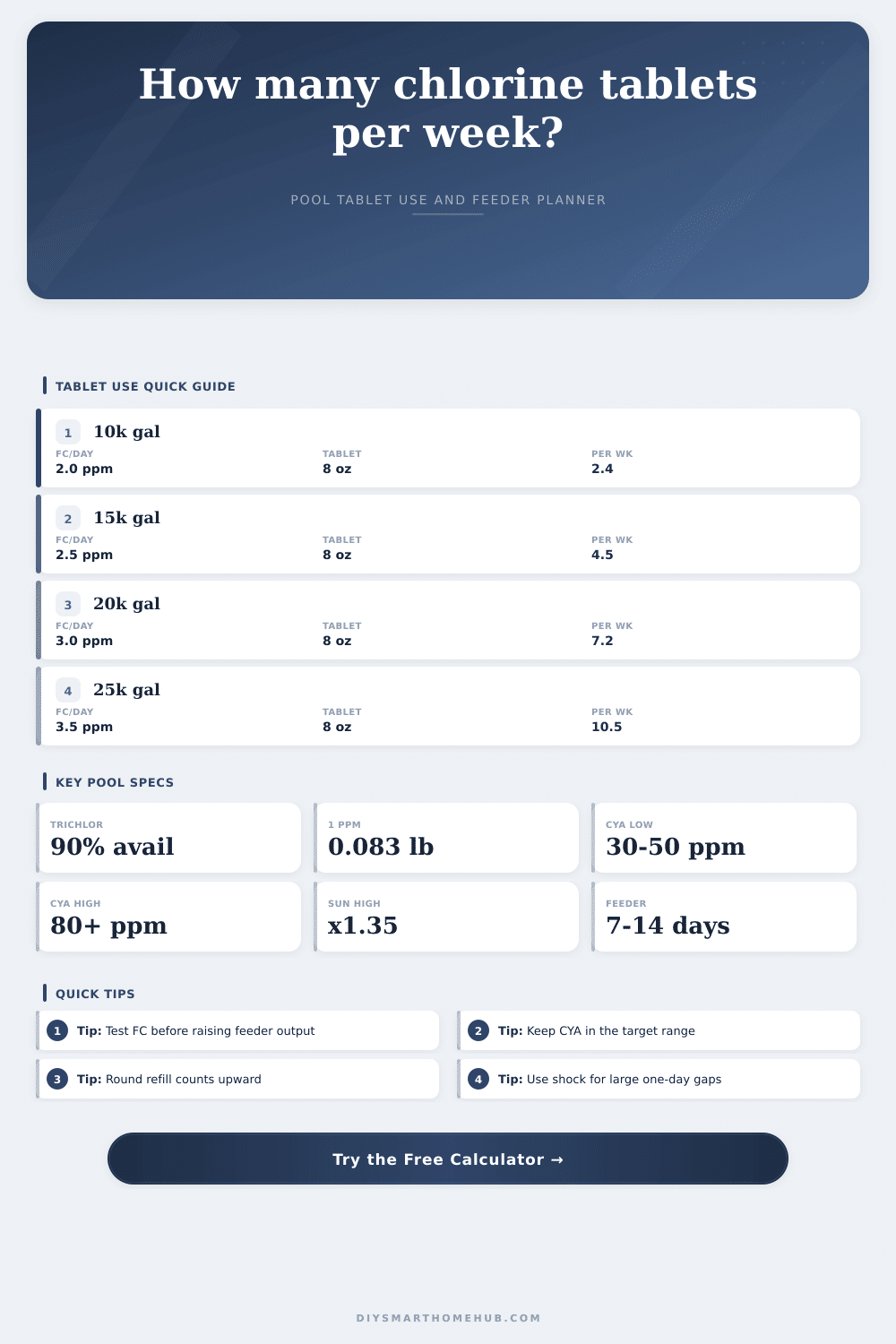
Chlorine Tablet Consumption Calculator
Estimate weekly chlorine tablet use from pool volume, free chlorine demand, stabilizer level, sun exposure, bather load, tablet strength, dissolve rate, and feeder capacity.
Calculation breakdown
| Tablet type | Typical weight | Available chlorine | Available chlorine per tablet | Best calculator use |
|---|---|---|---|---|
| 3 inch trichlor | 8 oz / 0.50 lb | 90% | 0.45 lb | Standard residential tablet feeder estimates. |
| Smaller 3 inch trichlor | 6 to 7 oz | 90% | 0.34 to 0.39 lb | Private-label buckets and compact floaters. |
| 1 inch trichlor | 1 oz / 0.0625 lb | 90% | 0.056 lb | Spa-sized feeders or fine release control. |
| Cal hypo tablet | 7 oz / 0.4375 lb | 68% | 0.298 lb | Non-stabilized tablet planning where compatible. |
| Factor | Low range | Typical range | High range | Calculator effect |
|---|---|---|---|---|
| CYA / stabilizer | 0 to 19 ppm, factor 1.22 | 30 to 70 ppm, factor 0.92 to 1.00 | 100+ ppm, factor 1.18 | Adjusts daily FC target for protection or over-stabilized water. |
| Sun exposure | Screened shade, factor 0.78 | Mixed sun, factor 1.00 | Intense all-day sun, factor 1.35 | Raises or lowers daily chlorine loss from UV. |
| Bather load | Light idle use, factor 0.88 | Normal family use, factor 1.00 | Party/community use, factor 1.55 | Accounts for organics that consume chlorine. |
| Dissolve speed | 10+ days per tablet | 5 to 7 days per tablet | 1 to 3 days per tablet | Compares required feed rate with expected release pace. |
| Formula item | Formula | Example | Use in calculator |
|---|---|---|---|
| Pool gallons | Gallons = cubic feet × 7.48052 | 2,406 ft³ = 18,000 gal | Base water mass for FC demand. |
| 1 ppm chlorine | Gallons × 8.34 / 1,000,000 | 18,000 gal = 0.150 lb | Converts ppm demand to chlorine pounds. |
| Tablet chlorine | Tablet lb × available chlorine % | 0.50 lb × 90% = 0.45 lb | Finds usable chlorine per tablet. |
| Weekly tablets | Weekly chlorine lb / tablet chlorine lb | 2.26 lb / 0.45 = 5.0 | Primary consumption result. |
| Example pool | Volume | Adjusted demand | 8 oz trichlor tablets |
|---|---|---|---|
| Compact above-ground | 8,000 gal / 30,283 L | 1.8 ppm/day | 1.9 tablets per week |
| Small backyard pool | 12,000 gal / 45,425 L | 2.2 ppm/day | 3.4 tablets per week |
| Family rectangle | 18,000 gal / 68,137 L | 2.5 ppm/day | 5.8 tablets per week |
| Large sunny pool | 28,000 gal / 105,991 L | 3.2 ppm/day | 11.6 tablets per week |
Trichlor 3 inch
High available chlorine and slow feed rate make it the baseline for most weekly tablet estimates.
Trichlor 1 inch
Useful when a small feeder needs finer dosing, but weekly count rises quickly on larger pools.
Cal hypo tablet
Lower available chlorine per tablet in this model, so equivalent weekly counts are higher.
Brominating tablet
Included for feeder capacity comparison where bromine systems are intentionally used.
Green water in your pool? Do you think the chlorinator’s busted? Do you add some shock treatment? Then it comes back again…because you’re not providing enough chemicals based off what your pool needs every day. How many tablets do you guess at adding? If you know which variables really matter, its a predictable math problem as far as chlorine goes.
Sunlight is the biggest cause of chlorine demand. Free chlorine are burned up by UV rays (that’s why we use stabilizer in outdoor pools). The stabilizer protects the chlorine from the sun but there are limits on how much protection that stabilizer provide. Too little stabilizer and the chlorine vanishes before it can does its sanitizing work. Too much stabilizer and now the chlorine doesn’t work. You need more product to achieve same result. A common misconception: more stabilizer is better, but in the end this will work against you. This tool allows you to take into account the amount of sun and your stabilizer level to find a balanced window.
How to Keep Your Pool Water Clean
Another thing that lowers chlorine levels is bather load. Urine, sweat, oils, and sunscreen contain substances that immediately use up all available chlorine. A crowded party uses more chlorine then a slow evening of quiet enjoyment; therefore, the bather count impact how much you need dose. If you ignore it, then you’ll likely overdose when few people use the pool and have no residual to prevent bacterial growth until the following tablet dissolves. The usage pattern option let you specify your typical usage, ensuring you’re actualy planning for what’s happening with water (safety and water clarity).
It’s also about knowing what tool spits out, what does it tell you? That will tell you when to refill and how many tablets to use each week. It makes it a weekly activity, a habit of maintenance. You’ll see this with the feeders that hold 6 tablets. So if it says you should of use 6 a week, then you know when to fill it up (Sunday).
And what happens if you don’t? Free chlorine goes to zero. Algae shows up. Knowing the capacity means not purchasing bulk bags that end up in your garage crumpling. It’s half chemistry, half logistics.
The equation also varies based off what kind of tablet. Most feeders uses trichlor tablets that contain both chlorine (ninety percent available) and a stabilizer. If your cyanuric acid level is already elevated, calcium hypochlorite tablets will give you chlorine but no stabilizer. You can see from the reference table that available chlorine percentage impact the total amount required. Over time using the incorrect one can skew your stabilizer balance and cause sluggish water.
Perfection isn’t necessary, just consistency. Use test strips to fine tune after getting an initial guess at your baseline. For example, if your free chlorine level stay high, turn down your feeder dial. If it’s low, turn it up. Your test kit and eyes will guide you. Use the math as a starting point. Guessing is not measuring, and predictably keeping your water in check keeps your wallet in check to.