Sump Basin Volume Calculator
Estimate sump basin capacity, gallons per inch, float drawdown volume, pump runtime, refill timing, cycles per hour, and daily pumped volume from real pit and pump measurements.
Basin volume estimate
The calculator converts round basin geometry into gallons, then applies pump and inflow rates to estimate cycling.
Compact pits gain little volume from tight float travel, so short cycling can appear quickly.
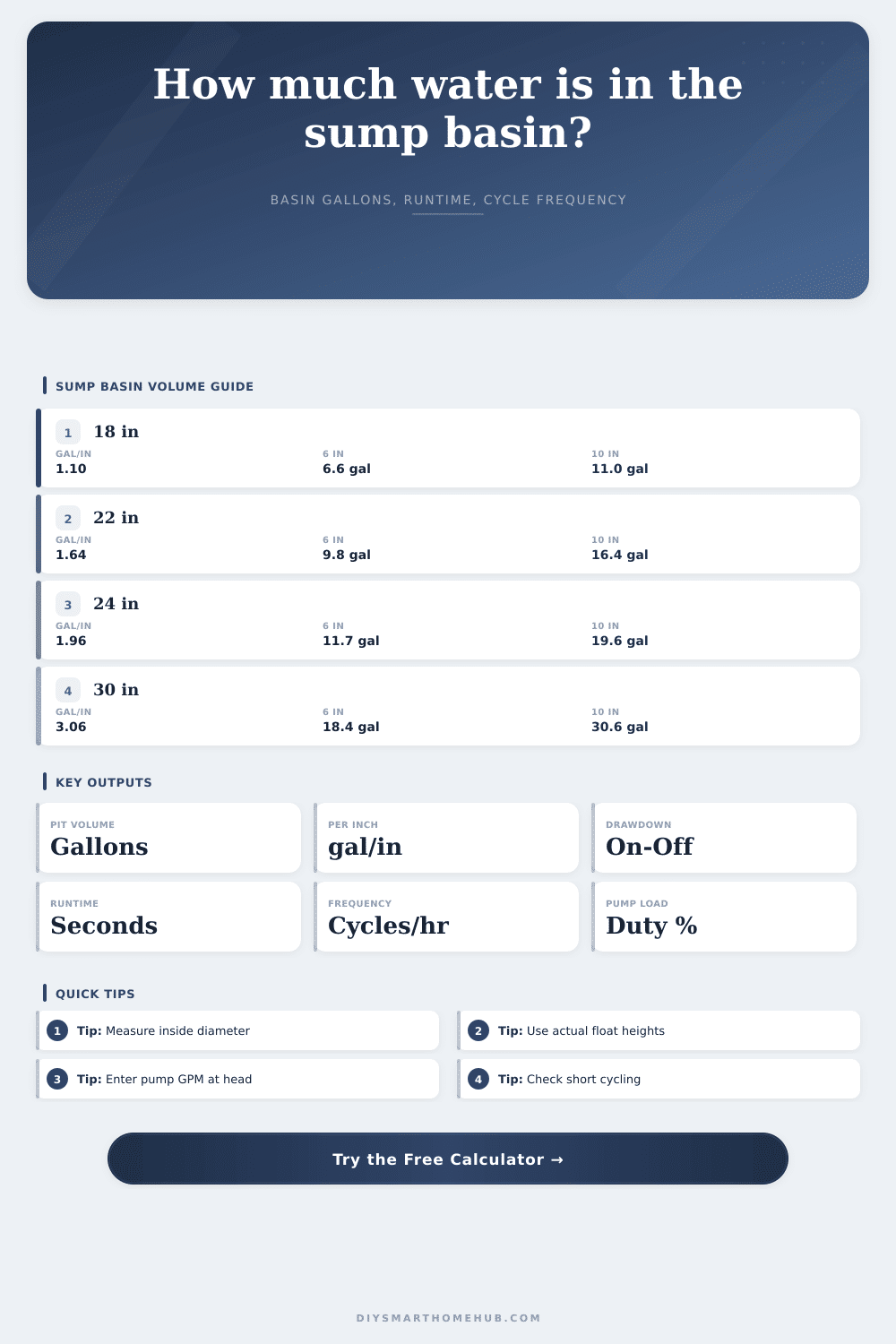
A common basement size where an 8 inch drawdown gives about 13 gallons per cycle.
A moderate volume step that makes float adjustment more forgiving during steady inflow.
Wide crocks deliver much longer refill time for the same on and off height spread.
| Basin inside diameter | Gallons per inch | Liters per cm | Best use |
|---|---|---|---|
| 16 in round basin | 0.87 gal/in | 1.29 L/cm | Small retrofit pits and tight spaces |
| 18 in round basin | 1.10 gal/in | 1.64 L/cm | Compact sealed basin with limited switch travel |
| 22 in round basin | 1.64 gal/in | 2.44 L/cm | Typical residential sump basin |
| 24 in round basin | 1.96 gal/in | 2.92 L/cm | Higher reserve for active seepage |
| 30 in round basin | 3.06 gal/in | 4.56 L/cm | Wide crock with lower start frequency |
| Calculated metric | Comfortable range | Watch range | What it suggests |
|---|---|---|---|
| Runtime per cycle | 20 to 90 seconds | Under 10 seconds | Short runtime often means narrow float travel or very small drawdown volume. |
| Cycle frequency | Under 10 cycles/hour | Over 15 cycles/hour | Frequent starts add wear even when the pump keeps up with inflow. |
| Duty cycle | Under 50 percent | Over 70 percent | High duty means incoming water is using a large share of pump capacity. |
| Inflow share | Under 50 percent of pump GPM | Over 80 percent | When inflow nears pump flow, the basin may not draw down reliably. |
| Scenario | Drawdown volume | Net drawdown GPM | Cycle estimate |
|---|---|---|---|
| 18 in basin, 5 in float travel, 2 GPM inflow | 5.5 gal | 28 GPM | 12 sec run, 18 cycles/hour |
| 22 in basin, 8 in float travel, 4 GPM inflow | 13.1 gal | 41 GPM | 19 sec run, 15 cycles/hour |
| 24 in basin, 10 in float travel, 12 GPM inflow | 19.6 gal | 43 GPM | 27 sec run, 30 cycles/hour |
| 30 in basin, 12 in float travel, 6 GPM inflow | 36.7 gal | 59 GPM | 37 sec run, 9 cycles/hour |
| Adjustment | Volume effect | Runtime effect | Cycle effect |
|---|---|---|---|
| Raise pump-on height | Adds stored reserve before starting | No change if off height stays fixed | Longer off time between starts |
| Lower pump-off height | Increases drawdown gallons | Longer pump run per cycle | Fewer cycles per hour |
| Narrow float differential | Reduces cycle volume | Shorter pump run | More frequent starts |
| Increase basin diameter | Adds gallons per inch | Longer run for same height | Longer refill interval |
Everything is quiet. The sump pump hums for a bit before shutting down again. Quiet is good; it’s what most home owners assume means their system is working.
What they don’t realize is there is a silent tug of war going on under the floor grates. The water tries to leak in, and the pump fights back trying to push water out. If your pump has been running longer than normal or you’ve been hearing it click on every couple minutes here and there… it’s not likely an issue with the pump itself. But rather, amount of water it’s handling. Fixing the issue of a pump short cycling can be as simple as understanding how many gallons your basin can hold.
Why Your Sump Pump Cycles Too Often
A sump pit‘s shape looks simple. It’s just a round hole. But its geometry make it really tricky. The volume of a cylinder (a round basin) increases as the square of the radius. So for a given height, a 30-inch basin holds twice as much than an 18-inch one. Don’t know how big your pit is? Use the calculator (above), and plug in what you measure, and let computer do the math.
Will your narrow pit hold all the water during a heavy rain? Or will it run out before pump can shut down? Most folks think that a deep pit is best. And maybe they are right. But if your diameter is too small, then increasing the depth won’t help you store enough gallons per cycle.
The actual metric: How many gallons of water does your pit hold between when your pump turns on and turns off? That number is called the drawdown volume. The runtime is determined by that drawdown volume.
Two gallons moved before the pump shuts off? Seconds. Motors need a constant load and airflow to keep them cool, and they don’t get momentum from short pulses of activity. They just take the abuse. Five seconds on, one minute off sounds like an efficiency gain, but it’s brutally hard on a pump. The bearings won’t reach operating temperature. The starter capacitor fires constantly. You are building up more heat from electrical resistance then you are cooling with airflow. Ideally you have a runtime of tens of seconds, not single digits.
That’s why the reference table on the page explains it all at a glance. A wider basin naturaly extends that runtime without changing anything about the hardware at all. Most DIYers fail at this step. You want enough water to build up before the pump turns on so there is plenty for it to process. Conversely, you don’t want much water near the pump intake or else it will kick on too often. The difference between those heights determines your effective tank size.
Adjusting your float arm so the pump turns on earlier to be safe decreases your cycle volume. Less water means less time running the pump and more often the pump has to come on. This creates a tradeoff: do you leave less water so it doesn’t get into the pump intake, or do you protect the equipment? Most times protecting the equipment is the right answer.
These figures depend on one more figure: Inflow rate. A slow-inflowing basin is just fine during a dry spell. However, a quick-delivery storm sends water rushing in. As the inflow rate edges closer to capacity of the pump, it will stay right up against the cut-on point. Water comes in and the pump turns on. The water goes out and the pump shuts off. Then it turns on again immediately because the basin doesn’t drain low enough to trigger the off switch. That’s the worst-case scenario for cycling.
To estimate this, the tool compares how fast your water enters vs. How much your pump can move, taking into account the head height from the pump to the discharge point. How much your pump can move, taking into account the head height from pump to reservoir. Keep in mind that as the height the water has to rise changes (as with a long, vertical discharge pipe), a pump’s capacity drop dramatically. What may be rated for forty-five gallons per minute in the lab becomes maybe thirty pumped out through a long, verticle delivery line. The higher number paints a rosy picture; reality isn’t so kind.
Don’t compromise when measuring the inside diameter. Plastic walls in many pre-fab pits are thick. Measuring from the outside lip makes it look like you have more volume than you actualy do. Tape measure goes directly over surface of the water, NOT around the dry concrete sides up top.
After you get both the float heights and the internal working diameter, then the rest just fits together. Do you have lots of reserve or is your present set-up creating unneeded stress on the pump? Is it time to raise the floats wider apart or do you realize you should of add a second pump? It’s no longer guessing, it’s a data driven decision.
A smooth, long cycle keeps the motor cool while keeping the basement dry. And that’s what you’ll hear at the beginning of this article … that quiet hum of a system that knows its volume.