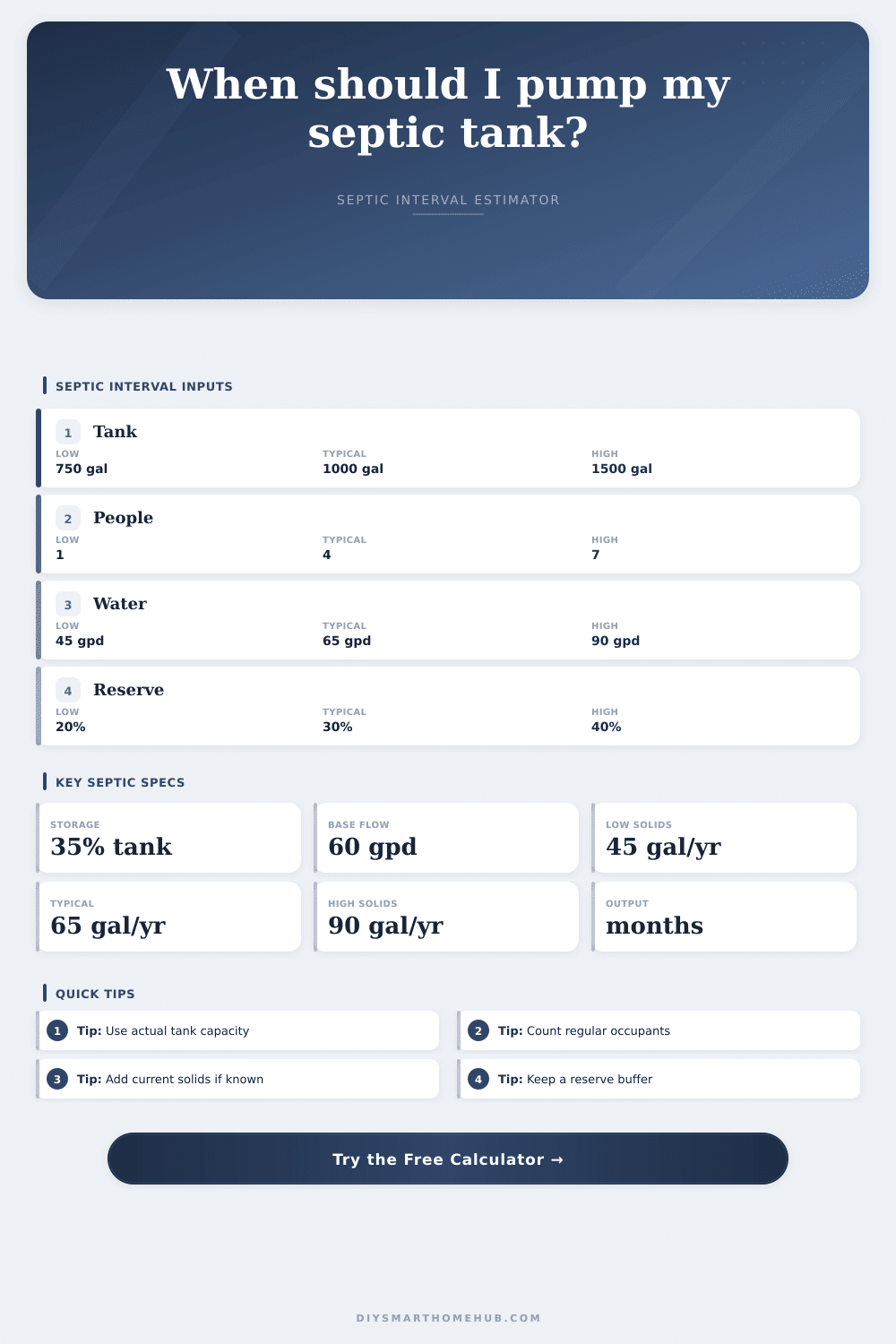
Septic Tank Pumping Interval Calculator
Estimate a septic tank pumping interval from tank gallons, household people, water use, garbage disposal use, laundry intensity, sludge and scum accumulation, current solids, and safety reserve.
Calculation breakdown
| Step | Formula | Purpose | Output |
|---|---|---|---|
| Daily flow | people x gal/person/day | Wastewater load | gal/day |
| Storage band | tank gallons x 0.35 | Modeled solids room | gallons |
| Reserve gallons | storage band x reserve % | Unused buffer | gallons |
| Interval | available storage / annual solids x 12 | Time estimate | months |
| Factor | Low input | Typical input | High input |
|---|---|---|---|
| Garbage disposal | 1.00x rarely used | 1.12x occasional | 1.40x daily |
| Laundry loads | 0.95x spread out | 1.00x typical | 1.25x very heavy |
| Water use factor | 45 gpd/person | 60 to 70 gpd/person | 90+ gpd/person |
| Solids rate | 45 gal/person/year | 65 gal/person/year | 90 gal/person/year |
| Scenario | Tank gallons | People | Modeled solids storage |
|---|---|---|---|
| Small cottage | 750 gal | 1 to 2 | 263 gal before reserve |
| Typical home | 1000 gal | 3 to 4 | 350 gal before reserve |
| Large household | 1250 gal | 5 to 6 | 438 gal before reserve |
| Large tank home | 1500 gal | 4 to 7 | 525 gal before reserve |
| Output | Low value means | High value means | Most affected by |
|---|---|---|---|
| Interval months | Reserve reached sooner | More storage time | Storage and solids rate |
| Annual solids load | Lower buildup | Higher buildup | People and factors |
| Available storage | Less remaining room | More remaining room | Tank and current solids |
| Retention hours | Higher daily flow | Lower daily flow | Tank gallons and water use |
Light solids load
Few people, low disposal use, and spread-out laundry produce a lower adjusted annual solids load.
Balanced use
Typical water use and moderate food waste keep the formula near the base accumulation setting.
Food waste load
Frequent disposal use raises the calculated solids load and reduces remaining storage months.
Laundry load
Heavy repeated laundry increases the adjustment factor used in the annual solids estimate.
Underneath your house lurks a well-kept septic system. It is a little piece of technology that quietely does its job by separating the waste, letting bacteria do their thing and breaking it all down. But then something goes wrong and that delicate balance get upset. More water flows into the system than it can handle, and/or more solids gets pushed through than it can hold onto. Suddenly you’re looking at a backed-up drain field and an oh-so-expensive emergency call.
The trick is to avoid that tipping point. You should of understand when to stay ahead of it by pumping the system instead of waiting until it is a disaster.
When to Pump Your Septic Tank
Generic guidelines (three years is what most people think) don’t consider your home’s real-life situation. If you live alone in a tiny cottage with 750 gallon tank, it will be much faster than if you have a houseful of six people who are running their garbage disposal every day and using high-efficiency washing machine. With the calculator above, you just enter how you actualy use water, and it does the rest for you. No more guesswork about whether or not your habits really max out the system.
Tank capacity is often most important input. Why? Because if you aren’t aware of how much water your tank holds, you’re shooting from the hip (flying blind). You can either dig out a tape measure and go to town or look for old records. Either way, find your tank’s capacity then proceed to next major variable: solids accumulation rate.
This is where most estimates goes wrong because they assume all wastewater is equal. It’s not. A garbage disposal will put a lot more organic matter into the system than one without; it won’t be broken down as rapidly in the tank. Likewise, running heavy laundry loads puts more solids into the system different than do light loads spread over time. These factors impact how fast your storage capacity fills.
Don’t forget about the safety reserve in your schedule. The tool has an option to set a percentage of solids to leave behind in the tank as a buffer. That way there’s always space in the tank for new wastewater to settle. Pumping at 100% full could suck up more than just solids, you could deprive yourself of some of the bacteria culture that helps keep the system working to digest waste. Having a reserve means having the biological engine running on all cylinders. It is not much, but it is important over time for long term system health.
Water use plays a quieter role. Too much flow each day isn’t a bad thing, per se. But it will stir things up if the system have insufficient retention time. If your home’s water use is large then the tank may not get sufficient time for heavier particles to settle out. Instead, they’ll stay in suspension and exit the tank to foul the drain field. There, they plug the pores in soil. This is why some households with “normal” amount of solids still require regular pumping.
Unfortunately, life is not as simple as these moddern models suggest. Your load will change drastically if you have a new baby, remodel, or change laundry habits. These changes affects your timeline and are outlined in the reference table on the page. Here you can visualize that an additional 10% of solid generation could cut months from your next service call. Don’t worry, it doesn’t require being an expert in math, just a basic understanding of how the curve works. More input = less time.
Bottom line: If you think about your septic system like another part of the house, one that needs care, there won’t be any nasty, expensive surprises. Pumping regularly, and knowing when to do it based off real information, means no stinky sewage in the ground and everything running smoothly down the drain. The system will work quietly and out of sight; until it’s time for some attention, at which point you’ll know.