Water Pressure Loss by Pipe Length Calculator
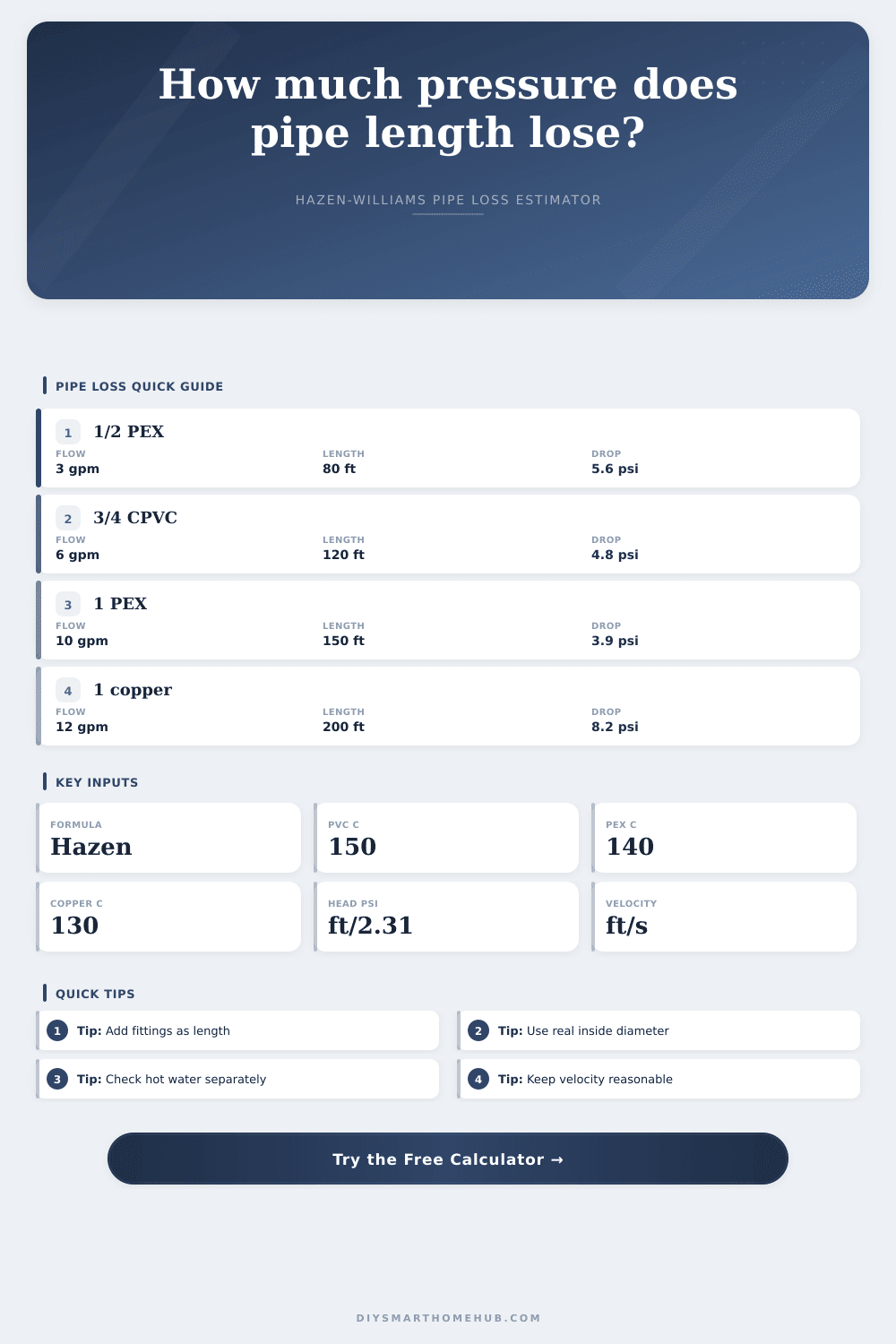
Estimate pressure drop through residential water pipe using the Hazen-Williams approximation, including straight run length, fitting equivalent length, pipe material C factor, flow rate, diameter, and starting pressure.
Detailed Hazen-Williams breakdown
| Pipe material | Typical C factor | Condition assumption | Calculator use |
|---|---|---|---|
| PVC or CPVC | 150 | Smooth plastic pipe | New water distribution, yard mains, and plastic branches |
| HDPE service pipe | 150 | Smooth plastic tubing | Long buried service runs and outdoor supply lines |
| PEX tubing | 140 | Smooth flexible tube | Manifold runs and fixture branches with many bends |
| New copper or brass | 130 | Clean metal pipe | Typical residential copper trunks and branches |
| New galvanized steel | 120 | Clean threaded steel | Shorter runs where steel is still in good condition |
| Aged galvanized steel | 80 to 100 | Rough, scaled, restricted | Conservative estimate for old supply piping |
| Nominal pipe | Typical inside diameter | Metric diameter | Why it matters |
|---|---|---|---|
| 1/2 in PEX | 0.475 in | 12.1 mm | Small branches lose pressure quickly at higher fixture flow |
| 1/2 in copper type L | 0.545 in | 13.8 mm | Slightly larger ID reduces loss compared with 1/2 PEX |
| 3/4 in PEX | 0.681 in | 17.3 mm | Useful for fixture groups and medium branches |
| 3/4 in copper type L | 0.785 in | 19.9 mm | Common trunk size for moderate residential flow |
| 1 in PEX | 0.875 in | 22.2 mm | Lower loss for longer manifold feeds |
| 1 in Sch 40 PVC | 1.049 in | 26.6 mm | Good low-loss choice for yard or service pipe estimates |
| Fitting or device | Small branch allowance | Larger trunk allowance | How to enter it |
|---|---|---|---|
| 90 degree elbow | 2 to 5 ft each | 3 to 8 ft each | Add each elbow to equivalent length |
| 45 degree elbow | 1 to 3 ft each | 2 to 5 ft each | Use about half of a 90 degree elbow allowance |
| Tee through run | 1 to 4 ft each | 2 to 6 ft each | Add a modest allowance when flow passes straight through |
| Tee branch turn | 4 to 10 ft each | 6 to 15 ft each | Use a higher allowance when flow turns through the branch |
| Ball valve full port | 1 to 3 ft each | 2 to 5 ft each | Small effect when fully open and properly sized |
| Filter housing or softener | 10 to 40 ft each | 15 to 60 ft each | Use manufacturer pressure-drop data when available |
| Scenario | Pipe and flow | Equivalent length | Approximate friction loss |
|---|---|---|---|
| Lavatory branch | 1/2 in PEX at 2 gpm | 45 ft | 1.5 psi / 3.5 ft head |
| Kitchen branch | 3/4 in copper at 5 gpm | 90 ft | 1.8 psi / 4.2 ft head |
| Two-shower trunk | 3/4 in PEX at 7 gpm | 130 ft | 7.4 psi / 17.1 ft head |
| Yard main | 1 in PVC at 10 gpm | 180 ft | 3.1 psi / 7.2 ft head |
| Older steel branch | 3/4 in steel at 6 gpm | 100 ft | 7.7 psi / 17.9 ft head |
Longer pipe run
For the same pipe and flow, friction head loss is nearly proportional to total equivalent length. A 160 ft run loses about twice the friction pressure of an 80 ft run.
Smaller inside diameter
The diameter term is raised to 4.87, so small changes in actual ID can dominate the result. This is why nominally similar tubing can calculate very differently.
Higher flow rate
Flow is raised to 1.85 in the Hazen-Williams formula. Doubling GPM can create much more than double the pressure loss through the same line.
When you turn on shower, the water feels tepid. When you twist handle, the stream slows to a trickle. It’s annoying.
Usually, there is nothing wrong with the water being supplied by the city or your own water heater. However, we do know where it’s coming from: pipes running through your walls. And every foot of that piping absorb some of energy in the water, robbing its flow. Why? It is physics, specificaly friction.
Why Your Shower Water Is Weak
This calculator, found on this page, apply the Hazen-Williams equation to estimate friction loss. That’s the formula commonly used by plumbers to approximate water flow through residential piping. It yields more than just one number. It includes the estimated pressure at the fixture, water velocity, and pressure drop.
It varies a lot with the input, start by checking what inside diameter of your piping is. ‘Nominal’ size is not an exact measurement but a sort-of-marketing term: a half-inch PEX tube will have a different inner bore than a half-inch copper pipe, and that matter to the calculation. And the exponent (4.87) are steep. Double your pressure loss by shaving a tiny fraction off its inner volume. You lose flow rate as well as pressure.
Material choice is less dramatic, but it is still part of equation. To consider how rough the inside of pipe is, there’s a measure called the C factor, also called a roughness coefficient, and new plastic pipes (PEX or PVC) scores high on this one: They’re slick. There’s no resistance; they have a high C factor.
As old galvanized steel ages, it forms rust and scale, which creates a rougher surface; and then creates turbulence. And turbulence eat pressure. So even if you’ve got good pressure from your main supply, an aged-steel pipe might see a drop in its C factor; even though it doesn’t mean there’s a leak, it means something, something gritty. Is keeping water from flowing.
Another variable is length. Not just physical distance, though, but equivalent length. These are straight runs of pipe. No problem.
What about fittings? That’s something else entirely. The more elbows, tees, valves, etc., the more resistance they provides, which can be added to the straight run in the calculator. That reflects the real-world complexity of plumbing… Water squeezing through manifolds and turning corners… And each one act as additional pipe. A system full of bends is effectively longer than actual distance from the meter to the sink. You’ll get wrong estimates if you ignore those fittings.
The last variable is velocity, or how fast the water moves through the pipe. This has an ideal range. Too little velocity and your system will not perform well, and sediment can even build up in the pipe. Too much velocity results in wasted energy, erosion and noise. For residential systems, you want a moderate velocity (i.e., moderate speed).
So if you are experiencing high pressure loss, look at your velocity. Is it close to the upper end of chart? If yes, then probably the pipe size is insufficient for your demand. Increasing diameter tends to work better than using a pump… Pumps adds friction to an already narrow space.
Knowing that will help you make informed choices. For example, using large pipe over a long run might work out better then a short run of smaller pipe. You might find that swapping some elbows actualy lowers the total equivalent length. The idea is to learn how your plumbing system behave at full capacity.
Pressure in the water system works as a budget, and each pipe, turn, elbow, etc., cuts into your allotment. When you know where those cuts are, you can design your plumbing accordingly and get it to work better.
You should of checked this earlier.