Greywater Reuse Volume Calculator
Estimate reusable greywater from showers, laundry, and bathroom sinks after capture percentage, filtration loss, storage time, and daily irrigation demand are applied.
Detailed greywater volume breakdown
| Source profile | Formula basis | Daily volume example | Best calculator use |
|---|---|---|---|
| Low-flow shower | 4 people x 1 shower x 7 min x 2.0 gpm | 56 gal/day / 212 L/day | Steady daily source with predictable timing |
| Efficient laundry | 6 loads/week x 16 gal/load / 7 | 13.7 gal/day / 52 L/day | Batch source averaged across the week |
| Low-flow sink | 4 people x 6 min/day x 1.0 gpm | 24 gal/day / 91 L/day | Small daily source that improves base volume |
| Mixed household | Shower plus laundry plus sink subtotal | 93.7 gal/day / 355 L/day | Complete source-side planning estimate |
| Capture setup | Capture percent | Filter loss | Net from 100 gal source |
|---|---|---|---|
| Partial manual capture | 45% | 5% | 42.8 gal / 162 L |
| Limited capture path | 60% | 10% | 54.0 gal / 204 L |
| Balanced capture path | 75% | 10% | 67.5 gal / 256 L |
| High capture path | 85% | 15% | 72.3 gal / 274 L |
| Near-full source capture | 95% | 20% | 76.0 gal / 288 L |
| Planning case | Filtered supply | Storage window | Reusable result |
|---|---|---|---|
| Demand limited | 70 gal/day | 24 hours | Demand below supply sets reuse |
| Storage limited | 70 gal/day | 12 hours | Only 50% is inside the window |
| Supply limited | 35 gal/day | 24 hours | Supply below demand sets reuse |
| Overflow heavy | 100 gal/day | 6 hours | Short window raises overflow |
| Scenario | People | Typical source mix | Planning note |
|---|---|---|---|
| Apartment shower loop | 1 to 2 | Shower only, low demand | Small volume with low overflow risk |
| Family laundry blend | 4 | Shower plus washer plus sink | Balanced supply for daily beds |
| Guest weekend peak | 6 to 8 | High shower and sink activity | Overflow rises if demand is unchanged |
| Small drip zone | 2 to 4 | Low source, low irrigation demand | Demand often sets the reusable cap |
Source-limited days
When filtered greywater is below irrigation demand, reusable volume equals the available filtered supply inside the selected storage window.
Demand-limited days
When demand is lower than filtered supply, reusable volume stops at the entered irrigation need and the remainder is counted as overflow.
Storage-limited days
Short storage windows reduce the share of daily filtered volume that can be counted as reusable in a once-per-day planning model.
Stand in the shower with me. Watch how all that clean water becomes soap plus hair, then drains away through sewer system. It is gone forever. A precious natural resource, almost as pure as rain, is dissapearing down the drain, and you’re paying for it by the gallon.
Reusing greywater catches that water before it escapes your home. Instead, you route it to lawn or garden beds. It makes good sense and it saves money. But it’s also pretty messy.
Why Greywater Math Is Hard
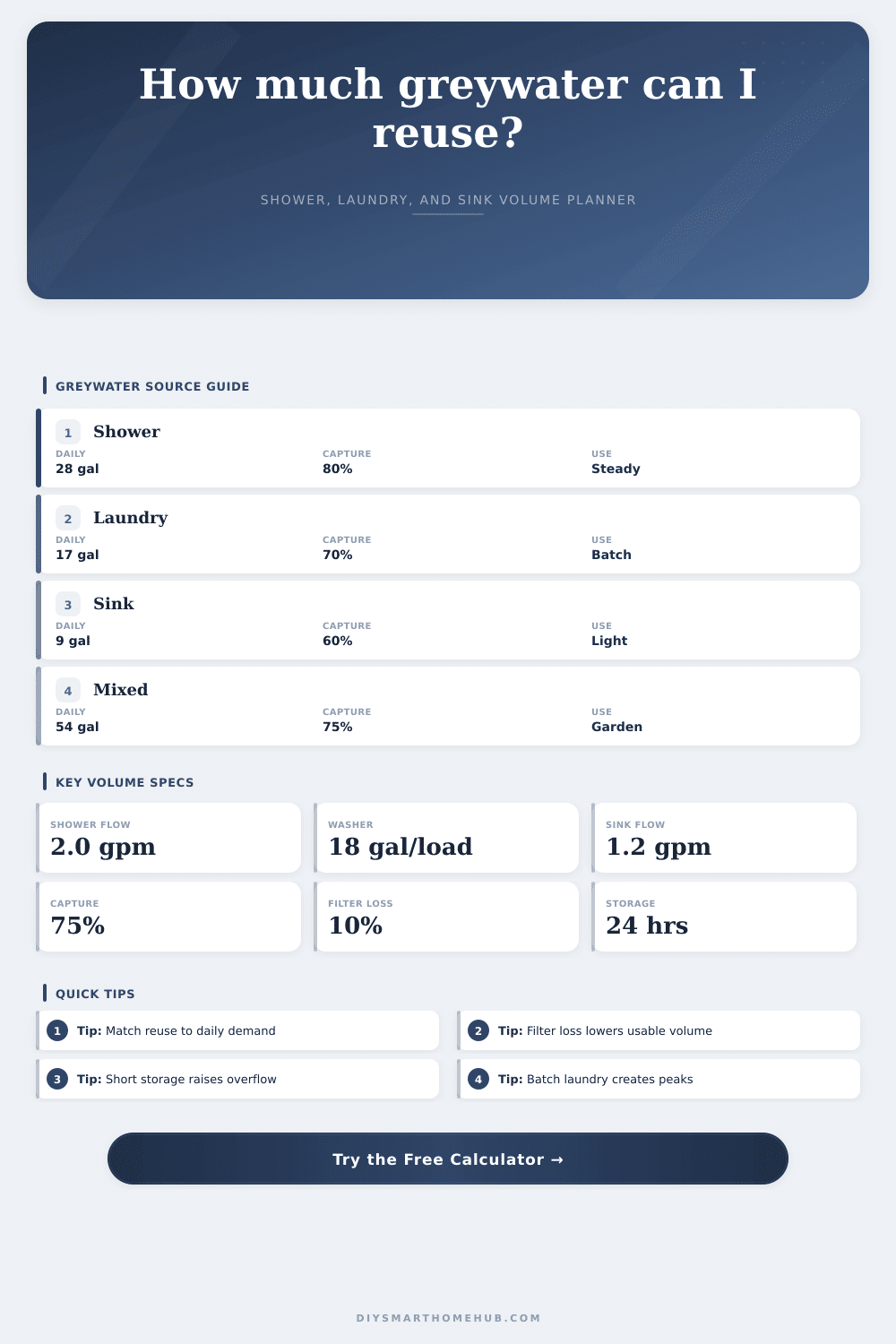
You have one stream of greywater, right? Nope! That’s the biggest mistake. Greywater isn’t all alike. Sink water isn’t the same as laundry water which aren’t the same as shower water. A shower delivers a continuous stream of warm soapy water (relatively simple to deal with). Laundry is more like a batch event… A big volume of water all at once (you need to plan for the peak or it could overwhelms your small system).
The graphic above shows this contrast: your water source changes. You can model your showers, laundry and sinks separately.
Remember: You’re not going to catch everything. Water’s going to go down drain before your diverter valve kicks open. Some will sit in the pipes. And some will be lost inside filtration process, getting caught in screens. Depending on how well-maintained your system is, and depending on things like diverter valves and clogged screen, you could lose 10% (or more) of your water to filtration/transfer. Many people misestimate this amount. They figure out their total usage and then say “I’ll just re-use it all.” Nope. No way.
The calculator above does this for you, it assumes realistic filtration loss rates, and realistic capture percentages so you don’t build a system using fantasy numbers.
The second important thing that new people notice is when to store it. As mentioned, greywater doesn’t enjoy being stored. It will start to stink after some time, and you don’t want your greywater to be a bacterial petri dish. The advice out there (and in most codes) is to use it within 24 hours. That means you’re capped at about how many gallons you can really re-use in a single day. If you catch a hundred gallons on Monday morning but you can only store six hours worth before it overflows, then you’ve essentially wasted all but six hours’ worth. It wouldn’t of because it’s dirty, but because it was there too long.
The other side of that equation is your own water need; your irrigation demand. If you have loads of greywater, but only need to irrigate with ten gallons a day, where does the rest get used? Remember: overflow isn’t a system failure. It’s a function off the math. Look at this example from the reference table on the page, showing how supply, storage, and demand interact. If your demand is low, you’ll experience overflow. If your storage window is short, you’ll experience overflow. If your source is weak, you’ll be supply limited. Identify your specific constraint to design an effective system.
The extra problem with laundry is that it’s an irregular load. You could wash three loads one day and none another. The calculator provides a daily number which averages all of this. But if you have a small tank, then those busy days like Saturday will flood your tank. Do you build for the average day or the busy day? What most folks discover about laundry is that their washing machine use far more than their shower. And sometimes more. That knowledge affects how you size your storage tank.
The trick with greywater reuse is that it’s a balancing act. There’s a lot going on in the juggling. You have to consider how much you want to use (landscape demand) and where you will store your water (storage time). You also need to know what percentage you are capturing (capture efficiency), what percent will get lost in the process (filtration loss), and how much you are starting with (source volume). Screw any one up and the whole system fall apart. Do all five correctly and you transform waste into free water.
When you see these numbers not as abstract data but as physical limits, they’re not that tough to grasp. How much time? How much space? How much water? Find a way to make the water fit inside the space and within the time while not spilling over.
It is not magic. It is just careful planning.