Rainwater Harvesting Tank Size Calculator
Estimate roof runoff, first-flush loss, daily demand storage, tank overflow, and a recommended rainwater tank size for irrigation, laundry, toilet flushing, and smart water monitoring plans.
Detailed sizing breakdown
| Roof surface | Typical coefficient | Capture behavior | Best calculator use |
|---|---|---|---|
| Standing seam metal | 0.90 to 0.95 | High runoff, low surface storage | Use for clean, pitched metal roof sections |
| Painted metal panels | 0.85 to 0.92 | High runoff with modest wetting loss | Use for sheds, garages, and porch covers |
| Asphalt shingles | 0.75 to 0.85 | Moderate runoff and texture loss | Use for typical residential roof capture |
| Clay or concrete tile | 0.70 to 0.80 | Good runoff with profile and splash loss | Use for tiled roof planes and mixed pitches |
| Flat membrane roof | 0.65 to 0.75 | More ponding, wetting, and delay | Use a conservative coefficient for low slope |
| Vegetated roof | 0.30 to 0.55 | Plants and soil retain a large share | Use only if runoff is intentionally collected |
| Catchment area | 1 inch rain at 0.80 | 2 inch rain at 0.80 | 25 mm rain at 0.80 |
|---|---|---|---|
| 250 sq ft / 23.2 sq m | 125 gal / 473 L | 249 gal / 943 L | 124 gal / 469 L |
| 500 sq ft / 46.5 sq m | 249 gal / 943 L | 498 gal / 1886 L | 248 gal / 939 L |
| 1000 sq ft / 92.9 sq m | 498 gal / 1886 L | 997 gal / 3773 L | 496 gal / 1878 L |
| 1500 sq ft / 139.4 sq m | 748 gal / 2830 L | 1495 gal / 5660 L | 744 gal / 2817 L |
| 2000 sq ft / 185.8 sq m | 997 gal / 3773 L | 1994 gal / 7547 L | 992 gal / 3756 L |
| Use profile | Typical demand | Dry-day target | Storage note |
|---|---|---|---|
| Container garden or hose bib | 10 to 25 gal/day | 7 to 10 days | Small tanks can cover short dry gaps |
| Smart drip irrigation zone | 25 to 60 gal/day | 10 to 21 days | Demand often controls the recommended size |
| Laundry or utility reuse | 35 to 80 gal/day | 7 to 14 days | Match storage to predictable appliance demand |
| Toilet flushing reuse | 20 to 70 gal/day | 10 to 21 days | Longer reserves smooth weather variation |
| Whole-property non-potable use | 100+ gal/day | 14 to 30 days | Multiple tanks may reduce overflow during storms |
| Nominal storage | Liters | Example fit | Overflow check |
|---|---|---|---|
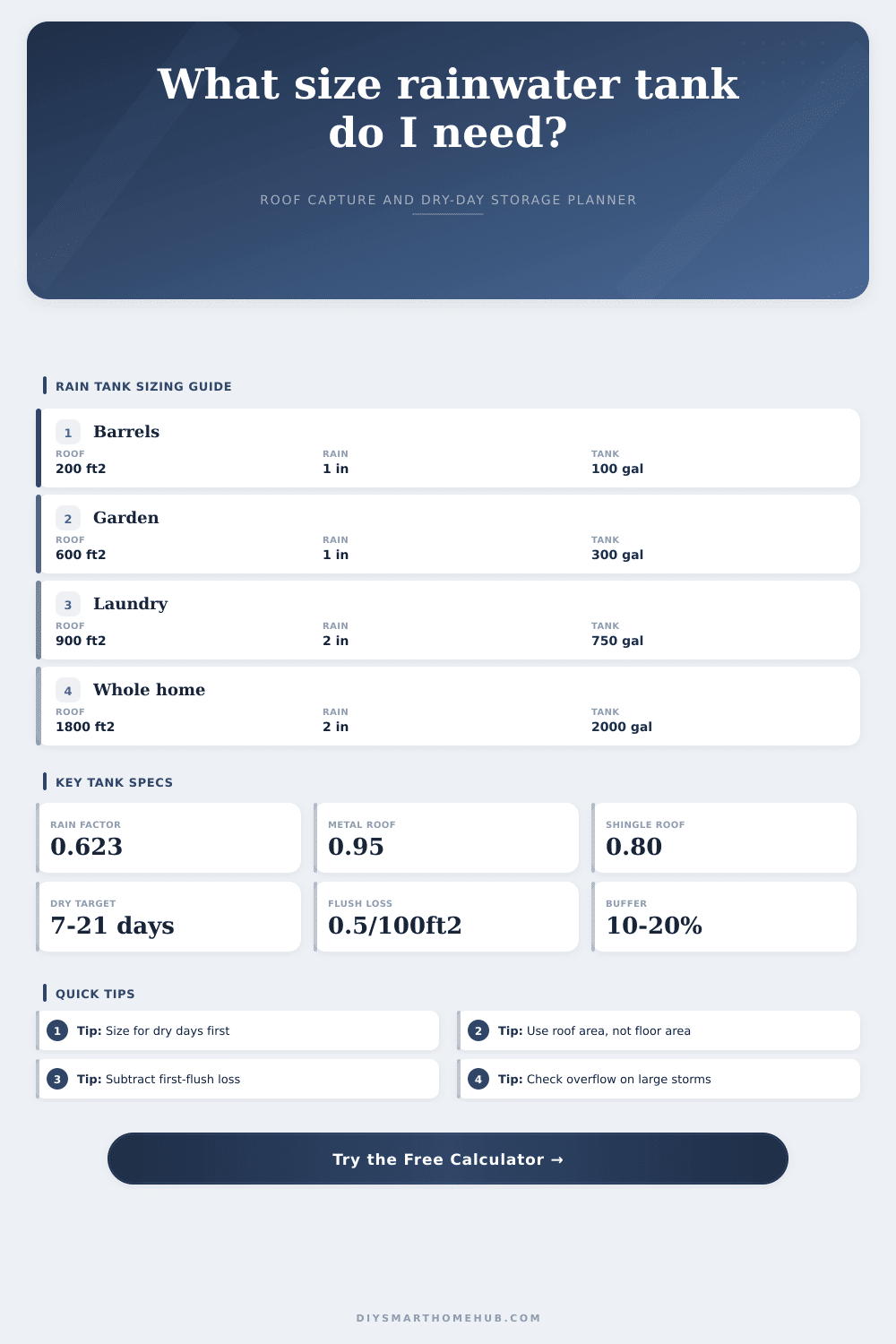
| 100 gal barrel pair | 379 L | Small garden beds and porch catchment | Overflows quickly on larger roof areas |
| 300 gal slimline tank | 1136 L | Townhouse irrigation and small sheds | Good for modest storms and short dry spells |
| 750 gal vertical tank | 2839 L | Garage zones, laundry, or mid-size gardens | Balances capture and demand for many homes |
| 1500 gal tank | 5678 L | Large gardens or toilet flushing reuse | Reduces overflow during 1 to 2 inch storms |
| 2500 gal cistern | 9464 L | Whole-property non-potable storage | Useful when roof area and demand are both high |
Capture-limited plan
If usable storm harvest is below dry-day demand, the roof or design rainfall is the limiting factor. The tank may not fully refill during the selected event.
Demand-balanced plan
If usable harvest and dry-day storage are close, the recommended tank is well matched to the entered use profile and rainfall event.
Overflow-heavy plan
If overflow is high, the entered tank is smaller than the selected storm can fill. Larger storage or controlled overflow routing may be needed.
Most rainwater projects start like this: One bucket, one downspout. And then there’s some initial burst of optimism. That optimism collide with reality of storage. Maybe it’s a small barrel versus a giant roof. Maybe it’s a cistern that holds a hot tub, and all you want is a little shed.
The issue is a mismatch. A tank isn’t simply something to catch water; it’s something to balance what your plumbing (or garden) demand against what the sky deliver. It requires you to think about days when no rain falls from clouds.
How to Size Your Rainwater Tank
After entering in rainfall and roof size, the calculator (above) does all the math for you. No more converting feet to inches or guessing about coefficients. However, knowing how those numbers impact system turns what might seem like a flimsy piece of plastic into a trustworthy system.
Most times the catchment area are the simplest number to figure out. This is the first entry in most calculators. Often folks take the square footage of house they live in as if their house was the catchment area. But it isn’t. It is actual surface area that is feeding rainwater into the tank.
A complicated roof with lots of pitches and valleys mean that you’re collecting only a fraction of the entire structure. Figure out the surface area from which rainwater actualy flows into your collection point and there you go. You’ve got the real thing. Not the brochures estimate.
Finally there’s the runoff coefficient. That’s just a fancy way of saying efficiency. Your roof doesn’t catch every drop and put it in tank. Evaporation happens. Dry shingles absorbs some of it. Moisture splashes down off the sides. A metal roof is slick and sheds almost all of rain it receives. An asphalt shingle roof is rough, holding on to more moisture before releasing it.
The table on page breaks this out: In case of a vegetated roof, the plants may retain half of it for their own use. Less goes to the tank. Use an incorrect coefficient and you could of been twenty percent or more too high when estimating your yield.
The dirty secret of rainwater harvesting are first-flush loss. Any time you have a storm event, that first rinse of water carries the dirtiest stuff: bird droppings. It is dust. There is decades of accumulated grime on surface of the roof.
By diverting this first splash you keep your filter clean. You keep your tank clean. And you save yourself a lot of wasted money by not forcing a pump to work extra hard before it can deliver a useful amount of water.
This is a small volume. It is often only a few gallons. But when you remove it from your total harvested volume, then what you’re storing is actualy usable. Otherwise, ignore it and you’ll get muddy water. Pumps will fail too soon.
Planning for the dry days is where it gets tricky. Intermittent rain is fine. But what happens when there’s the longest stretch of sun in your area? What if you want to do laundry and use toilet?
Perhaps you’ll want a buffer for 15 days. Maybe you only want to water some tomatoes. In that case, three days may be enough. The results shows the demand (and thus the recommended tank size) for this kind of safety net against drought.
It doesn’t simply take into account how big your roof can hold. And then there’s the other side of the coin: Overflow. When you have a tank that’s too small, what happens on the first hard rain of year? You lose all those perfect gallons of water.
What about having a tank that’s too big? That one just sits there empty for month after month, collecting dust and algae. The sweet spot is when your tank fill in an average rainfall. It does not happen every single time it rains. It should not overflow with the very first big storm of the year.
It’s rhythmic. It’s not just about size. The roof is where it begins. The material is a factor. The first flush is dirty. The dry spells are buffered. It is a simple matter of patience.
The goal isn’t to catch every drop, but the right ones. Store them well. Let the rest flow.