Whole House Filter Replacement Interval Calculator
Estimate the next change date from rated gallons, daily household demand, water quality derates, pressure-drop limit, max service months, and staged prefilter protection.
Calculation breakdown
| Water condition | Planning range | Capacity effect | Pressure effect |
|---|---|---|---|
| Low sediment | Clear city water | 0.96 to 1.00x | Slow loading |
| Medium sediment | Fine dust visible | 0.82 to 0.90x | Moderate loading |
| High sediment | Silt, rust, well fines | 0.66 to 0.78x | Fast loading |
| Heavy sediment | Frequent clogging | 0.55 to 0.66x | Very fast loading |
| Prefilter stage | Main-filter lift | Pressure relief | Prefilter check |
|---|---|---|---|
| No prefilter | 1.00x | 0% | Not staged |
| 5 micron sediment | 1.08x | 18% | Every 45 days |
| 1 micron sediment | 1.10x | 25% | Every 35 days |
| Spin-down plus sediment | 1.14x | 35% | Every 30 days |
| Sediment plus carbon guard | 1.18x | 28% | Every 40 days |
| Household profile | Daily gallons | Common rating | Typical interval |
|---|---|---|---|
| Part-time or small condo | 45 to 90 | 50k to 100k gal | Time limit often wins |
| Two-person home | 90 to 140 | 75k to 100k gal | 6 to 12 months |
| Family home | 160 to 260 | 100k to 150k gal | 3 to 9 months |
| Large or high-use home | 280 to 420 | 150k to 300k gal | 2 to 6 months |
| Trigger | What it means | Action | Result impact |
|---|---|---|---|
| Gallon capacity | Media is near rated load | Replace main filter | Protects water quality |
| Pressure drop | Cartridge is restricting flow | Replace or inspect stages | Restores flow |
| Max service months | Calendar limit reached | Replace even if gallons remain | Avoids stale media |
| Prefilter check | Upstream stage may be loaded | Rinse or replace prefilter | Extends main life |
Most homeowners change their entire-house water filters according to a calendar-based schedule that aligns with there memories (not their plumbing). Either they does it every six months because “that’s how often I remember,” or they do it when the water flow gets so weak that taking a shower is more like a meditative drip.
Both are expensive. Swapping too-early means throwing away good filter material that still has some life left in it. Doing it to-late risks bacteria growing on walls of the housing; it also allows sediment to pass through without being filtered, coating all your appliances and fixtures.
How to Know When to Change Your Water Filter
Once you input the specifics of your home’s water quality and use, the calculator above do the math for you, no more guessing at conversion factors and coefficients. No more going by habit; go by data instead.
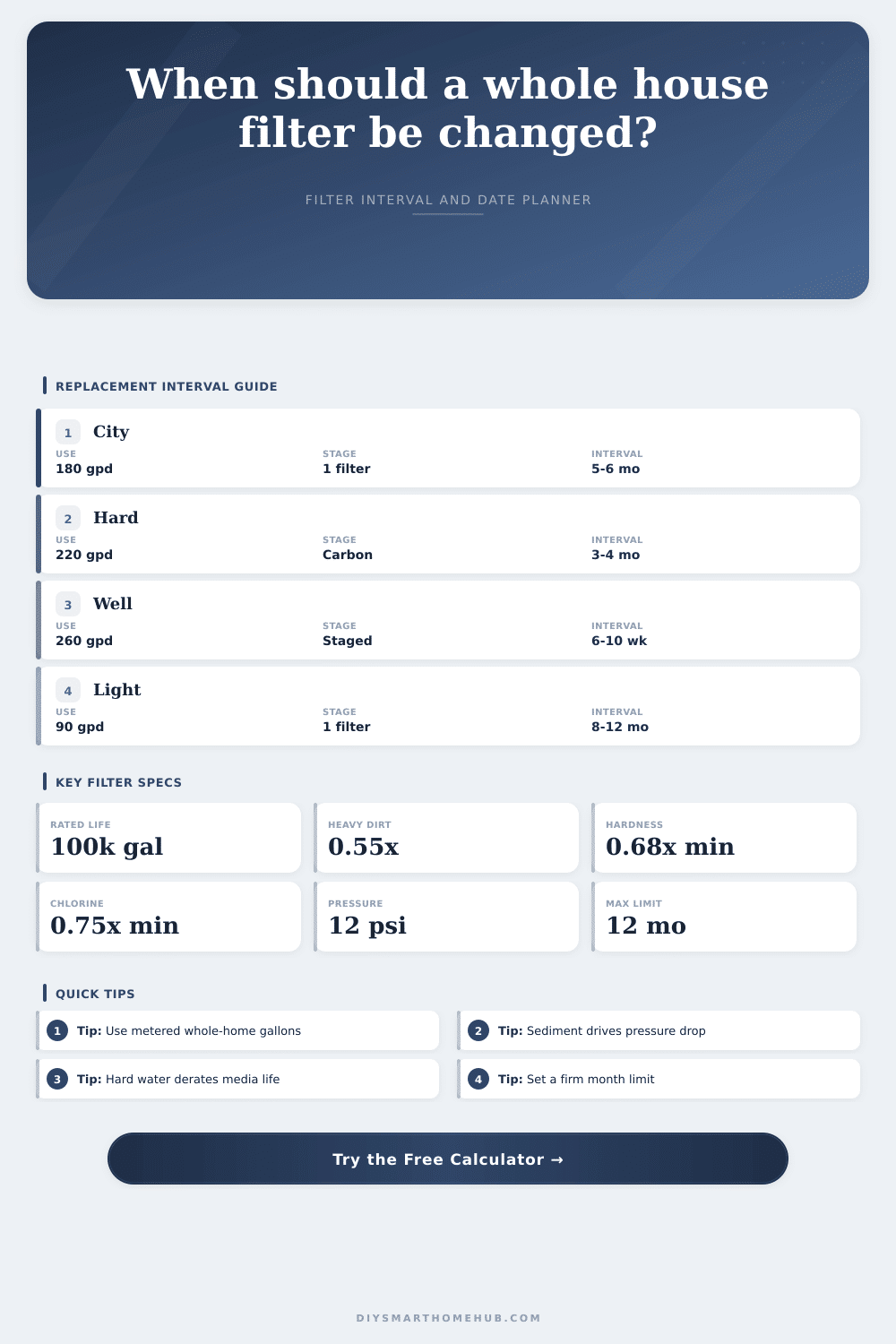
Daily household usage is the critical first input. Unless you’re running your sprinklers through your filter house, or filling your swimming pool with water that travels through it, this is the water you use indoors every single day. Exclude that from your number because otherwise, you’ll greatly overestimate your wear. Even with clean city water, one hundred and eighty gallons a day can chew through a typical hundred thousand gallon rating in less than a year if you have an indoor-only family of four.
From there, the tool figure out how long that capacity will last, and it takes reality into account. People also misunderstand sediment. In reality, it’s there. Filters is rated for clean water. Your water is probably dirty with fine dust, rust, and silt. Before chemical media is depleted, the sediment will plug the pores and cause a pressure drop. Based off your sediment load, the calculator includes a derate factor. Heavily loaded well water can cut usable capacity by nearly half.
Even if the filter could still hold more gallons, you must change it because the restricted flow mean there is still useful chemical left.
Another issue is water chemistry. Though chlorine doesn’t carry dirt into the filter to clog it, it degrades the activity sites and media structure. Likewise, high hardness form scale inside the filter structure. Both destroy the active sites, and the tool has lower ratings specifically for each condition. In aggressive municipal supplies (hard and chlorinated), the factors stack against you. That’s what would of explained why a filter labeled for a hundred thousand gallons may indeed work well for only seventy thousand.
Staging gives you a mechanical advantage by providing an economical way to get more life out of your expensive filter. You install a low-cost sediment prefilter ahead of your high-end carbon block; it’s protecting your big-ticket item. And the reference table on the page spells that out for you. By trapping most of the particulates, a five micron prefilter will extend the life of the main stage by nearly ten percent. What’s a regular changeout of a whole house filter becomes changing a cheap prefilter every several months. That moves maintenance from a large-scale chore to a routine job.
Capacity also doesn’t change a strict deadline based on time. Filters need to be replaced at minimum once per year even if you’re using very little water and the water itself is crystal clear. Water sitting in your housing are a perfect environment for biofilm formation. Any organic matter trapped in filter media is food for bacteria. By enforcing a max service life of 12 months, you ensure that you will replace the filter before it becomes a source of contamination instead of protector.
The calculator does this automatically and prevents you from stretching an interval indefinitely just because the water still tastes fine. It tells you what the trigger was to go off (this is key if you’re trying to troubleshoot). It tells you on what date to make the change. And it tells you how often to replace, as an interval.
This is our output: That means that I will need to change out my media according to the replacement interval and specific date provided by the calculator. The trigger was gallons of water used, so I’m just running out of media because of either the water chemistry or because I use too much of it. Either way, now I know how to set up my system best for the next run.
How do you maintain a filter? Not with the filter, but rather with the water. It all becomes apparent once you start to measure what’s actualy running through your filter and stop guessing.
Maybe it’s your irrigation that’s going through the filter so often you’re constantly changing them out. Maybe it’s the sediment in your well shortening your run times by months. The numbers will tell the story. Your role is simply to listen for the answer and swap the cartridge when the numbers indicates it’s time.