Hot Water Demand by Fixture Count Calculator
Estimate diversified fixture demand, peak hot-water flow, tank first-hour rating, tankless GPM at temperature rise, and recovery watts from common household fixture counts.
Setpoint minus incoming water temperature.
Diversified share of connected fixture flow.
Required hot flow at the modeled temperature rise.
Approximate gas input matching peak recovery.
Match the calculated FHR, then confirm storage and recovery can handle the busy hour.
Match the peak hot draw at the temperature rise, not only the brochure max GPM.
Use FHR for comfort, then expect electric resistance backup during dense overlap.
Useful for a remote sink, but not a whole-home substitute for shower and tub peaks.
| Fixture group | Modeled mixed flow | First-hour event | Calculation role |
|---|---|---|---|
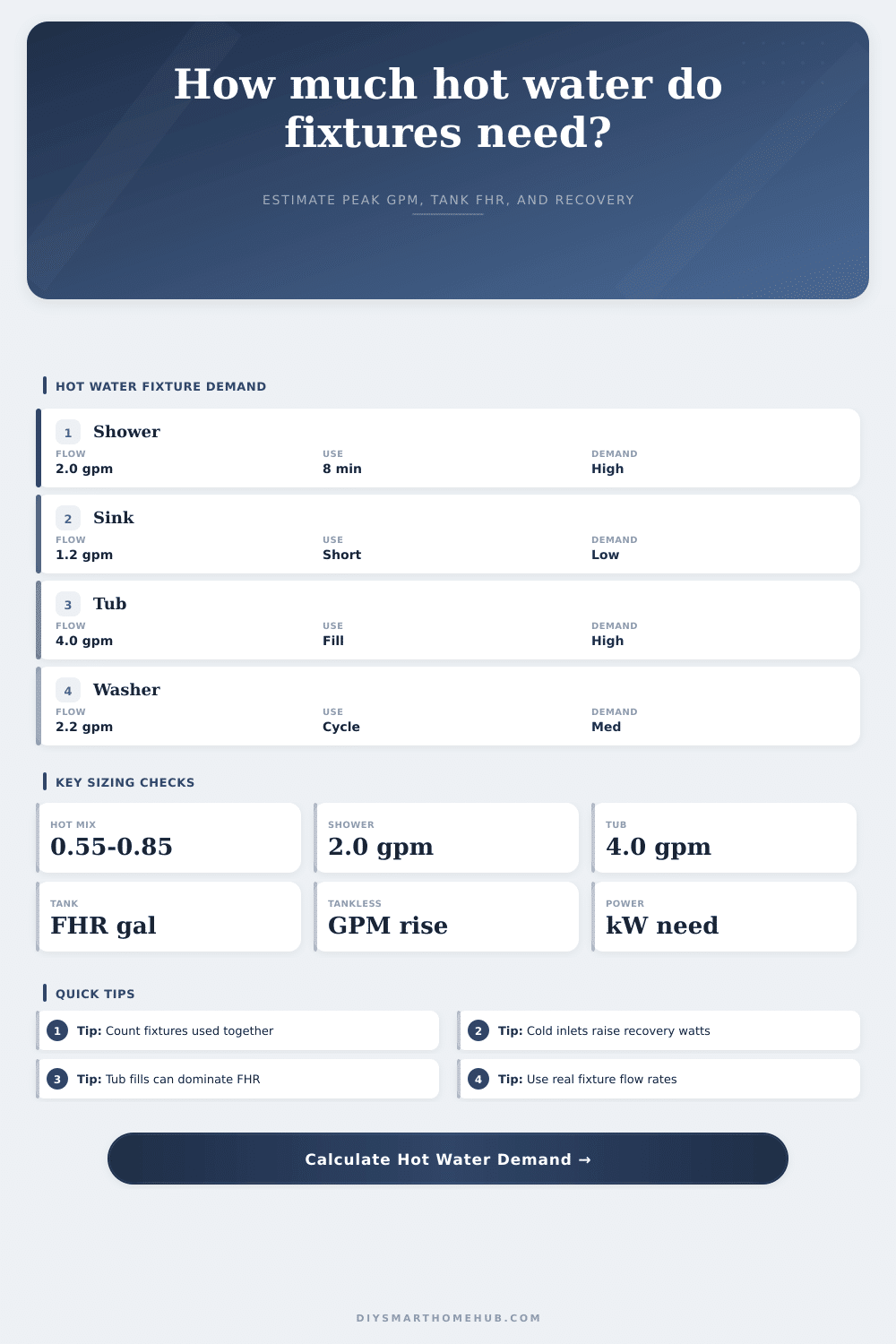
| Shower head | 2.0 gpm mixed | 8 minutes per likely event | Strong peak GPM and first-hour driver |
| Sink or lavatory | 1.2 gpm mixed | Short 1.5 gallon hot use | Adds overlap without dominating tank size |
| Tub filler | 4.0 gpm mixed | 24 gallons hot per fill allowance | Dominates tank FHR when tubs are counted |
| Clothes washer | 2.2 gpm intermittent | 9 gallons hot per active cycle | Adds both recovery and first-hour draw |
| Dishwasher | 1.5 gpm intermittent | 5 gallons hot per active cycle | Moderate first-hour and overlap load |
| Total fixtures | Base diversity range | Profile modifier | Planning note |
|---|---|---|---|
| 1 to 3 fixtures | 0.78 to 1.00 | Usually normal | Small homes have fewer fixtures but less diversity benefit |
| 4 to 8 fixtures | 0.56 to 0.74 | Normal or busy | Typical family homes land in this range |
| 9 to 15 fixtures | 0.44 to 0.58 | Busy or guest | Larger homes need diversity but still allow overlapping baths |
| 16+ fixtures | 0.34 to 0.50 | Zone mentally | Very large layouts may need separate zones or engineered sizing |
| Incoming water | 120°F setpoint rise | Effect on tankless GPM | Recovery effect |
|---|---|---|---|
| 75°F warm climate | 45°F rise | More rated GPM available | Lower watts per GPM |
| 60°F mild climate | 60°F rise | Moderate derating | Typical planning value |
| 50°F cold season | 70°F rise | Use 70°F rating closely | Higher recovery watts |
| 40°F very cold inlet | 80°F rise | Substantial GPM derating | Large recovery load |
| Scenario | Fixture mix | Typical peak hot draw | Likely capacity focus |
|---|---|---|---|
| Small apartment | 1 shower, 2 sinks, 1 dishwasher | 1.5 to 2.5 gpm | Compact tank or small tankless |
| Two-bath home | 2 showers, 4 sinks, laundry, dishwasher | 2.8 to 4.2 gpm | Tank FHR and tankless rise rating |
| Family morning | 3 showers plus fixtures | 4.0 to 6.5 gpm | Strong tankless or higher FHR tank |
| Tub-heavy suite | Large tub plus shower overlap | 4.5+ gpm | First-hour tank draw and recovery |
Why does your hot water run out so often? Why does it always do this just as you’re about to head off to work? That’s not bad luck; that’s almost always a mistake in math prior to purchasing the components. Generally, most folks estimate their requirements based on how many bathroom they have. They should of consider what fixtures is running at once. That’s where most go wrong.
After inputting your inlet temperatures, and your fixture counts, calculator does the math for you. You no longer have to guess with conversions and coefficients. It takes your plumbing drawings and converts them into numbers such as first-hour ratings and peak gallons per minute.
How to Pick the Right Water Heater
Why? Because tankless and tanks solves different problems. A tank is like a battery; it stores hot water for brief periods of time. Tankless are like generators; they generate heat when needed. When demand outstrips their ability to produce, they suffers. You have to understand what will break in your house.
Begin by considering your shower heads. Shower heads use more water than dish washers and run longer then sink faucets. Shower heads is usually the biggest drain on your system because they runs longer and draw more water than other fixtures like sinks or dishwashers. What happens if all three of those showers are on within an hour? You’re looking at peak flow. Most standard tanks won’t cut it during such a scenario.
To account for the overlap, you’ll want to tweak this with a simultaneity factor. This factors into equation because not all faucets open at the same time. It spreads the load. The power grid doesn’t have to build enough plants to support everyone using all their appliances at once. So yes, it’s less than total possible demand, but it’s still significant.
Now think about the incoming water temperature. That’s another secret variable that sabotages so many installs. In the winter, groundwater may be forty degrees where you live. In Arizona, it may be seventy-five degrees. Twice as much energy are needed to heat forty degree water up to a hundred and twenty degrees. This is more than heating it from seventy-five to a hundred and twenty.
To use the calculator, enter the inlet temperature. It will tell you how many gallons per minute you can gets out of a tankless unit. Manufacturers state the maximum flow at a low temperature rise. But that means nothing if your water starts off freezing. Size for the worst case. Don’t size for the average.
When you’ve got multiple washing machines, or big soaking tubs, then you start thinking about tank size. Dumping that much hot water into a tub is huge, it empties a storage tank before the burner fills it back up. And if you don’t have enough recovery power (too small a first-hour rating), you won’t have any hot water at the sink. This recovery power is measured in BTUs or kilowatts by the tool. It tells you what to ask for on gas line or electrical panel.
It is not just about how well it fits in the closet. But does your setup support the unit? Size matters: Too big…wastes money. Too small…cold shower! How do you know? Size it for your busiest morning. For the rest of the day, the unit run efficiently. Want to know for sure? Know the volume in the first hour and peak flow. The rest is simple math. No more guesswork. Never have an icy surprise again; know exactly what you need.