Water Dispenser Filter Life Calculator
Estimate replacement timing from rated gallons or liters, household dispensing volume, water hardness, TDS, sediment, allowed flow-rate drop, filter age, and calendar cap.
Detailed filter-life breakdown
| Dispenser filter type | Typical rated capacity | Best input basis | Life calculator note |
|---|---|---|---|
| Refrigerator carbon block | 150 to 300 gallons | Cartridge gallon rating | Often reaches calendar cap before gallon capacity in small homes |
| Large inline dispenser filter | 500 to 1,500 gallons | Inline housing rating | Capacity lasts longer, but flow drop still limits service life |
| Countertop gravity cartridge | 40 to 150 gallons | Cartridge pair or unit rating | Small media volume can exhaust faster under high TDS |
| Pitcher or reservoir filter | 20 to 60 gallons | Pitcher replacement rating | Daily refill behavior usually dominates replacement timing |
| RO post-carbon filter | 500 to 1,000 gallons | Post-filter service rating | Calendar cap can matter because flow is already restricted |
| Water profile | TDS or hardness signal | Capacity factor | Why it changes life |
|---|---|---|---|
| Soft, low TDS | Below 100 ppm | 1.08x | Lower dissolved solids and scale pressure preserve media capacity |
| Typical municipal | 100 to 250 ppm | 1.00x | Baseline for many residential dispenser ratings |
| Mineral taste | 250 to 400 ppm | 0.86x | More dissolved solids compete for adsorption sites |
| Hard water | 10 to 15 grains | 0.72x | Scale and mineral load increase pressure rise and taste breakthrough |
| Very hard or high TDS | Above 400 ppm | 0.58x | High mineral loading shortens useful gallon capacity |
| Iron or sulfur prone | Noticeable staining or odor | 0.52x | Reactive compounds can exhaust carbon media early |
| Condition | Light case | Typical case | Heavy case |
|---|---|---|---|
| Sediment load | Clear water, 1.05x | Light load, 1.00x | Heavy load, 0.62x |
| Flow threshold | 15% drop, early | 25% drop, balanced | 45% drop, late |
| Calendar cap | 2 to 3 months | 6 months | 9 to 12 months |
| Use pattern | 0.6 gal/day | 2.2 gal/day | 6 gal/day plus |
| Scenario | Rated capacity | Daily household use | Expected replacement driver |
|---|---|---|---|
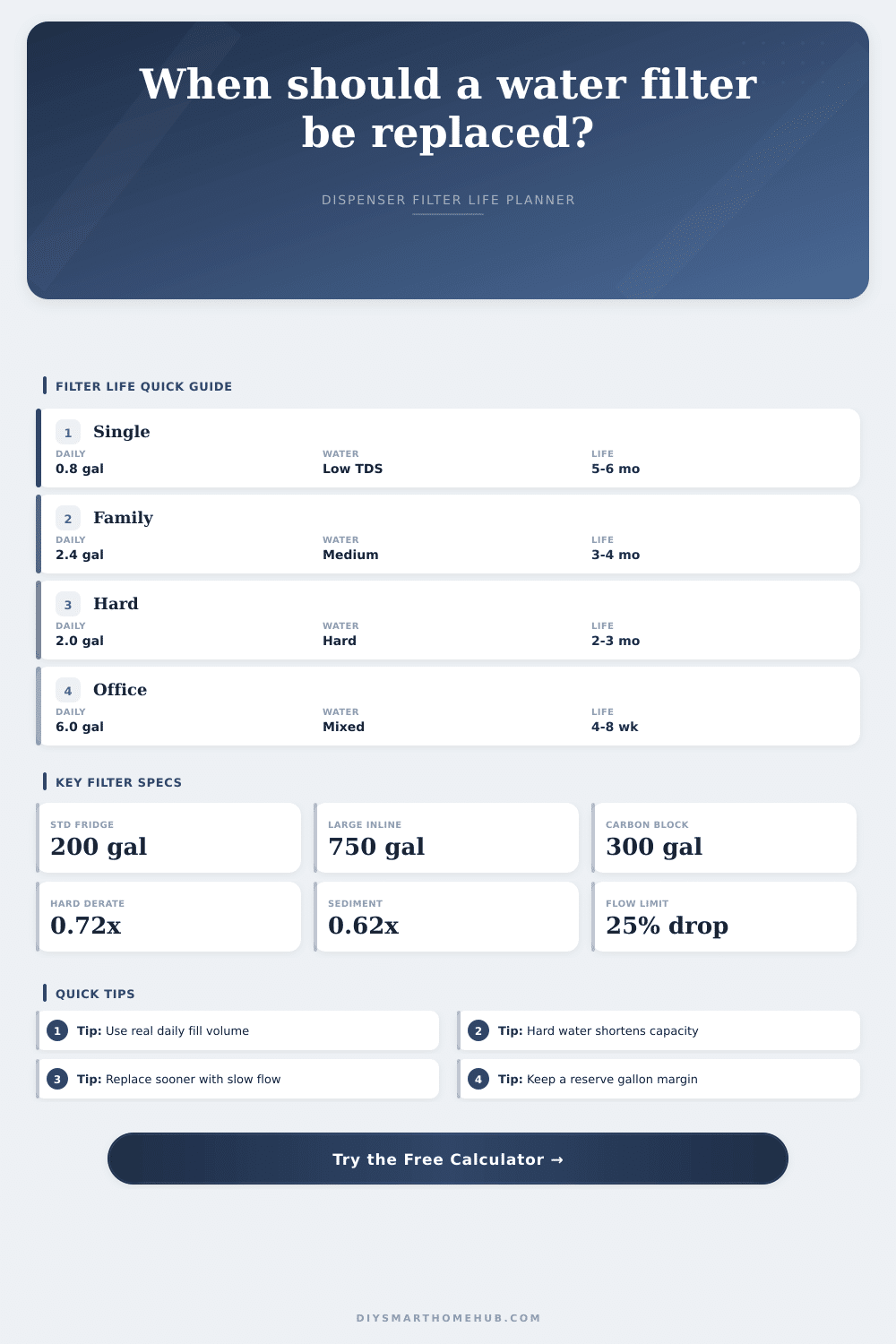
| Single apartment | 200 gallons | 0.8 gallons/day | Calendar cap often arrives first |
| Family refrigerator dispenser | 200 gallons | 2.2 gallons/day | Gallons and calendar may be close |
| Hard-water family home | 300 gallons | 2.0 gallons/day | Hardness derate usually dominates |
| Small office cooler | 750 gallons | 6.0 gallons/day | Usage volume can overtake the cap |
| Low-use vacation home | 200 gallons | 0.25 gallons/day | Calendar cap nearly always dominates |
Capacity limited
High daily dispensing volume uses the rated gallons quickly. The calculator converts household use into days until gallon capacity is gone.
Water-quality limited
Hardness, high TDS, iron, and sediment reduce usable capacity because media loads faster and flow resistance rises earlier.
Calendar limited
Low-use filters can still reach a month cap before gallon capacity is used, especially in reservoirs and refrigerator dispensers.
Everyone knows when their fridge’s water dispenser flows so slowly it feels like it is leaking instead of flowing, that slow drip are a clear sign your fridge filter needs replacement. It’s annoying in itself. However, the bigger issue is that you’ve probably used up a worn-out filter for weeks or even months by the time the drip turn to a trickle.
Most of us replace our filters only when water gets gross-tasting (or the dispenser fail to provide pressure). So we’re already consuming filtered water past its prime; beyond that, the material inside it is losing effectiveness at removing things from your water.
Why You Should Change Your Fridge Filter
Enter the calculator above: Plug in what kind of water you drink at home and how much of it, and it’ll do the math for you about how long until you reach that unseen damage mark. Filters are rated by how many gallons they can filter which is a best-case scenario. It’s assuming your family use water at a steady, moderate pace, and your water is relatively clean. But your water quality is going to change all that.
Carbon block filters don’t like hard water. Calcium and magnesium will scale up the media surface and clog up the pores where contaminants gets trapped. If you’re on hard water, this can cause your filter to derate down to just 72 percent of rated life. That’s a big one; that means a six-month filter becomes a four-month chore. These kinds of reduction factors is accounted for in the tool, so you won’t have to guess how much your local mineral content is shaving off the filter’s life.
Another element that shortens the life of a filter are sediment. Carbon doesn’t work well with physical particles; it only handles chemicals and makes water taste better. Especially if you pull from a well or have old piping in your house, you’ll notice very small particulates clogging up the filter media long before the carbon is saturated. That’s where the sediment question comes into play based off the calculator. Heavy sediment environments can decrease your effective capacity as much as almost forty percent.
You may be far away from reaching your gallons, thinking there’s no way the filter could be anywhere close to dead…but it already has its flow throttled due to physical blockage. It is not based on amount of water, but on what kind of water it is.
Water chemistry isn’t everything; household behavior is also significant. How much filtered water do you actualy use? More than you realize! Sure, you’re thinking about the glasses you fill and drink throughout the day. But what about all that other stuff? An ice maker run at least once per night. The coffee pot fills up first thing in the morning. Kids refill water bottles when they gets home from school.
In a house with a family of four, those numbers can add up fast, two gallons a day or more before you know it. If you add in hard water reducing capacity, your supply will run out much faster then the manufacturer’s label says. Plug in those daily volumes into calculator to find out exactly how fast your own routine consumes the reserve.
And then there’s that calendar thing nobody thinks about. Even if you never pour a drop of water through it, the media within the filter degrade with time. If it gets wet enough, bacteria will begin to form on the carbon sitting idle and the chemical bond in the carbon that creates its adsorption sites weakens. That’s why they put a max calendar cap on fridge filters, which is typically six months.
The calculator compares how many gallons (usage) it has depleted versus how much time (calendar), and lets you know what’s really the limiting factor. Six months at a vacation house means the calendar win. In a busy family kitchen, gallons wins.
When you understand the variables, maintenance is no longer guesswork about what needs changing. Replace the filter while it’s still working, not after the flow has died. Consistent water quality and a healthy appliance are the results. It is no surprise that the flow slowed down or that there’s a bad taste in your water. You should of deserve just clean water when you need it.