Smart Scale Recipe Scaling Calculator
Resize a recipe from original servings to target servings, then plan grams, baker percent, hydration, scale rounding, bowl tare, loss factor, ounces, and cup references.
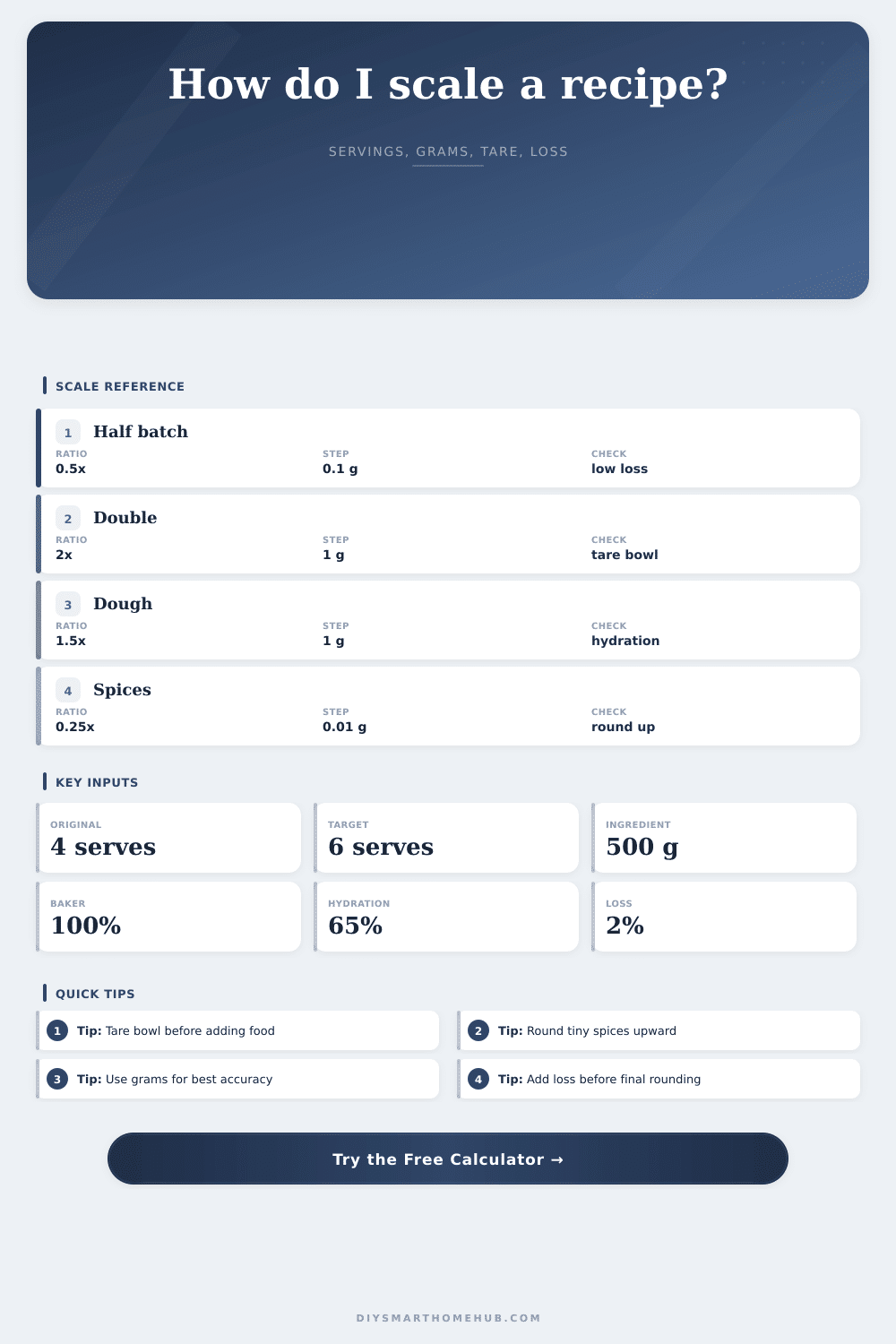
Best for yeast, salt, spices, and small formula corrections.
Good kitchen precision for most single-ingredient scaling.
Common food scale setting for flour, liquid, butter, and sugar.
Acceptable only for large batches where small rounding is harmless.
Every ingredient starts with target servings divided by original servings.
The scaled grams are multiplied by the loss factor before display rounding.
Ingredient grams divided by baker percent gives the equivalent flour weight.
Flour equivalent times hydration percent estimates the matching water amount.
| Scale display | Best use | Max rounding swing | Recipe note |
|---|---|---|---|
| 0.01 g | Yeast, salt, spice, cultures | 0.005 g | Useful for tiny percentages and small batches. |
| 0.1 g | Leaveners, coffee, spices | 0.05 g | Good balance for precise kitchen work. |
| 1 g | Flour, sugar, water, butter | 0.5 g | Standard for most recipe scaling. |
| 5 g | Large prep containers | 2.5 g | Use only when ingredient tolerance is wide. |
Rounding swing is half the display step because targets can land between two visible scale values.
| Ingredient reference | Grams per cup | Ounces per cup | Scaling caution |
|---|---|---|---|
| All-purpose flour, spooned | 120 g | 4.23 oz | Do not pack; grams are more repeatable. |
| Granulated sugar | 200 g | 7.05 oz | More dense than flour, so cup volume is lower. |
| Water or milk | 240 g | 8.47 oz | Milliliters and grams are close for water. |
| Butter | 227 g | 8.00 oz | Use package marks only as a rough cross-check. |
| Honey or syrup | 340 g | 11.99 oz | High density and sticky transfer loss matter. |
| Cocoa powder | 85 g | 3.00 oz | Very packable; weigh rather than scoop. |
| Formula item | Baker percent | Hydration context | Scale behavior |
|---|---|---|---|
| Flour | 100% | Base weight | All baker percentages compare back to flour. |
| Water in sandwich bread | 58% to 65% | Moderate dough | Small changes are noticeable in handling. |
| Water in pizza dough | 62% to 72% | Wet dough | Hydration controls stickiness and extensibility. |
| Salt | 1.8% to 2.2% | Flour based | Use fine resolution for small batches. |
| Instant yeast | 0.2% to 1.2% | Time based | Small gram changes can shift fermentation speed. |
| Oil or fat | 2% to 10% | Enriched dough | Loss factor helps when weighing sticky fats. |
| Preset | Ratio | Raw scaled grams | Rounded target |
|---|---|---|---|
| Half loaf flour | 0.5x | 500 g | 510 g |
Sometimes a recipe include weights, other times volume measures (a cup, a spoon). When scaling a batch down or up, confusion arises because you might not have right measurement. Typicaly it’s a matter of whether the ingredient has been measured in weight or its volume.
Recipes teach us to measure with cups and spoons, but measuring by the gram are more accurate. Why? Because density at which an ingredient gets packed changes your weight. Scoop flour into a cup and it will weighs one thing. Measure it by weight on a scale and you’ll see that varies. That variation matter when making bread: It impacts finished texture. With pastry: It impacts layering.
Why Weighing Ingredients Is Better Than Measuring
If we’re talking about converting from volume measurements, say serving size, to weight, then there are calculators out there to do the math but without knowing what the number means, that doesn’t really help. Baking is about more than multiplying a recipe to scale. It’s also about dealing with human error and losses due to physical factor.
The bigger your batch, the longer it takes to move all those ingredients around and the larger the surface area in bowls. Not everything gets mixed in; some will get stuck to bowl. Having tools that take this into account can be really helpful. You’ll add a bit extra to compensate (a very small %) for these losses.
Baking is a game of compounding small errors. Losing a couple percent on an ingredient doesn’t sound like much, but across multiple ingredients those losses adds up to an ounce you don’t have. This impacts the sweetness of glaze or the hydration of dough.
Ingredients vary by how well they work on any given scale. Typical kitchen scales will only shows to the nearest gram. For sugar, flour, etc., this is fine. Not so much for salt or yeast. In baker’s percentages, salt are roughly two percent of the flour. So if I want to make something with five hundred grams of flour, I’ll want ten grams of salt. A typical scale will round that to either nine or eleven and that changes how quickly it ferments and how it tastes. For these tiny quantities, we’re looking at needing a scale that can go down to the hundredth of a gram.
The level of accuracy needed depend on the task. Hydration is how much water you use relative to flour. It can be expressed as a percentage. Fifty percent hydrated dough is drier then seventy percent hydrated dough. When you scale a recipe, always maintain that ratio. If you add more flour, make sure it has an equivalent amount of added water or your dough will change. A calculator translates baker’s percentages into real-world water weights. That way the scaled recipe act like original.
Trust the math, the scale, the recipe, and your process. Minimize loss and maximize consistency. Tare your bowl first, weigh things together where possible, consider sticky ingredients, and consider how much is stuck on your tools. All these little thing matter. The numbers are provided by your tools; the attention is provided by you. Weighing ingredients is not a guess. You should of used better scale.