Coffee Grind Dose Calculator
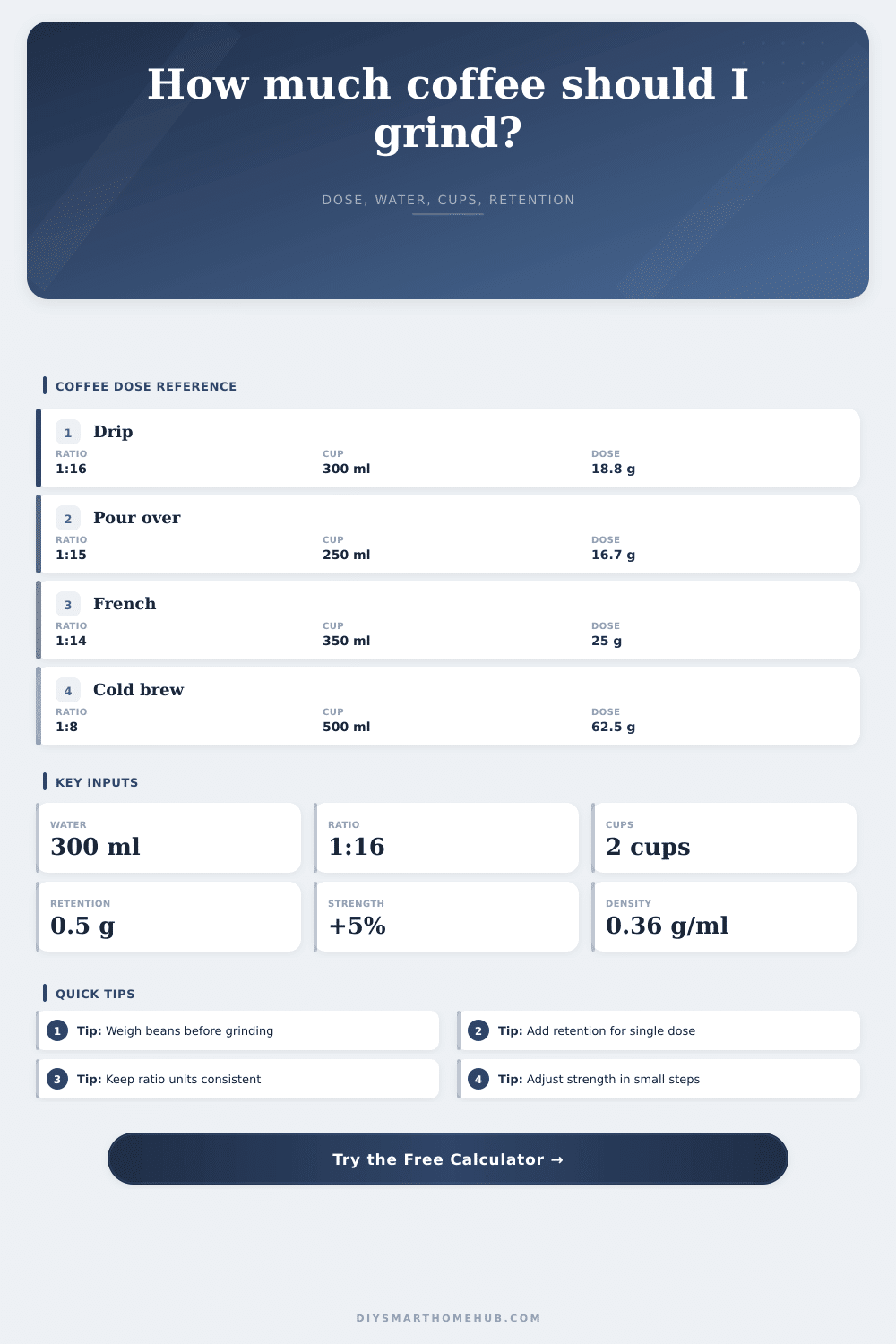
Calculate how many grams of coffee to grind from brew water, cup count, brew method, ratio, strength adjustment, grinder retention, and bean density.
Fuller everyday cup for pour over or strong drip brewing.
Balanced starting point for many automatic drip batches.
Lighter cup that can suit darker roasts or longer contact.
Gentler cup for high-solubility beans or low bitterness.
Manual cone brews often start fuller, then move toward 1:16 as grind and drawdown improve.
A balanced batch reference where 600 ml of water uses about 37.5 g of coffee.
Immersion and metal filtration commonly use a higher dose for body and cup clarity balance.
Concentrate batches use much more coffee because the finished drink is usually diluted later.
| Brew method | Typical ratio | Grind direction | Dose cue |
|---|---|---|---|
| Automatic drip | 1:15.5 to 1:17 | Medium | Good baseline for multi-cup batches. |
| Pour over | 1:15 to 1:16.5 | Medium fine to medium | Adjust dose with drawdown and taste. |
| French press | 1:13 to 1:15 | Coarse | Higher dose balances immersion body. |
| Immersion brewer | 1:12 to 1:16 | Medium fine to medium | Short steeps often need more coffee. |
| Espresso | 1:1.8 to 1:2.5 | Fine | Dose is basket-led; water approximates beverage yield. |
| Moka pot | 1:8 to 1:12 | Fine to medium fine | Dense dose for short, strong cups. |
| Cold brew concentrate | 1:6 to 1:10 | Coarse | Large coffee mass before dilution. |
Ratios are coffee mass to brew water mass. Because water density is close to 1 g/ml, milliliters and grams match closely for kitchen dosing.
| Serving plan | Brew water | Coffee in brew | Total beans with retention |
|---|---|---|---|
| One 250 ml cup | 250 ml | 15.6 g | 16.1 g |
| Profile | Retention | Density | Planning note |
|---|---|---|---|
| Single-dose hand grinder | 0 to 0.2 g | 0.34 to 0.42 g/ml | Weighed input is close to brew dose. |
| Low-retention electric grinder | 0.2 to 0.8 g | 0.32 to 0.40 g/ml | Add a small fixed buffer to the beans weighed. |
| Hopper grinder | 0.8 to 2.5 g | 0.30 to 0.38 g/ml | Retention matters most for one-cup batches. |
| Dark roast beans | varies | 0.28 to 0.34 g/ml | Lower density means more scoop volume for the same grams. |
| Light roast beans | varies | 0.36 to 0.46 g/ml | Higher density means less scoop volume for the same grams. |
| Preset | Water | Ratio | Coffee in brew | Total beans |
|---|---|---|---|---|
| Two-cup drip batch | 600 ml | 1:16 | 37.5 g | 38.0 g |
The coffee-to-water ratio is more of a guideline than a hard-and-fast rule. Remembering that I’ve learned a 1:16 is great but tweak it up or down if your coffee is coming out sour or cardboard-like. Your grinder holds back some grounds. Your beans aren’t all the same density. And “cup” to you could mean an extra-large mug or just small espresso shot.
A calculator can close that gap between a complex ratio and the tangible number of grams in front of you on the scale. It takes the guessing out of variables you can’t visually estimate. The main ingredient in any good brew is amount of water. Since water has a density of approximately one gram/milliliter, you can ignore the difference between milliliters and grams. Why? Because it allows you to concentrate on what realy matters, coffee.
Why Use a Coffee Calculator
Altering your ratio alters concentration of solids in the cup. For example, using a 1:15 results in a heavier, fuller-bodied drink suitable for many light roast. Switching to a 1:17 or 1:18 result in a cleaner, more tea-like cup which tends to work well with darker, more soluble beans. Make that decision about the balance and let the tool do the math. No need to do mental arithmetic and stand awkwardly at messy kitchen counter.
Grinder retention. Also known as the coffee that gets trapped in the chute and on the burrs; is something most people overlook. It might only be half a gram, but that half a gram add up. So if you weigh your beans prior to grinding, factor in grinder retention. Otherwise, if you weigh the grounds once they drop into the filter or portafilter, then you’re measuring what actualy makes contact with the water.
You can enter a retention buffer value into the calculator. Such a fine point could of made all the difference. Consistency equals good coffee.
Scoop volume relies heavily off the density of the beans. You’re using heaping scoops or tablespoons if you don’t own a scale. However, a light roast bean is more dense than a dark roast bean. Therefore, a scoop of light roast will weigh more then a scoop of dark roast. The density input in the calculator changes your gram target to an estimated volume. It’ll tell you about how many milliliters (or tablespoons) of whole beans you should have. It’s not accurate enough to dial-in your espresso but it works wonders when planning out cold brew jars or batch brews.
When brewing cold brew, you’re actually creating a concentrate, which is why you’ll notice very high ratios (for example, 1:8 or even as high as 1:6). That sounds excessive, I know, but keep in mind, you’ll dilute this later. If you brew your cold brew with the same ratio as a traditional drip machine what do you get? A weak, watery brew. Those are the extremes the tool covers, and what you’ll notice is just how much of an increase there need to be in the dose for an immersion method.
The other exception is French press. Because of its coarse metal filter, you’ll allow more fines and oils into the cup. You want to increase your dose a bit (typically ~1:14). More coffee help round out the mouthfeel.
You can also fine tune your strength. Maybe your home water is extremely soft and will pull hard on coffee. Try reducing your dose by five percent. Maybe you have a brand new bag of coffee and are finding it sour if you don’t go strong enough on the dose, bump it up. The changes are subtle, but can make the difference between a great cup and a good cup.
Don’t use a huge adjustment in dose to compensate for a crappy grind. If your grind isn’t right, first adjust your water. Then your dose. Third, adjust amount of coffee. It takes out the guesswork. There’s no emotion involved in this system. You don’t guess. You calculate. You plug in your variables, press the button, and try it. Taste it. Adjust accordingly. Lower if it’s too strong. Raise if it’s thin.
A good base-line value makes sense. A good base-line value factors in the oddities of your equipment. It also considers the amount of water you have on hand and how many cups you wish to pull. It transforms what was once a chaotic routine into an experiment you can repeat. Sure, you still need to taste the coffee, but now you’re starting with something precise instead of a crapshoot. This is where the purposeful brewer is separated from the accidental. We weigh, we grind, we brew, and we refine.