Slow Cooker Start Time Calculator
Calculate the local heat start time, latest prep beginning, cook finish, warm-hold window, high or low conversion, appliance warm-up, and delayed-start safety warning for a slow cooker recipe.
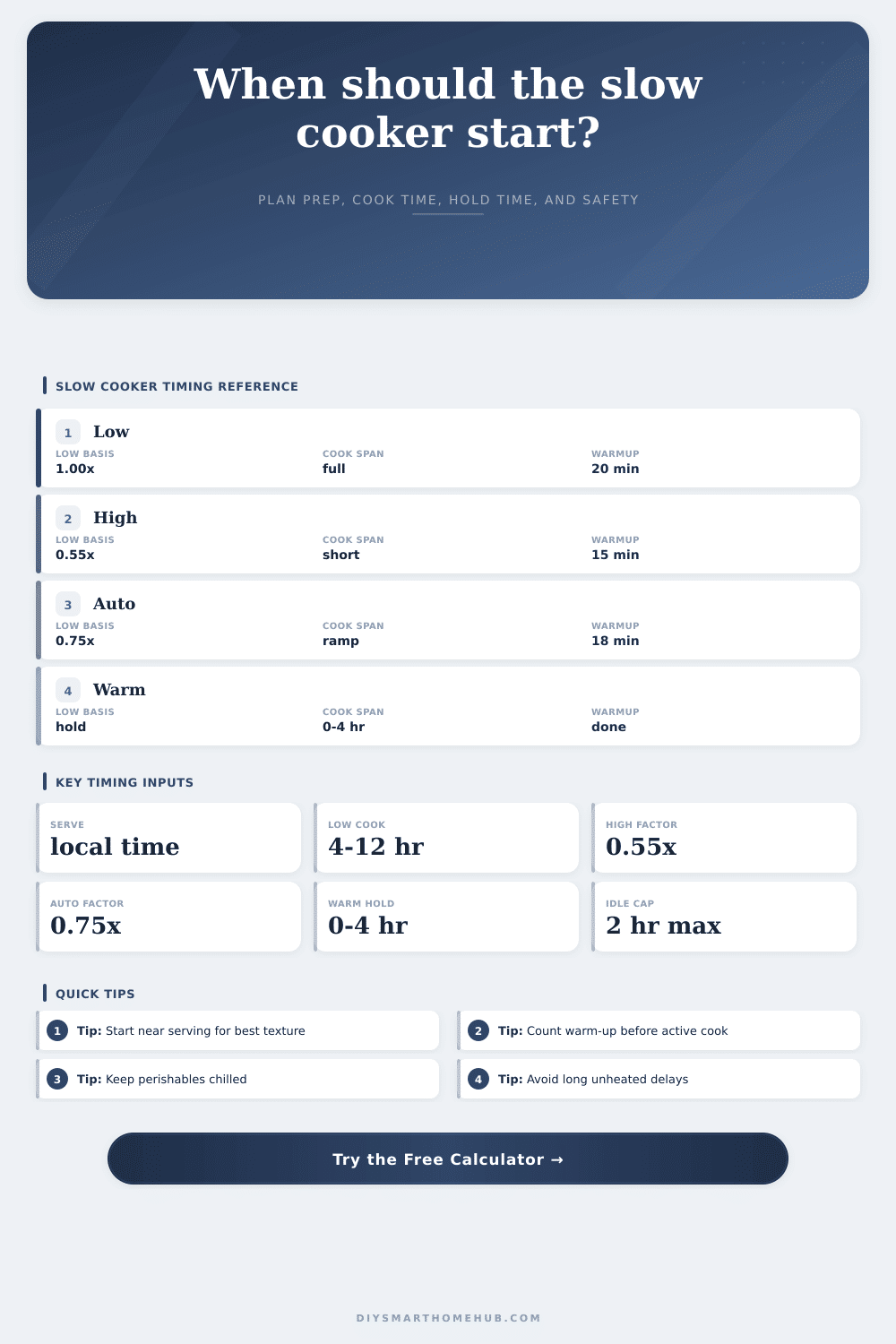
| Setting | Formula | Example from 8 hr low | Use case |
|---|---|---|---|
| Low | low x 1.00 | 8 hr | All-day recipes |
| High | low x 0.55 | 4.4 hr | Shorter block |
| Auto/ramp | low x 0.75 | 6 hr | Mixed heat cycle |
| Warm | hold only | 0-4 hr | After cooking |
| Serve time | Cook total | Hold limit | Start window |
|---|---|---|---|
| 18:30 | 8 hr 20 min | 2 hr | 08:10-10:10 |
| 12:00 | 4 hr 35 min | 1 hr | 06:25-07:25 |
| 07:30 | 6 hr 18 min | 0.5 hr | 00:42-01:12 |
| 19:00 | 10 hr 25 min | 3 hr | 05:35-08:35 |
| Unheated idle | Display | Math condition | Meaning |
|---|---|---|---|
| 0 min | No delay | load at start | Best timing |
| 1-60 min | Monitor | idle <= 60 | Short wait |
| 61-120 min | Caution | idle <= 120 | Near limit |
| 120+ min | Warning | idle > 120 | Unsafe delay |
| Recipe type | Low range | Prep span | Hold target |
|---|---|---|---|
| Stew | 7-9 hr | 20-35 min | 0-2 hr |
| Chili | 6-8 hr | 15-30 min | 1-3 hr |
| Roast | 8-10 hr | 20-45 min | 0-2 hr |
| Oats | 6-8 hr | 5-15 min | 0-1 hr |
| Beans | 9-12 hr | 10-25 min | 0-2 hr |
Slow cooking takes a long time. Eight-hour cook times mean you need to plan ahead. Dinner’s supposed to be at 6:30, but it’ll take eight hours before the meat is tender. That’s why you might be standing in the living room in sweatpants. It’s not that you can’t cook; it’s that the math don’t work.
There’s active cooking time and a warm-up phase, this is followed by a hold window. Guesswork leads to hoping for the best. Plan a couple minutes then save your brainpower for later. This calculator does the math for you, giving you a simple time to follow instead of a complicated schedule.
How to Plan Your Slow Cooker Time
That’s where the math comes in. This number represents your slow cooker’s warm-up allowance, which is basically just amount of time it takes for your slow cooker to actualy get up to temperature. There is always a lag. The recipe calculator assume as much, and asks how long it should of be allowed to warm up. Typically, it’ll take about 20 minutes. While that’s going on, its heating element is chugging away, slowly bringing the temperature inside to life. Only once this period end will the rest of the recipe begin to tick.
Disregard this pre-heating window and your dinner will finish premature. Then what? It’s been sitting on the “warm” setting for three hours. Now it’s all mushed together. Bad timing leads to bad texture, respect the heat rise.
Then there’s the matter of heat: How does it affect the equation? It is not merely turn-the-knob stuff. Higher settings do cook more quickly, but not precisely half-as-quickly. The conversion factor is about 55 percent, according to the referenced table. An eight-hour low recipe will cook maybe four and a half hours on high. Many people neglect to account for that change when starting out. If they use a high setting, they start at same time and end up with mush by noontime. Once you choose your setting, the calculator accounts for timing difference automatically.
Taste takes a back seat. You don’t want perishables like dairy and meat sitting at room temperature for too long. If you load all ingredients in the morning and leave them to sit until dinner, bacteria will grow on them. The timer tracks how long those ingredient was left idle before being heated. If you put it all in there two hours beforehand and then forget about it until dinnertime, that’s a problem. The warning system lets you know whether or not your planned schedule work out. Does the meal need to be kept in the fridge till the last minute?
There’s a hidden variable called preparation time. How long will it take to chop up those onions? How long will it take to brown that meat? How many different spices do I need to measure out? It takes twenty or thirty minutes. Subtract that time from total time available. Eight hours for cooking plus one hour for prepping means you’ll need to start working nine hours ahead of dinner.
Enter this into the calculator. It will tell you how far in advance to heat things up. And it will tell you when it’s time to get out the knife and start chopping, that closes the gap between your real life schedule and recipe card itself.
Then there is the warm hold function which comes in handy when plans change. After the slow cooker finish its cooking cycle, it maintains temperature and keeps the food hot and safe for several hours. This is nice because instead of having only one minute, you now have a start window. If you have an appointment to get to, then you can still start early. The food will stay good for a while. But it will not last forever. Two to four hours is about as far as most moddern models do well. After that, the texture realy starts to degrade. This tool shows you how much of that buffer you are using up. And that’s what helps you decide whether to start earlier or wait until later.
“Confidence is what slow cooking’s all about. You don’t want to have to worry if you started too late. You don’t want to have to wonder if you left it on for too long. You want to be able to walk in your kitchen and pull a perfect meal out of there. With warm-up, cook time and hold limits, we break down the variables so that the guesswork goes away. That gets your time back that you was spending worrying about it. It also gets your meal back that you wanted to eat. Start with the math, and the food will turn out right.”