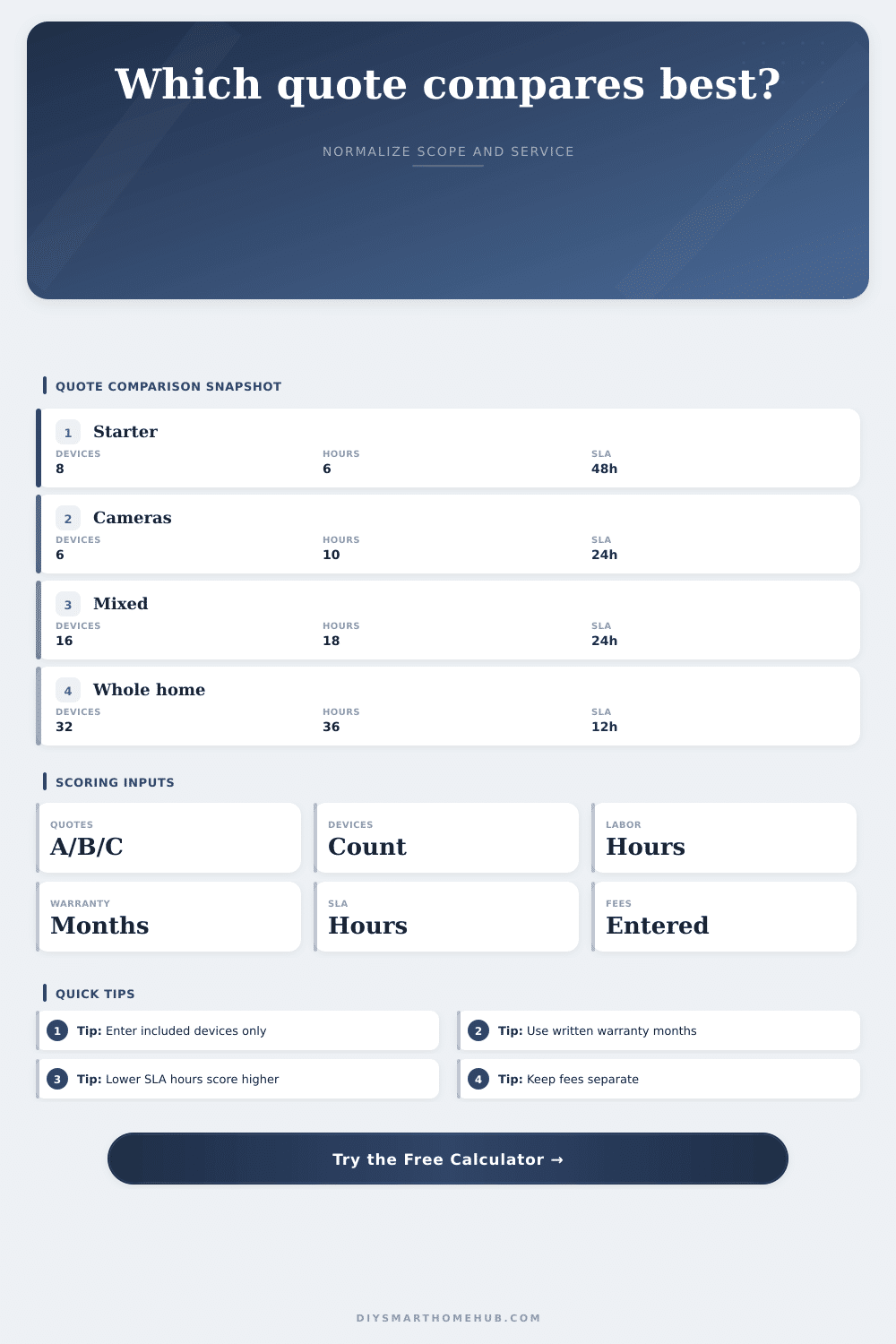
Installer Quote Comparison Calculator
Compare three smart home installer quotes using only the amounts, device counts, labor hours, warranty months, response SLA hours, and travel or permit fees you enter.
1.Load a Quote Scenario
2.Enter Quote Values
Quote A
Quote B
Quote C
The calculator treats each column as an anonymous quote. Quote amount and travel or permit input are kept separate, then combined for normalized comparison.
3.Quote Results
4.Comparison Grid
Quote A
0- Total entered$0
- Per device$0
- Support0
Quote B
0- Total entered$0
- Per device$0
- Support0
Quote C
0- Total entered$0
- Per device$0
- Support0
5.Weighting Reference
The remaining 10% rewards lower travel or permit input. Every score is calculated from the three quote columns above.
6.Score Formula Table
| Score part | Formula | Weight | Direction |
|---|---|---|---|
| Normalized amount | Lowest per-device divided by quote per-device | 40% | Lower is stronger |
| Warranty months | Quote warranty divided by highest warranty | 20% | Higher is stronger |
| Response SLA | Fastest SLA divided by quote SLA | 15% | Lower is stronger |
| Labor hours | Quote hours per device divided by highest hours per device | 15% | Higher is stronger |
| Travel or permit | Lowest fee input divided by quote fee input | 10% | Lower is stronger |
7.Entered Value Checks
| Input | Used in | Normalization | Output effect |
|---|---|---|---|
| Quote amount | Total and per-device amount | Quote amount plus fees | Main value score |
| Included devices | Per-device denominator | Minimum one device | Scope comparison |
| Labor hours | Labor per device | Hours divided by devices | Labor detail score |
| Warranty months | Support duration | Compared to highest quote | Warranty score |
| Response SLA hours | Support response speed | Compared to fastest quote | SLA score |
| Travel or permit input | Fee adjustment | Compared to lowest fee input | Fee score |
8.Preset Scenario Reference
| Preset | Device range | Labor range | Support range |
|---|---|---|---|
| Starter sensors | 8 to 10 | 5 to 8 hours | 6 to 18 months |
| Four-camera exterior | 4 to 6 | 9 to 13 hours | 12 to 36 months |
| Apartment bundle | 12 to 15 | 10 to 16 hours | 6 to 24 months |
| Whole-home sensors | 24 to 30 | 22 to 32 hours | 12 to 36 months |
9.Result Band Table
| Score band | Meaning | Typical driver | Compare next |
|---|---|---|---|
| 90 to 100 | Strong across inputs | Low amount with strong support | Device scope |
| 75 to 89 | Competitive quote | Good balance of value and SLA | Warranty gap |
| 60 to 74 | Mixed comparison | One or two weak inputs | Fee and hours |
| Below 60 | Low weighted fit | High normalized amount or slow SLA | Scope mismatch |
10.Input Notes
If you have three quotes from contractors, you’re faced with a decision. Those quotes will differ. They’ll probably look different than each other. One might be cheaper overall but install less stuff. Another may provide fast service but require additional money for permit. It’s hard! What do you pick?
The truth is, it shouldn’t feel like that. All those choices aren’t equal. You aren’t looking for the lowest dollar amount. You’re trying to make all the included work comparable. That way you know what you’re getting.
How to Compare Contractor Quotes
Most buyer fail to account for unknowns. They fixate on bottom line. They forget about warranty duration and labor time. Those will end up costing you far more over time than your upfront savings.
The calculator does this: It makes you analyze the same metrics across all options. How many device are covered? What’s the total cost? How many hours of labor is that? How many hours of service do you get with the warranty/service level agreement?
Finally, this one is important. If the warranty only lasts six months, it doesn’t matter how quick they responds. The tool takes that into account. It shows you an actual value score. It is not a raw price tag.
Quotes are treated like anonymous columns. You are no longer biased by branding. Why does it matter?
For many reasons, labor hours do. If I get a quote saying it will take 30 hours to install it on 16 devices, that’s different than getting a quote that says it’ll take me only ten. One installer is probably doing things right: mounting brackets correctly, wiring through the wall. The other installer may be cutting corners and using wireless adapters.
When you plug those figures in, you’re quantifying quality of the install. It rewards thoroughness. It penalizes rushing. It punishes looking cheap up-front with a crappy install later. The calculator compare labor efficiency per device.
The cost depends on how long the warranty lasts. Most warranties last 12 months. A 24 month warranty means they’re confident in their craftsmanship and believe in the hardware. And if someone else is willing to give you double the warranty for slightly more money, it’s probably a better deal. The tool does pick up on this point and puts a lot of focus on warranty length.
You’re also paying for sensors. Don’t forget about permit fees, either. Some quotes will bury those expenses into the final price. Others separate them out. The calculator keeps these two items apart so you can get an accurate sense of what the work would cost without all the admin overhead. This helps ensure you don’t pay to much.
The tool lets you run tests against preset scenarios, to see what various scales look like. For example, installing a doorbell is pretty straightforward. There’s not much work involved. Run a sim. Then compare it to a complex camera retrofit. This gives you an idea of how pricing scale based off complexity.
What you’ll find is that pricing typically falls per device as you scale up the project. If the installer is efficient. That’s just typical industry behavior. When you have large projects, they spread out the fixed cost of setup and travel.
But it is not all math. There’s no way for it to account for everything. Still gotta rely on the wrench-holder guy. A great number doesn’t mean anything if the installer isn’t reputable. It doesn’t mean anything if they’re rude and don’t return emails.
You should of looked closer though. So treat the numbers as a short list. And do some digging on them yourself, plus your gut instinct to pick the final partner from that shortlist. The best quote is where numbers meet people.
Looking at installer quotes boils down to sifting through the surface numbers. You need to understand how an up-front cost translates to long-term support. That’s where the tool removes the noise. So you can concentrate on the numbers that will matter most in your experience.
You can reduce a stack of papers into a clear decision, leaving the guesswork to the algorithm. You put yourself back in control of your home security investment. Actualy, it is moddern way to do things naturally.