Filter & Consumable Annual Cost Calculator
Estimate yearly replacement quantities, pack rounding, spare buffer, and annual cost for HEPA filters, mop pads, vacuum bags, and drinking water filters.
Formula breakdown
| HEPA adjustment | Factor | Formula role | Planning note |
|---|---|---|---|
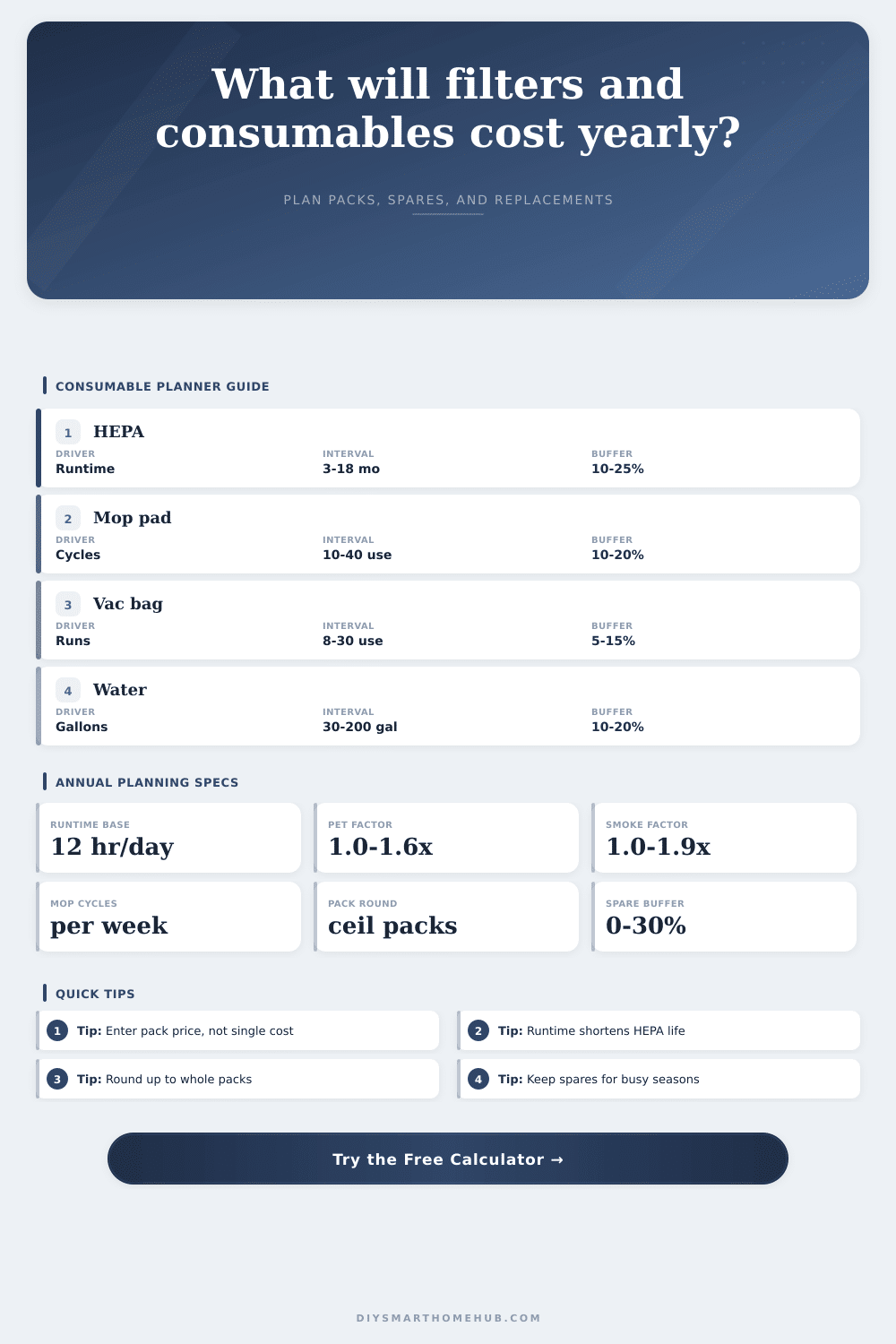
| Runtime baseline | 12 hr/day | Rated life × 12 / hours | Longer runtime shortens life |
| One low-shed pet | 1.18x load | Divide service life | Light hair and dander |
| Multiple pets | 1.35x load | Divide service life | Frequent filter loading |
| Smoke or wildfire | 1.55x load | Divide service life | Particle load rises quickly |
| Renovation dust | 1.90x load | Divide service life | Temporary heavy derating |
| Consumable | Annual formula | Pack formula | Common driver |
|---|---|---|---|
| HEPA filters | Devices × filters/change × 12 / adjusted months | Ceiling(planned filters / filters per pack) | Runtime and air load |
| Mop pads | Weekly cycles × 52 × pads/cycle / pad life | Ceiling(planned pads / pads per pack) | Cleaning frequency |
| Vacuum bags | Weekly runs × 52 / runs per bag | Ceiling(planned bags / bags per pack) | Dirt bin volume |
| Water filters | Stations × gallons/day × 365 / gallons per filter | Ceiling(planned filters / filters per pack) | Daily water use |
| Home scenario | Purifier runtime | Cleaning cycles | Typical buffer |
|---|---|---|---|
| Light studio | 8 hr/day | 2 mop, 3 vacuum/week | 5% |
| Pet apartment | 12 hr/day | 4 mop, 6 vacuum/week | 15% |
| Allergy home | 20 hr/day | 5 mop, 7 vacuum/week | 20% |
| Large house | 16 hr/day | 8 mop, 12 vacuum/week | 20% |
| Pack rounding example | Exact need | With 15% buffer | Whole pack result |
|---|---|---|---|
| HEPA 2-pack | 5.2 filters | 6 filters | 3 packs |
| Mop pad 6-pack | 13 pads | 15 pads | 3 packs |
| Vac bag 8-pack | 19 bags | 22 bags | 3 packs |
| Water 3-pack | 7 filters | 9 filters | 3 packs |
You don’t have to be an engineer to see the invisible and understand your maintenance needs. Just buy them.
A water filter is a appliance that cleans. There is a robot vacuum. An air purifier. These aren’t machine that run forever. They eat up capacity. They consume. They fill up. They become clogged, and then they don’t work very well.
Plan Your Filter Replacements Now
How can you know which one needs replacing? The job description are to know what’s getting measured so you can spend money.
We all do it: most of us purchase filters as a reaction. Red light. Beep. Wait, what? Oh, the machine’s been struggling for weeks. Wrong move.
You can get a calculator to do the math for you. It turns your slightly uneasy feeling into a clear annual dollar amount. It makes you think not only about price of the box but also about its runtime and load. Twenty hours a day in wildfire season? That doesn’t matter if you use normal twelve-month replacement chart. The tool accounts for that fact of life. It split the rated life by the load factor. It recognizes that the dust inside the mesh take up space. More dust means less airflow, more dust means you swap out the filter earlier.
That’s when it gets complicated by pack sizes. You can’t buy 3.7 filters. You purchase a pack of filters. What happens if the calculator rounded up and told you to buy two packs, but there is only three left on the shelf? Then what?
This is why the spare buffer isn’t wasteful. A fifteen percent buffer is insurance. It is insurance for the fact that life comes in chunks. You might find yourself needing a replacement at the last minute just before a holiday sale closes. You might move into a new apartment and need one immediately. Buying the extra now is cheaper than having to pay shipping fees to get it in an emergency.
Same with water filters: when does it change? By volume, not by time. Gallons per day. The tool asks for that. Sounds abstract, but imagine what your family life looks like. Got a fridge dispenser? Got a smart pitcher to drink out of? Got a pet fountain? Each one pulls from the same cartridge lifespan. Underestimate how much you pull in a day and the filter will run dry before time’s up. The result is stale tasting water. And that is what people miss. They think they got a bad filter. Nope. The filter is just empty, they’re out of water.
Vacuum bags and mop pads are easier. They happen more often. Robot vacuums goes every day. Add in weekly cycles; that adds up quick. The number of times it’s been run vs. The bag capacity: The tool does that math for you. Got pets? Bags will fill quicker than expected. That’s accounted for by the multiplier on the calculator. And it takes into account how many are in a pack. There is twelve bags, but they are sold in packs of eight. Buy two packs. Now you have four spares.
Spare mops just sit there, taking up space in a drawer until next year. The tool will tell you exactly where all that money go. This stuff ain’t free. Planning it out is overhead. This is why it should of been cheap overhead.
Because once a year when that light goes yellow in November, you’re not shocked at the price. Because you planned ahead. You’ve got the spare on hand. Your machine continues to run. Your water is fresh and clear. Panic is avoided. Last minute ordering isn’t needed.
It’s not about becoming a spreadsheet wiz either. It’s about eliminating guesswork. Guessing = Waste. Planning = Control.
You know the cost. You know the schedule. You know when to order. The numbers does all the work.
You keep doing what you’ve always been doing, going about your day and breathing easy while all that invisible work remains invisible. It is exactly as it should be.