Surround Speaker Distance Calculator
Calculate 5.1 and 7.1 surround speaker distances from listener position, room geometry, target side and rear angles, speaker height, delay milliseconds, and SPL trim spread.
Calculation breakdown
| Layout | Side surround angle | Rear surround angle | Distance use |
|---|---|---|---|
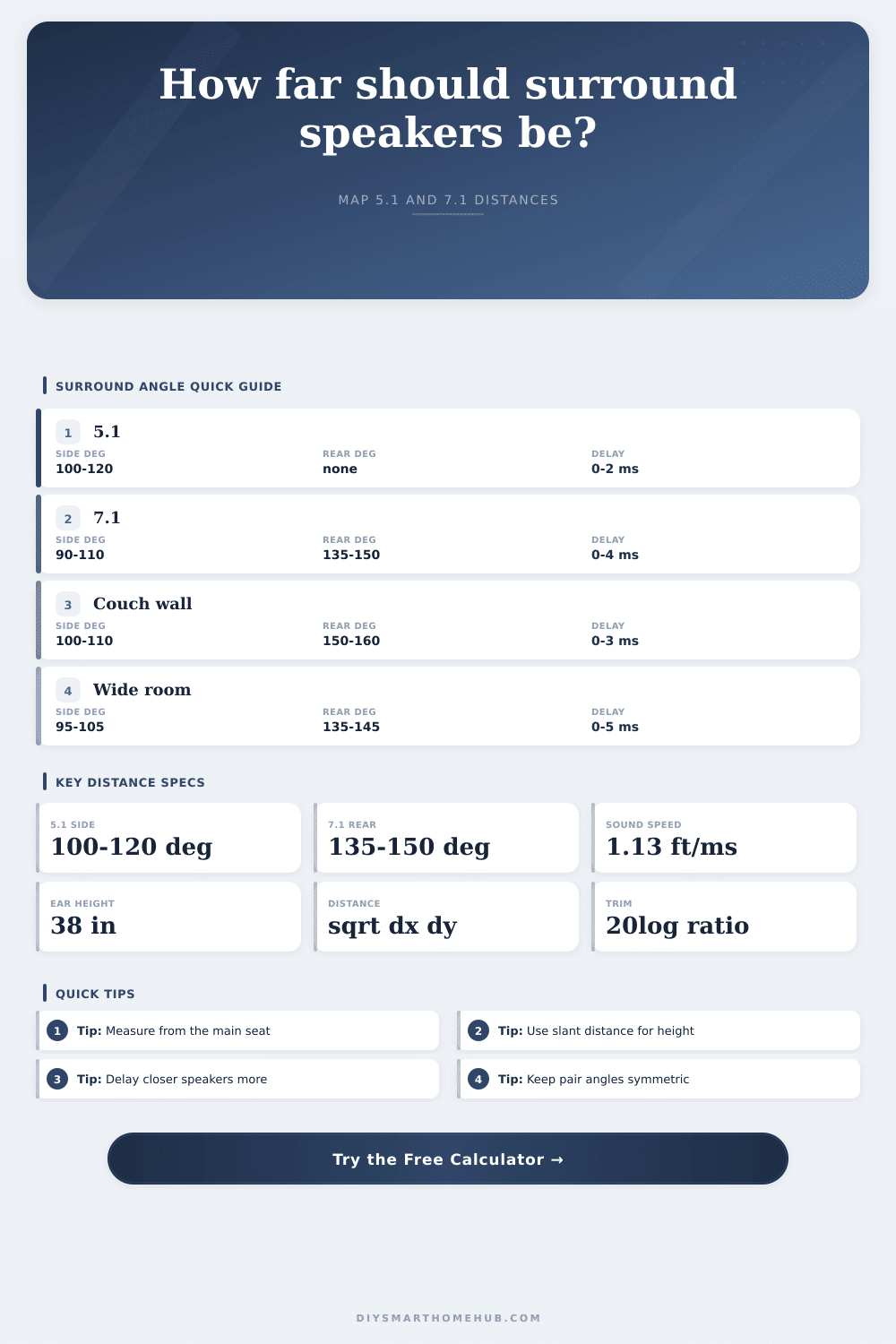
| 5.1 relaxed side | 100° from front center | Not used | Good when the sofa is close to the back wall. |
| 5.1 reference | 110° from front center | Not used | Balanced side and rear wrap for one surround pair. |
| 5.1 rear-biased | 120° from front center | Not used | Useful in deeper rooms with space behind the listener. |
| 7.1 separated | 90° to 110° from front | 135° to 150° from front | Side pair carries lateral effects, rear pair anchors back image. |
| Near rear wall | 100° from front center | 150° to 155° from front | Rear pair often lands on the back wall with short distance. |
| Distance difference | Delay difference | Metric difference | Calibration meaning |
|---|---|---|---|
| 0.5 ft | 0.44 ms | 0.15 m | Small but measurable in a precise setup. |
| 1.0 ft | 0.88 ms | 0.30 m | Common left-right mismatch from an offset seat. |
| 2.0 ft | 1.77 ms | 0.61 m | Closer speaker usually needs added delay. |
| 4.0 ft | 3.54 ms | 1.22 m | Noticeable spread in wide or asymmetric rooms. |
| 6.0 ft | 5.31 ms | 1.83 m | Large correction; check whether angles are practical. |
| Height above ear | Elevation at 5 ft | Elevation at 8 ft | Distance effect |
|---|---|---|---|
| 0 in / 0 cm | 0.0° | 0.0° | Horizontal distance and slant distance match. |
| 12 in / 30 cm | 11.3° | 7.1° | Small slant-distance increase for close surrounds. |
| 24 in / 61 cm | 21.8° | 14.0° | High side surrounds need a vertical angle check. |
| 36 in / 91 cm | 31.0° | 20.6° | Distance setting can be several inches longer. |
| 48 in / 122 cm | 38.7° | 26.6° | Usually too elevated for bed-layer precision. |
| Near speaker | Far speaker | Level difference | Trim estimate |
|---|---|---|---|
| 5 ft | 6 ft | 1.6 dB | Cut the nearer channel about 1.6 dB. |
| 6 ft | 8 ft | 2.5 dB | Common for one seat offset in a medium room. |
| 7 ft | 10 ft | 3.1 dB | Delay and trim both need attention. |
| 8 ft | 12 ft | 3.5 dB | Large spread; check whether placement can move. |
| 10 ft | 14 ft | 2.9 dB | Wide rooms can still calibrate cleanly. |
Geometrically speaking, where to put surround speakers is a lot less important then what path the sound takes through space to reach your ear(s). Instead of aiming directly at them or some other direction, you want the sound coming from them to blend smoothly with everything else around you. This creates a continuous, immersive soundspace.
That means not only angle but also distance: If there’s a big difference between the distance to one speaker versus another, then your brain will latch onto that object as being the sound source, rather than perceiving it as coming from all around you. The calculator figures out those equations based off your entered information about size of the room and where you sit, which spares you needing to guess at strange coefficients, and converts the theoretical angles into actual distances you can measure on the wall.
How to Place Your Surround Speakers Correctly
The horizontal angle (ninety or a hundred and ten degrees off of the front center) is what most folks concentrate on. And rightly so, because it is important. But adding height add an additional variable that even seasoned installers sometimes get tripped up by. Mounting a surround speaker above your seated ear level casts a diagonal path from the speaker to your head. The longer this path, the further away your eardrums are from the speaker’s driver. If you move the speaker up two feet, you might be adding several inches to the overall length of its path. And that slight variation will make you miss your mark during calibration if all you did was measure along the ground.
To set delays accurately you must take into account this slant distance. One millisecond equals about one foot, small variations in path length add up and becomes audible as time differences. The chart on the page provides reference information that shows what these time adjustments should of be based on a few feet of separation. For example, if your right surround is farther away from your ear than your left, the left channel gets there first. To make it come in sync with the other, you have to delay the nearer channel a bit. Otherwise, the imaging becomes distorted and soundstage appears tilted towards the nearer speaker.
Another thing that screws up symmetry is listener offset. Chances are, you don’t sit smack dab in the middle of your living room. Perhaps there’s a TV cabinet that pushes you two feet to one side, or the dog prefers that spot on the rug. That offset alters the distance to all the speakers in the system. To account for this left/right shift, the calculator takes it into account when spitting out delay numbers for each channel. It will tell you exactly how many milliseconds of additional delay to insert on the near side to match the far side’s delay. It is not much of an adjustment, but it is important to a coherent sound field.
The same applies for volume balance. The inverse square law states that sound pressure decreases with increasing distance. So a speaker 20 percent further away sounds much quieter then the other. The app calculates the SPL trim required to even things up. Then you assign this trim in your receiver settings and lower the level of the near speaker until both speakers is perceived equally loud. Without this, the louder speaker grabs your focus which diverts it from what’s on the screen.
There is also an element of room shape involved here. Deep seating areas and wide rooms can make for unusual speaker placements in surrounds. One could sit halfway down one side wall with a speaker, and then have one tucked in the rear corner. That’s not uncommon. It can be accommodated.
Measure correctly and believe the calculations. Avoid assuming symmetry based off what it looks like. Pull out the tape measure and note precisely how far (in feet) from your seated position to each speaker’s acoustic center. Be carefull entering the measurements. Even if the layout appears off-balance, the resulting numbers will point you to the right spot to create a balanced surround.
Consistency is key. No matter what direction the sound comes from in the mix, it needs to feel naturaly. Remove the physical obstacles, delay, distance, height… And you have good surround sound. It’s simple mathematics.
It requires some time to dial-in the settings, but once done, the room vanishes. All that remains is the story playing out on screen, surrounded by sound that feels real.