In-Wall Speaker Spacing Calculator
Calculate in-wall left and right speaker separation from seating distance, stereo angle, room width, coverage angle, height difference, SPL loss, and amplifier impedance grouping.
Calculation breakdown
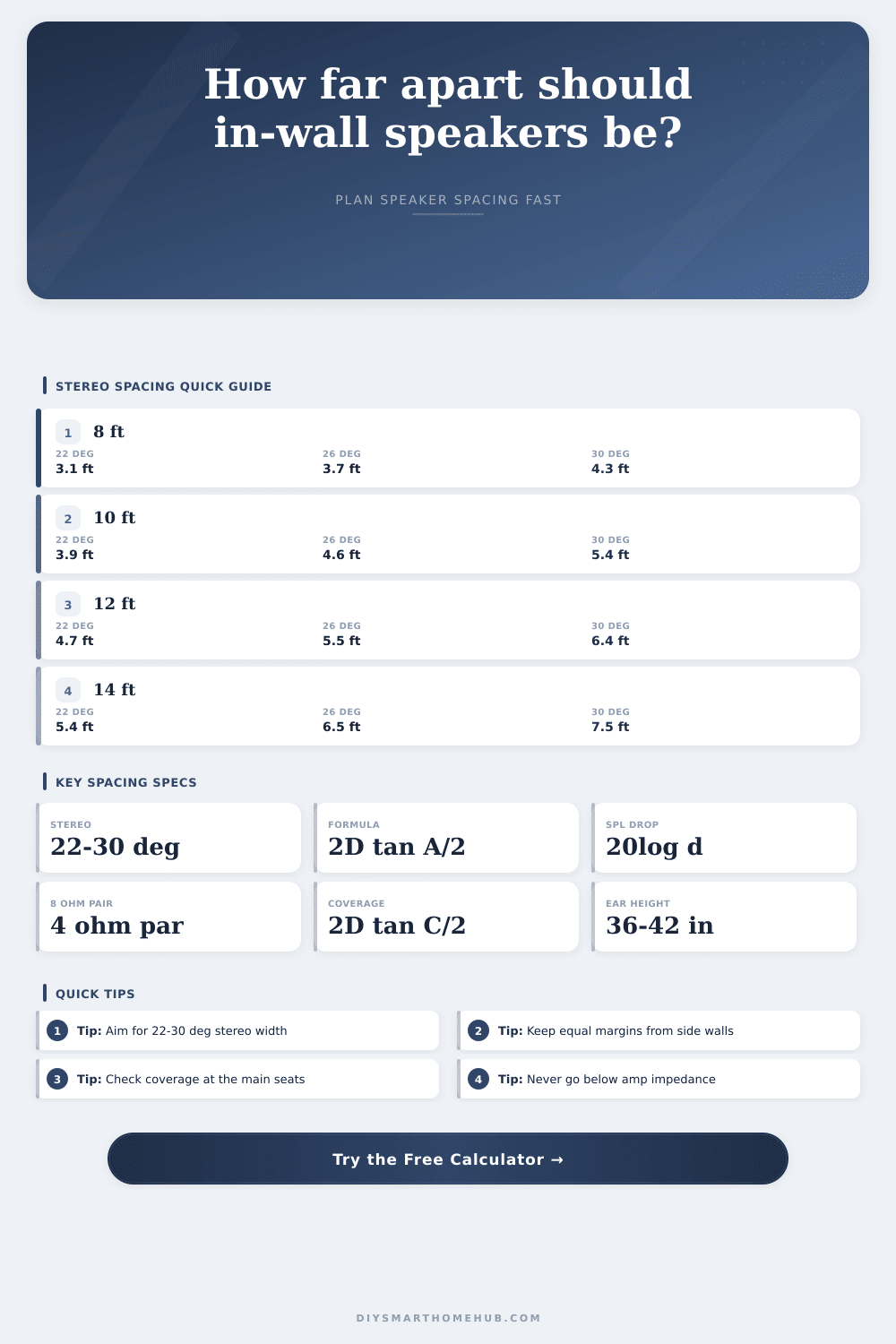
| Seating distance | 22° separation | 26° separation | 30° separation |
|---|---|---|---|
| 6 ft / 1.83 m | 2.3 ft / 0.70 m | 2.8 ft / 0.84 m | 3.2 ft / 0.98 m |
| 8 ft / 2.44 m | 3.1 ft / 0.95 m | 3.7 ft / 1.13 m | 4.3 ft / 1.31 m |
| 10 ft / 3.05 m | 3.9 ft / 1.19 m | 4.6 ft / 1.41 m | 5.4 ft / 1.63 m |
| 12 ft / 3.66 m | 4.7 ft / 1.43 m | 5.5 ft / 1.69 m | 6.4 ft / 1.96 m |
| 14 ft / 4.27 m | 5.4 ft / 1.66 m | 6.5 ft / 1.97 m | 7.5 ft / 2.28 m |
| Speaker above ear | 8 ft seat angle | 10 ft seat angle | Planning signal |
|---|---|---|---|
| 0 in / 0 cm | 0.0° | 0.0° | Acoustic center is ear-height aligned. |
| 6 in / 15 cm | 3.6° | 2.9° | Small vertical offset for most seats. |
| 12 in / 30 cm | 7.1° | 5.7° | Check tweeter dispersion and seat height. |
| 24 in / 61 cm | 14.0° | 11.3° | High mounting may narrow direct coverage. |
| 36 in / 91 cm | 20.6° | 16.7° | Consider vertical coverage limits carefully. |
| Distance | Loss from 1 m | 87 dB speaker at 25 W | Use in calculator |
|---|---|---|---|
| 6 ft / 1.83 m | 5.2 dB | 95.8 dB | Close seating, modest acoustic loss. |
| 8 ft / 2.44 m | 7.7 dB | 93.3 dB | Common den or small living room. |
| 10 ft / 3.05 m | 9.7 dB | 91.3 dB | Typical main sofa distance. |
| 12 ft / 3.66 m | 11.3 dB | 89.7 dB | Larger room with more level drop. |
| 14 ft / 4.27 m | 12.6 dB | 88.4 dB | Longer throw needs level headroom. |
| Grouping | Formula | Equivalent load | 4 ohm channel check |
|---|---|---|---|
| 1 x 8 ohm | R | 8 ohm | Comfortable load. |
| 1 x 6 ohm | R | 6 ohm | Comfortable load. |
| 2 x 8 ohm parallel | R / 2 | 4 ohm | At the minimum limit. |
| 2 x 8 ohm series | R + R | 16 ohm | Safe load, lower output. |
| 4 x 8 ohm series-parallel | (R + R) / 2 | 8 ohm | Comfortable load. |
Remember, it’s all about the geometry of where you mount speakers into walls, which is why people tend to overthink the driver size. Because you’re dealing with a fixed point on your wall… Your hands can’t hold drywall. You want the physical position more than the box size itself. Otherwise, soundstage will be thin and disconnected from what you hear.
Once you input dimensions of your room, the calculator do the math for you so there’s no guessing with angles. The variable here is stereo angle, that’s the angle made between your left ear, your right ear and the two speakers. Typically, audio engineers aim for about twenty-two to thirty degrees, which provides a steady image. When speakers is too wide apart or when you sit too closely to them, the center channel drop out. Then the voices sound like they’re originating on the left or right speaker, not floating out front.
How to Place Your Speakers Correctly
For tight seating situations (small dens), a twenty-two degree spread sounds good. For a larger living room where you’d prefer more cinematic spread, go with a thirty degree layout. You’ll notice the difference, it will show how wide music sounds. That means if you have a 26 degree angle it gets wider in linear feet depending on how far away from wall the seat is. With a 26-degree angle and a ten-foot seat distance, the ends are about four and a half feet apart.
When you add in furnitures or a fireplace you may find you don’t have all that much space, but the tool lets you enter your usable wall width and see if it meets the need. If we say our wall is twelve feet wide and the math says we need at least ten feet between the speakers, you’ve got two feet of wiggle room and you’ll want to split that in half so as not to put one speaker against a corner. Putting a speaker too close to a corner screw with its bass response.
The other variable is height. Because most folks are trying to make their speakers visually dissapear, they typically hang them too high. That sets up a vertical angle that pulls the sound out of your ears. We’re human, after all, which means we hear differently vertically… Our pinnae will filter sound differently whether it’s coming from above or below. For every inch the acoustic center of the speaker sit above your ear level, you add a phase shift that drowns the treble. The calculator takes that drop into account regarding level and angle. This allows you to determine if it is worthwhile to go through the additional effort of dropping the mounting stud. Frequently, yes.
Impedance grouping is a technical trap for DIY installs. Let’s say you’d like to put four speakers on each channel and use it as background music around the home. Two eight-ohm speakers wired in parallel becomes a four-ohm load. Most amps don’t go below four ohms, but that’s the bare minimum they can operate without blowing something up. Four speakers wired in parallel? You’re looking at a two-ohm load. Say goodbye to your consumer-grade receiver. This tool calculates impedance based off your wiring plan. It ensures your setup doesn’t dip lower than four ohms, which is a safe floor for most amplifiers. Before cutting a single wire, this tool warns you whether your chosen series/parallel wiring scheme will work.
Next is coverage angle. How large is the sweet spot? If it’s only about sixty degrees, then you’d better be sitting right on top of it. Something with a broader, say, one-twenty degree dispersion will sound good anywhere in the room, but won’t be as precise. Do you want flexible or do you want precise? Standard in-wall speakers is usually at ninety degrees, so that’s a nice compromise for typical listening.
These relationships are laid out clearly on the page, and the reference tables makes it easy to see the trends. Without having to do any calculations yourself, you know that as the distance increases, SPL drops. This is why a speaker advertised as being 90db @1m is going to sound much softer than it does at 10 feet. Lose ten decibels. And that’s a lot. This means you’d better have some headroom in your amp if the room is big.
Take some measurements for the final step. Not on the wall. It is not behind the adult-sized sofa, either. How far is it from the wall to your ear? Before marking that drywall, sit down in the chair. It’s about how the room sounds. And then let your ears confirm the numbers. When done right, you don’t see the boxes; you only hear the music.