Smart Lock Battery Life by Daily Unlocks Calculator
Estimate smart lock battery life from pack chemistry, daily motor cycles, wireless wake draw, keypad use, temperature derating, and low-battery reserve.
Formula breakdown
| Battery pack | Nominal voltage | Capacity used | Raw energy |
|---|---|---|---|
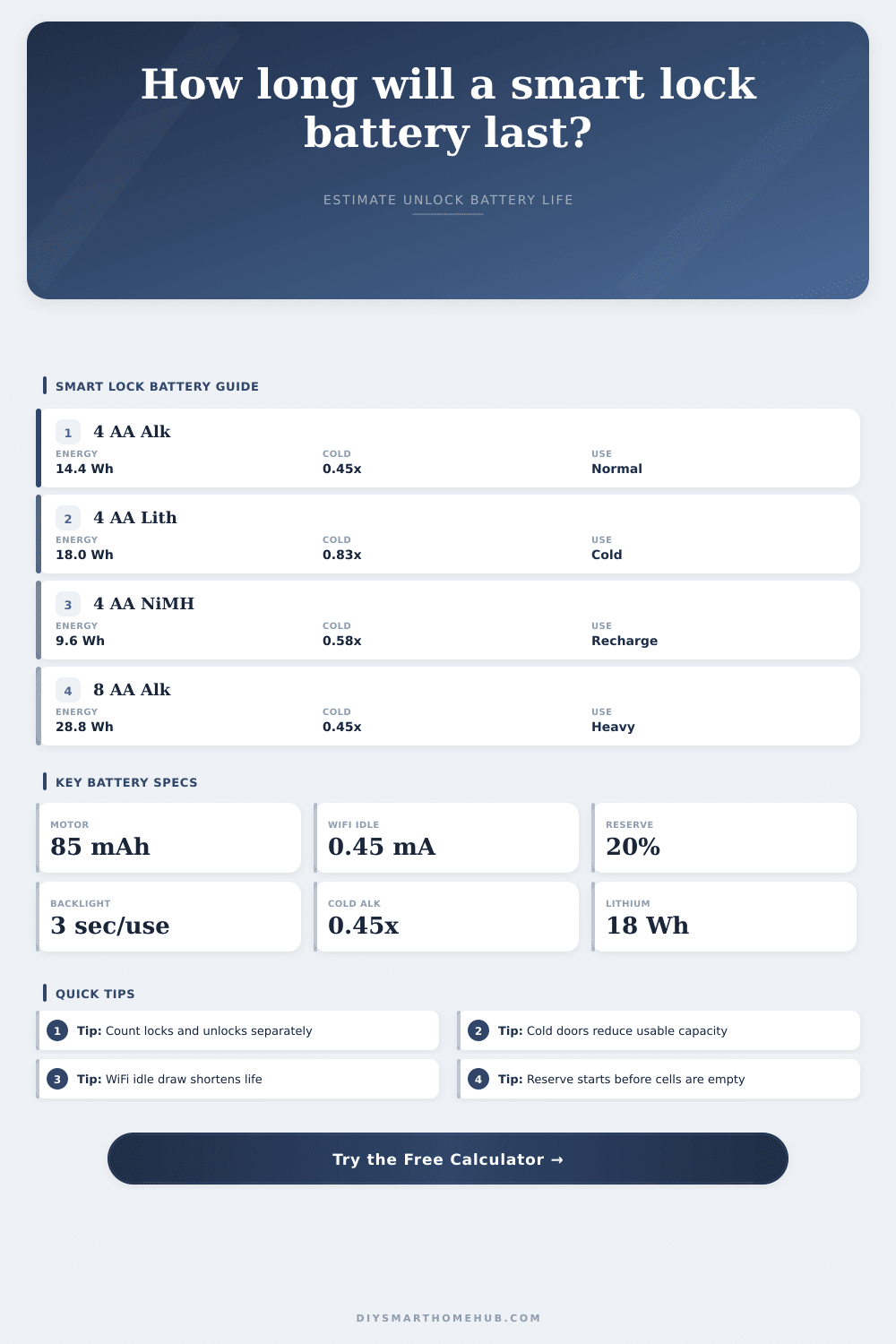
| 4 AA alkaline | 6.0 V | 2.4 Ah | 14.4 Wh |
| 4 AA lithium | 6.0 V | 3.0 Ah | 18.0 Wh |
| 4 AA NiMH rechargeable | 4.8 V | 2.0 Ah | 9.6 Wh |
| 2 CR123A lithium | 6.0 V | 1.55 Ah | 9.3 Wh |
| Rechargeable lithium pack | 7.4 V | 2.0 Ah | 14.8 Wh |
| 8 AA alkaline pack | 6.0 V | 4.8 Ah | 28.8 Wh |
| Wireless profile | Sleep current | Wake burst | Typical effect |
|---|---|---|---|
| Bluetooth LE | 0.012 mA | 8 mA for 2 sec | Lowest radio drain |
| Z-Wave | 0.025 mA | 18 mA for 4 sec | Secure wake overhead |
| Zigbee | 0.020 mA | 15 mA for 4 sec | Mesh wake overhead |
| Matter over Thread | 0.018 mA | 14 mA for 4 sec | Sleepy device profile |
| WiFi | 0.45 mA | 80 mA for 6 sec | Higher baseline draw |
| Door exposure | Alkaline | Lithium | NiMH |
|---|---|---|---|
| Indoor 68°F to 77°F | 1.00x | 1.00x | 0.95x |
| Cool 41°F to 59°F | 0.82x | 0.96x | 0.78x |
| Cold 14°F to 32°F | 0.62x | 0.91x | 0.68x |
| Freezing below 14°F | 0.45x | 0.83x | 0.58x |
| Hot entry over 95°F | 0.88x | 0.92x | 0.82x |
| Use pattern | Unlocks | Locks | Motor load |
|---|---|---|---|
| Side door or office | 2/day | 2/day | 55-70 mAh |
| Two adult front entry | 6/day | 6/day | 70-90 mAh |
| Family entry | 12/day | 12/day | 80-110 mAh |
| Keypad rental | 22/day | 22/day | 95-130 mAh |
| Dragging deadbolt | 10/day | 10/day | 130-180 mAh |
A few months ago you added a smart lock and expect it will just work forever, requiring no thought whatsoever. Then one day your phone won’t unlock front door because the deadbolt is dark. That happens often enough. Typically it’s because company says something like “Up to 6 months” as their stated battery life, which is a best-case scenario in an ideal world… But if you live in a busy house with a drafty entry, or if you have a brutal winter, well, there’s not much you can do about that.
What does drain the batteries? Turn a nasty surprise into a manageable maintenance plan. Amp-hours don’t necessarily represent same value; most of us take them at face value (as in: “They have higher amp hours, therefore they’re better”). But as with all batteries, chemistry really counts. Rechargeable batteries is different from lithium batteries, and lithium batteries are different than alkaline batteries (especially in low temperatures). On paper, a regular pack of alkalines may appear tough enough, but inside they has high internal resistance that multiplies in cooler temps, significantly reducing their effective capacity. Lithium AAs keeps their voltage constant down to freezing temps, making it worthwhile to pay up for exterior door use.
How to Make Your Smart Lock Batteries Last Longer
Once you’ve chosen chemistry, the calculator does the rest, it uses your battery type to strip away guesswork and give you a realistic estimate. The largest draw on energy isn’t necessarily any chemistry but rather the actual process of locking and unlocking. When you engage your motor to unlock, there’s a big spike in current. Eight times a day seem reasonable enough. But double that really fast if you’re a family with kids running out the door for school or you’ve got company coming and going.
A major difference here is whether you are using a manual thumbturn vs. A motor driven cycle. Manually turning the lock from inside save energy. Engaging the motor each and every time consumes double amount of power. A little thing like this make a huge difference over time and contributes to how long it lasts.
Most people don’t even consider wireless protocols as another factor, but they is one. WiFi remains in a more awake state constantly connected to your router, while Bluetooth LE only wakes when your phone gets near. The trickle power consumption doesn’t seem like much on a second-by-second basis, but over the course of months and weeks it totals up to a significant part of your overall drain. Direct-to-WiFi locks frequently fall prey to this constant background tax, which is why hub-based locks tend to last longer.
Another key variable is temperature, which affects battery life. A cold battery is sluggish and holds less charge compared to the same battery at a warmer temperature. The batteries in your home will perform worse even before you use them if your front door points to the north. They will also perform worse if your door is not well insulated. They’ll also fare worse then the same batteries located in some warm room indoors. By accounting for these derating factors, the tool gives you a realistic estimate of how long the battery should of lasted. Instead of giving you an over-optimistic estimate of a “best case,” it forces you to face the reality: That same battery that lasted six months during July may last just two months during January.
Also keep in mind the reserve threshold: Locks are programmed to warn you when a certain percentage of energy remains to prevent a total lockout. The reserve, or the remaining unused capacity, is basically a waste in terms of long life. You’re not using up all the capacity of those cells even though you’re trying to use as much as possible. Without that reserve, however, you could find yourself locked out of your own house and reliability wins over squeezing every last milliwatt out of each cell.
This is laid out nicely in the reference table found on the page, which shows the total watt-hours of each pack so you can get an idea of how they compare when made equal. When you look at them this way it becomes clear that just because a pack has higher capacity in Watt Hours doesn’t mean it’s bigger, and it doesn’t necessarily work well with the load (chemistry or voltage).
At the end of the day, battery life is less about how many days they last and more about planning for them and being aware of your usage patterns. You don’t want to treat your smart lock like a regular door and think it’ll last forever. But if you’re mindful of the chemistry and start tracking the number of cycles you can push that battery quite a bit longer. Just pay attention to the small details to keep everything running smoothly.