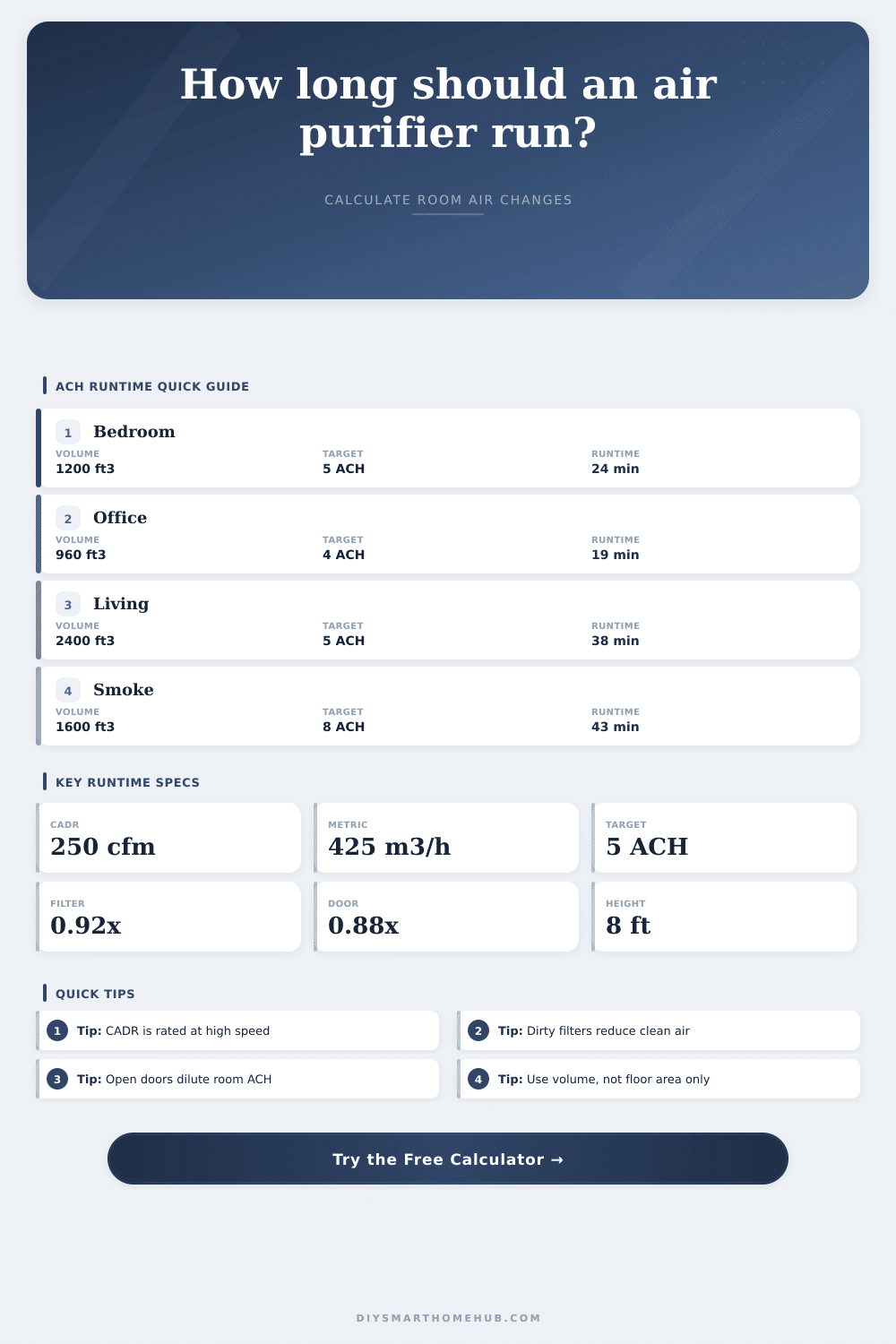
Air Purifier Runtime by Room Air Changes Calculator
Estimate how long an air purifier needs to run to reach a target room air change level using room volume, CADR, speed setting, filter loading, door openness, and purifier count.
Detailed air-change breakdown
| Use case | Typical ACH target | Runtime meaning | Best input choice |
|---|---|---|---|
| Everyday dust reduction | 2 to 3 ACH | Moderate recirculation for normal rooms | Normal room air, door cracked or closed |
| Sleep and allergy control | 4 to 5 ACH | More frequent filtration across the sleeping zone | Closed door, medium or high speed |
| Home office focus room | 4 to 6 ACH | Steady filtration during long occupancy | Clear placement, normal filter |
| Cooking odor reset | 6 to 8 ACH | Faster cleanup after a short particle event | Cooking multiplier, high speed |
| Smoke intrusion response | 8 to 12 ACH | Aggressive recirculation when outdoor particles enter | Smoke multiplier, closed door |
| Rated CADR | Metric CADR | 5 ACH room at 8 ft | 8 ACH room at 8 ft |
|---|---|---|---|
| 100 cfm | 170 m³/h | 150 sq ft room | 94 sq ft room |
| 150 cfm | 255 m³/h | 225 sq ft room | 141 sq ft room |
| 250 cfm | 425 m³/h | 375 sq ft room | 234 sq ft room |
| 350 cfm | 595 m³/h | 525 sq ft room | 328 sq ft room |
| 500 cfm | 850 m³/h | 750 sq ft room | 469 sq ft room |
| Adjustment | High value | Low value | Why it changes runtime |
|---|---|---|---|
| Fan speed | High: 1.00x | Sleep: 0.35x | Most published CADR ratings are taken near full speed. |
| Filter loading | New: 1.00x | Overdue: 0.62x | Dust-loaded media raises resistance and lowers airflow. |
| Door openness | Closed: 1.00x | Open plan: 0.55x | Clean air spills into connected spaces instead of one room. |
| Placement | Clear: 1.00x | Blocked: 0.72x | Restricted intake or outlet flow reduces actual mixing. |
| Scenario | Room volume | Effective CADR | Runtime to target |
|---|---|---|---|
| 12 x 12 bedroom, 5 ACH | 1,152 ft³ | 180 cfm | 32 minutes |
| 10 x 12 nursery, 4 ACH | 960 ft³ | 65 cfm | 59 minutes |
| 15 x 18 office, 5 ACH | 2,160 ft³ | 240 cfm | 45 minutes |
| 20 x 25 living room, 5 ACH | 4,000 ft³ | 300 cfm | 67 minutes |
| 16 x 16 smoke room, 8 ACH | 2,048 ft³ | 310 cfm | 53 minutes |
CADR vs airflow
CADR represents cleaned airflow, not just fan airflow. A high fan setting with weak filtration can move air without delivering the same clean-air volume.
Room volume matters
Two rooms with the same floor area can need different runtimes when ceiling height changes. Tall ceilings increase cubic volume directly.
Runtime is cumulative
The result estimates the run time needed to deliver the selected air-change volume. Continuous operation may still be useful while particle sources remain active.
Most likely, you purchased a fancy-pants purifier. Perhaps it has an impressively high clean air delivery rate. But after running for an hour in your bedroom, you’re still enveloped by a weighty feeling of… It is something. Chances are, this isn’t because your machine is malfunctioning. No, this have to do with the gap between what manufacturers say their machines will deliver and how well they work in your home.
For most consumers, the clean air delivery rate is a set-in-stone figure. It isn’t. Depending on certain factors within your environment, it vary. Once you know the size of your room, use the calculator above to calculate how much airflow you need. This way you can avoid guessing at how much clean air are still in your zone.
Why Your Air Purifier Is Not Working Well
Instead of thinking about it in terms of floor space, you have to think about it in terms of volume. A bedroom that measure twelve by twelve but only has an eight foot ceiling contains around one thousand one hundred fifty cubic feet of air. If a living room has the same amount of floor space, but the ceiling is vaulted, then its volume will be significantly greaterer. More air needs to move through. Which take more effort. Buyers often forget about this. They make their unit selection based off square footage. They should of made their selections based on cubic feet.
Another consideration is speed. High speed are used by manufacturers to create big headlines. When you’re asleep, you don’t run your purifier at full speed. There’s a huge difference between max speed versus sleep modes. Many models operate in whisper mode at roughly thirty-five percent of their rated air flow. On high, some unit change the air five times an hour. On low, they might only do so two times. The calculator takes that into account. So when you input what you’re using, it reflect the actual run time. How can you make a strategy for air quality based off a setting you’ll never run?
Performance also varies with placement, and not always as you’d expect. For example, it’s tidy to hide a unit in the back of a corner behind the sofa, but poor performance result. Clean air requires an air path. Outlets blocked by furnitures or walls prevent the circulation of clean air. It just collects there. The tool punishes for lack of space. And this is because mixing decreases when flow are restricted. The more air the fan can absorbs, the better the performance. How good it mixes in the space matter too.
Resistance equals filters. Air flows freely. Air flows through a new filter. Dusty, hair-laden filters impede airflow. Resistance reduce fan speed. It reduces the delivery rate. The more clogged your filters get, the longer the runtime estimate. Clearing your livig room last spring took 30 minutes, but now it take 45 minutes. Keep tabs on filter health. Keep performance up.
And don’t forget about room boundaries. Your bedroom is connected to the rest of the house through an open door. Unfiltered air flows in; clean air flows out. Now you’re not purifying a single room: you’re purifying the whole house, slowly, inefficiently. Keep that door closed and concentrate your air changes where they’re needed.
Comfort typicaly requires four to five air changes an hour. Eight or higher may be needed against heavy cooking smells or smoke. It shows how long it takes to reach those levels in real-world conditions. That gets rid of marketing hype, it reveals what actualy happens.
You can purchase a strong unit. But without adjusting for location, speed, and volume, you’re paying for partially clean air. Run the numbers. Adjust the fan.