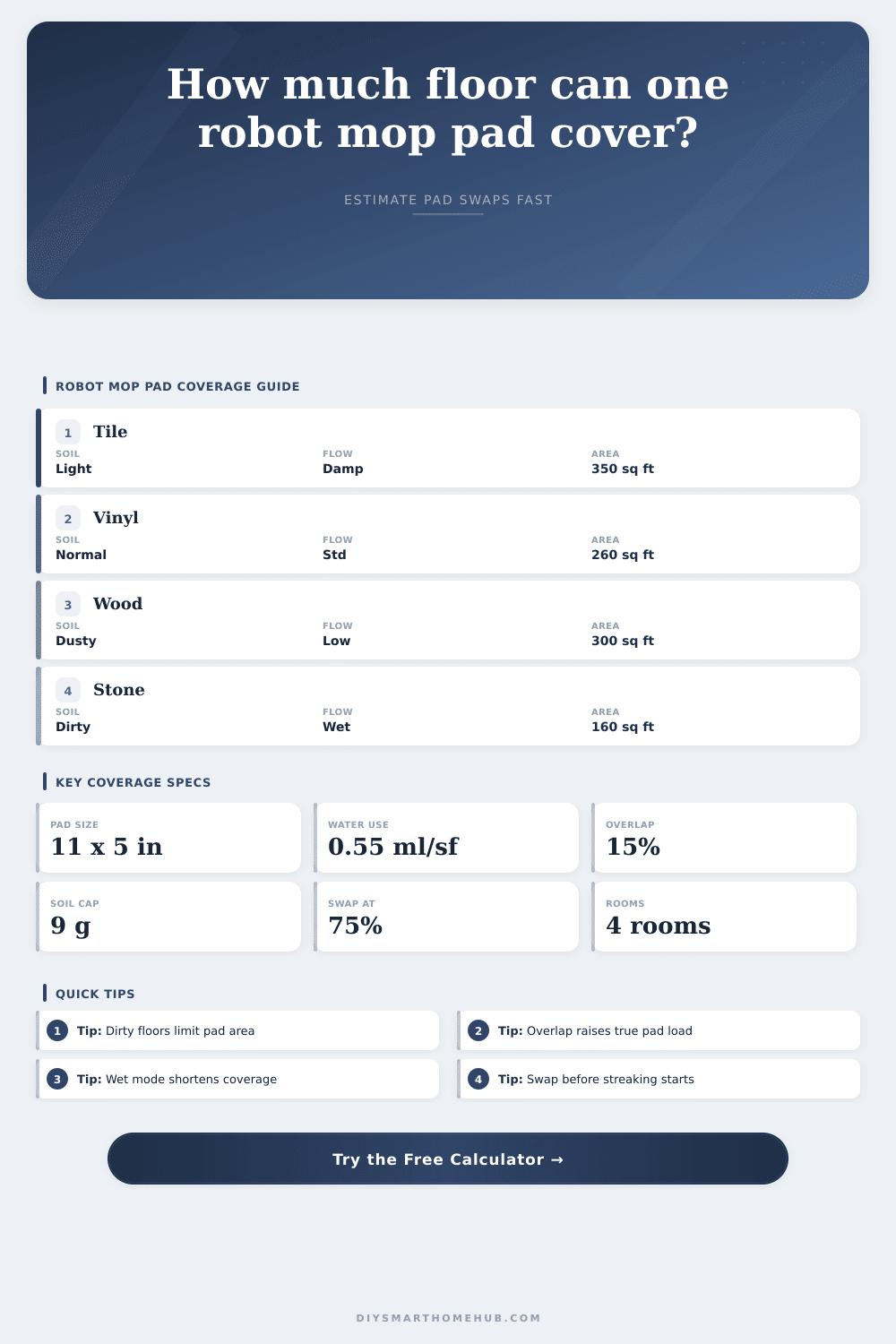
Robot Mop Pad Coverage Area Calculator
Estimate how many square feet a robot mop pad can cover before it becomes water-limited, soil-loaded, streak-prone, or ready for a swap across multiple rooms and cycles.
Detailed pad coverage breakdown
| Cleaning condition | Water film target | Soil loading used | Expected pad behavior |
|---|---|---|---|
| Light damp dusting | 0.30 to 0.40 ml per sq ft | 0.010 to 0.018 g per sq ft | Usually water-limited only near the end of a long run |
| Normal weekly cleaning | 0.45 to 0.60 ml per sq ft | 0.022 to 0.035 g per sq ft | Balanced water and microfiber loading are both relevant |
| Wet kitchen pass | 0.75 to 0.95 ml per sq ft | 0.045 to 0.070 g per sq ft | Coverage drops because both moisture and residue rise |
| Dirty entry or pet tracks | 0.65 to 1.10 ml per sq ft | 0.060 to 0.095 g per sq ft | Soil loading commonly becomes the first pad limit |
| Pad type | Water holding estimate | Soil loading estimate | Best use case |
|---|---|---|---|
| Standard flat microfiber | About 80 ml | About 9 g before streak risk | Routine sealed hard floors with balanced water flow |
| Dense reusable microfiber | About 95 ml | About 12 g before streak risk | Larger zones and weekly cleaning with normal residue |
| Chenille or high-pile pad | About 110 ml | About 13 g before streak risk | Dusty smooth floors where fiber depth helps pickup |
| Textured scrub microfiber | About 85 ml | About 10 g before streak risk | Sticky spots, kitchens, matte tile, and grout texture |
| Dual spinning round pads | About 120 ml total | About 14 g before streak risk | Active mopping paths with wider moving contact patches |
| Disposable damp pad | About 45 ml | About 5 g before streak risk | Small clean rooms where convenience matters most |
| Thin vibrating mop pad | About 65 ml | About 7 g before streak risk | Light maintenance passes with controlled water delivery |
| Project area | Mapped area | Normal weekly pads | Dirty wet-pass pads |
|---|---|---|---|
| Small kitchen and bath | 120 to 180 sq ft | 1 pad | 1 to 2 pads |
| Apartment hard floors | 350 to 600 sq ft | 2 to 3 pads | 3 to 5 pads |
| Open plan first floor | 600 to 900 sq ft | 3 to 4 pads | 5 to 7 pads |
| Large home hard floors | 1,000 to 1,600 sq ft | 4 to 7 pads | 7 to 12 pads |
| Two-cycle deep clean | Same area twice | Double the pad load | Swap early between cycles |
| Setting | Water use in formula | Overlap effect | Coverage note |
|---|---|---|---|
| Low damp maintenance | 0.35 ml per sq ft | 10% overlap equals 1.11x pad load | Best for sealed wood and daily dust pickup |
| Standard balanced flow | 0.55 ml per sq ft | 15% overlap equals 1.18x pad load | Good default for weekly tile, vinyl, or laminate |
| High wet pass | 0.82 ml per sq ft | 20% overlap equals 1.25x pad load | Useful for visible soil but shortens pad range |
| Scrub or stain mode | 1.05 ml per sq ft | 25% overlap equals 1.33x pad load | Assume early swaps on sticky floors or textured grout |
Saturated coverage
The water side estimates how much floor can be dampened before the pad stops carrying a useful wet film, adjusted for flow setting, floor absorption, and tank assistance.
Microfiber loading
The soil side estimates how much residue the pad can hold before it redistributes grime. Dirty, sticky, or gritty floors usually make this the controlling limit.
Contact patch
Pad width, contact depth, compression, and pad texture affect pickup efficiency. Larger pads help, but overlap and room edges still add hidden pad load.
A robo-vac whirs around your kitchen’s floors. You watch it go. You let it go about its business. And then you see it up close. A streak remains on the tiles. The nooks and crannies gets ignored. Or the bot heads home with a soiled mop, and spreads the morning’s spill back onto the afternoon’s clean zone. You didn’t purchase this thing to save time only to end up as foreman to miniature, plodding janitorial staff.
Most robots aren’t the issue. The issue is typicaly that you don’t understand the volume of space a single mopping cloth will cover until it’s done for the day. A microfiber pad is a sponge. You know what sponges have? There are two limitations, and one is water. Another is dirt.
Why Your Robot Vacuum Pads Get Dirty So Fast
Everyone thinks about the size of the water tank. Thinking that you need a big water tank to ensure your robot can sprays and clean is wrong. Yes, there’s a limit to how much moisture can be stored in the pad. But there’s another limitation; the pad has only so much capacity for collecting soiled material. When the fiber becomes saturated with pet hair, grease, or dust, it no longer picks up more. Instead, it moves existing dirt around.
The calculator above will do this math for you. But knowing why helps you not to buy three extra pads per month.
The floor actualy makes a difference too. A smooth sealed wood floor may allow me to clean thirty square feet before the pad needs changing. Deep grout lines and textured stone grab all they can get. This means there is more mechanical drag between the pad and floor. So it gets loaded up sooner. And if there is sticky kitchen goo on there the soil cap will reach its limit in no time.
So what does it do? The tool adjusts its effective area depending on what floor you select. It is not magic; it just admits that an active fighting floor does not allow as much cleaning than something that lets go easily.
Another trap is water flow settings. Thorough means high wet mode, it leaves a shiny film. That’s why they get saturated so quickly. Damp may cover twice as much as wet. It works for a longer time. It sacrifices intensity to prolong duration. Most homes don’t want a deep scrub daily. They want consistent maintenance. Using the correct balance doesn’t have the robot changing out the pad every twenty mins.
Overlap is the silent killer of efficiency. You won’t see robots driving perfectly straight lines. They’ll overlap their pass to make sure they covers everything. That additional motion means they’re hitting the same part of the floor two times, this will wear down your pad quicker. On that page is a reference table. That explains how you lose range with even a fifteen percent overlap. Seems small? But across the entire house it equals an additional pad swap.
Know that it’s okay to expect the worst case scenario in your toughest room. The ones that typically limit you are kitchens and entryways. Maybe the math is telling you that you need four pads total throughout the entire home. But when you look at the numbers, two are going on kitchen all by themselves. Adjust accordingly. Don’t attempt to fit a deep clean into a maintenance run. Keep the tasks separate. Do a quick, damp pass for daily dusting. Reserve the big water flow for the once-a-week deep clean. A robot doesn’t have to do everything at once to be the best setup for your home.
The best robot setup is the one that knows when to stop. Running until depleted will result in a messier floor than stopping before the pad gets completely saturated. Listen to its limits. Swap it out earlier. Get the floors looking like new, without any of the manual labor you would of wanted to avoid in the first place.