Litter Refill Interval by Cats Calculator
Estimate how many days before each litter top-up, how much litter to add, how long a bag lasts, and when a full change is likely due based on cats, boxes, depth, litter material, and daily scooped waste.
Detailed litter math
| Litter material | Bulk density | Base removed per cat | Typical refill behavior |
|---|---|---|---|
| Clumping clay | 56 lb/ft³ / 0.90 kg/L | 0.23 lb/day | Predictable depth loss from urine clumps |
| Lightweight clumping clay | 38 lb/ft³ / 0.61 kg/L | 0.19 lb/day | Same depth drops with fewer pounds added |
| Silica crystal | 30 lb/ft³ / 0.48 kg/L | 0.08 lb/day | Less scooped weight but faster saturation limit |
| Pine pellet | 25 lb/ft³ / 0.40 kg/L | 0.16 lb/day | Sawdust removal matters more than clump size |
| Corn or wheat clumping | 34 lb/ft³ / 0.54 kg/L | 0.18 lb/day | Moderate weight with good clump removal |
| Walnut shell clumping | 32 lb/ft³ / 0.51 kg/L | 0.17 lb/day | Low-density refill with darker granules |
| Paper pellet | 20 lb/ft³ / 0.32 kg/L | 0.13 lb/day | Frequent partial replacement keeps wet zones down |
| Tofu clumping litter | 38 lb/ft³ / 0.61 kg/L | 0.20 lb/day | Clumps are light but volume loss is visible |
| Inside box size | Floor area | 3 in clay fill | 3 in silica fill |
|---|---|---|---|
| 18 x 14 in | 1.75 ft² / 0.16 m² | 24.5 lb | 13.1 lb |
| 20 x 15 in | 2.08 ft² / 0.19 m² | 29.2 lb | 15.6 lb |
| 22 x 16 in | 2.44 ft² / 0.23 m² | 34.2 lb | 18.3 lb |
| 24 x 18 in | 3.00 ft² / 0.28 m² | 42.0 lb | 22.5 lb |
| Automatic globe drawer | 1.4 to 1.8 ft² | 20 to 25 lb | 11 to 14 lb |
| Setup | Daily removed litter | 20 lb clumping clay bag | Full change pressure |
|---|---|---|---|
| One average cat, one 20 x 15 box | 0.30 to 0.40 lb/day | About 45 to 65 days | Often 28 to 42 days |
| Two cats, two 20 x 15 boxes | 0.60 to 0.85 lb/day | About 24 to 34 days | Often 21 to 35 days |
| Three cats, three jumbo boxes | 0.95 to 1.35 lb/day | About 15 to 21 days | Often 14 to 28 days |
| Four cats, high-use room | 1.35 to 1.90 lb/day | About 10 to 15 days | Often 10 to 21 days |
| Planning variable | Raises refill frequency | Lowers refill frequency | Calculator effect |
|---|---|---|---|
| Cat count | More cats share the boxes | Fewer cats or separated boxes | Scales daily waste removal |
| Box floor area | Small trays lose depth faster | Wide trays spread loss out | Converts pounds removed into depth drop |
| Target depth | Low threshold gap | More depth above threshold | Sets days before top-up |
| Litter density | Light materials lose more depth per pound | Dense clay loses less depth per pound | Changes volume from daily weight loss |
| Scoop frequency | More complete daily removal | Delayed scooping hides removal briefly | Adjusts removed waste and change window |
Refill interval
Top-up timing is based on how fast scooped clumps, feces coating, and tracked litter reduce the average depth from the target line to the threshold line.
Bag life
Bag life includes both refill litter and a prorated share of full-change replacement, so it is usually shorter than daily clump weight alone suggests.
Full change
The full-change window combines material saturation, cats per box, box floor area, scooping frequency, and the selected freshness target.
Yeah yeah, I know: keeping up with a litter box is familiar territory. You scoop out what’s there, you clean around the edges, you pretend not to notice the stink wafting down the hall. But when do you refill? When do you change the whole thing? Do you let it get down to nothing? (Or are you one of those who changes it regularly just to be on the safe side?)
Turns out, most of us gets it wrong, mostly because we’re measuring by sight instead of by volume. Specifically, how fast does the depth drop between where the clump stops sticking to the bottom and minimum fill line you set? It’s the gap you’ll see few people noticing. They notice that it smells; not that it’s removing so much.
How to Know When to Refill Cat Litter
Use this handy-dandy calculator tool to calculate how long a bag lasts and when it’s time to top up. It figures out how much litter you have left. It takes into account the actual square footage your boxes occupy and how many cat are using it. It also looks at what kind of litter you’re using, since a bag of lightweight silica crystals isn’t going to weigh as much as a bag of heavy clumping clay.
Finally, it factors in density of that litter. Even though two bags may be the same size, one might last you more by volume then the other. The math converts from depth/weight for you so you don’t need to imagine it yourself.
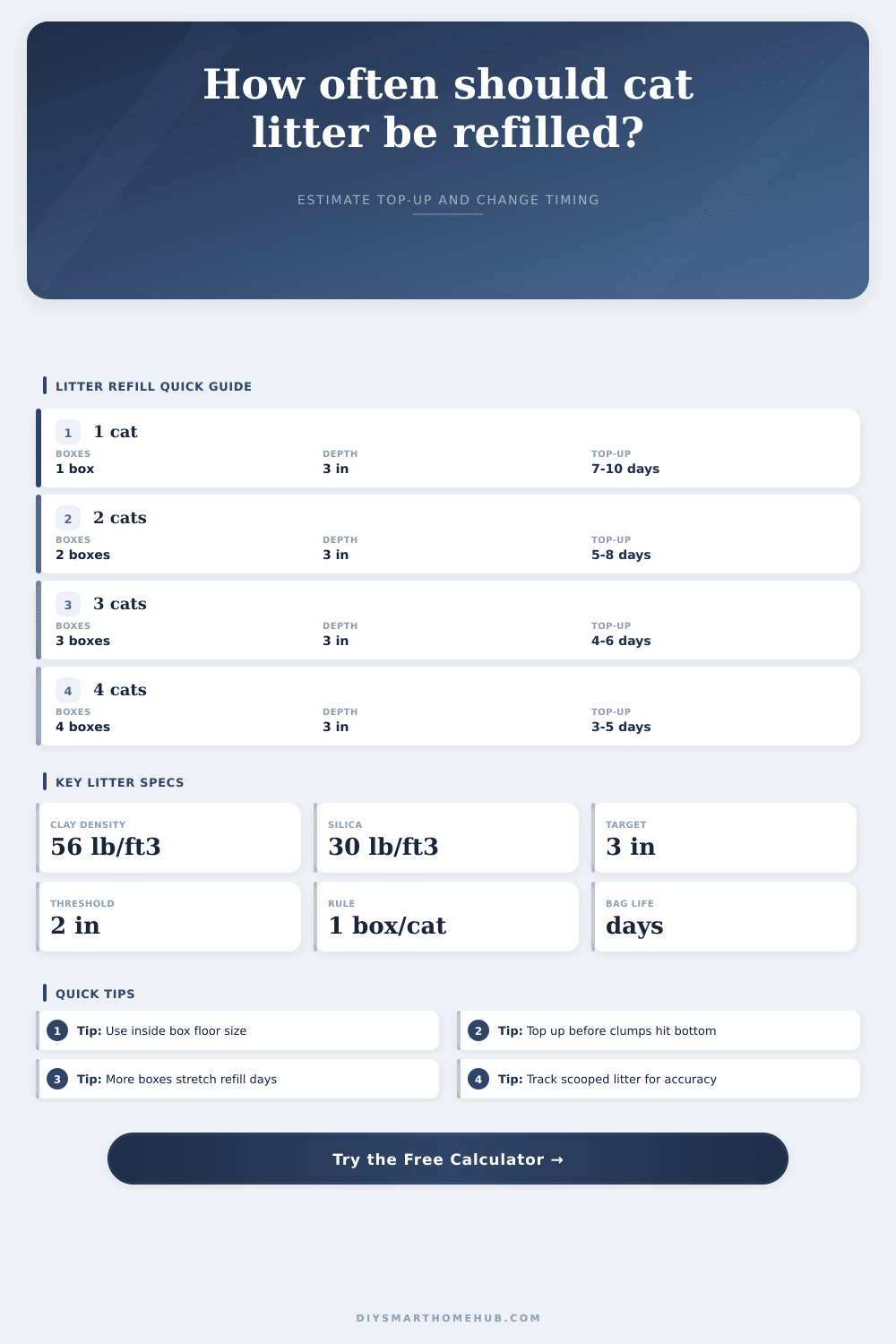
Now think about the density. Most standard clumping cat litter is a clay that weigh in at roughly fifty-six pounds per cubic foot, which isn’t terribly heavy on its own but does pack down rather compactly. Compare that to weight of silica crystals, which weigh closer to thirty pounds per cubic foot, a good deal lighter. That means that a given pound of litter made from silica will take up far more space vertically in the box compared to a pound of clumping clay.
In fact, if you don’t adjust for the density (i.e., how much it weighs), you’ll see that your silica boxes will appear shallow in just a few days despite the bag being half full. The calculator accounts for this by considering your daily amount of waste removed and adjusting bulk density to match.
Finally, consider tracking. When a cat leaves a litter box, she’ll kick some granules onto the floor. And not just because it’s messy, but also because there is so much of it! Long haired cats and kittens are high-trackers. If you live in a house that sheds a lot of litter onto the floor and into the trash bag, you will lose more litter than your refill schedule shows unless you take tracking into account. The input numbers for tracking levels let you account for this hidden loss.
Otherwise, you may wonder why your refill interval seems mysteriously short. Turns out it’s not just your scooping time draining your supply; it’s that floor mat, which is usually the silent consumer.
The other measure (which sounds like it ought to be more straightforward but isn’t) is bag life. “I’ll get 20 pounds’ worth in there.” Not so fast. How long does one bag last? That’s going to vary by how frequently you replace the whole bed and how many cats uses the litter boxes.
The more cats you have, the faster they fill up, right? No: if you’ve got three boxes with three cats who all pee separately, each box will take longer to reach the refill line. This is because you’re spreading the waste over a bigger total surface area. But sum of the waste removed from your house every day adds up fast.
The chart on the page explains it all clearly: increasing the number of boxes can extend your refill days while also increasing the volume of waste that comes from your whole house. Simply put, your goal is to maintain at least two inches of litter, or as much as possible without falling below that target.
When the level falls below two inches, urine will begin soaking through and saturating underlying plastic, forming a perpetual stink reservoir that even new litter won’t cover. So by monitoring how long each refill lasts, you maintain the litter layer within its sweet spot.
It’s no longer a question of whether the box requires action. It’s now known when. It is all about simple consistency. You know how long you’re going to spend on maintenance, you know what your budget is, and you know your cats are livig comfortabley.