Fish Tank Stocking Level Calculator
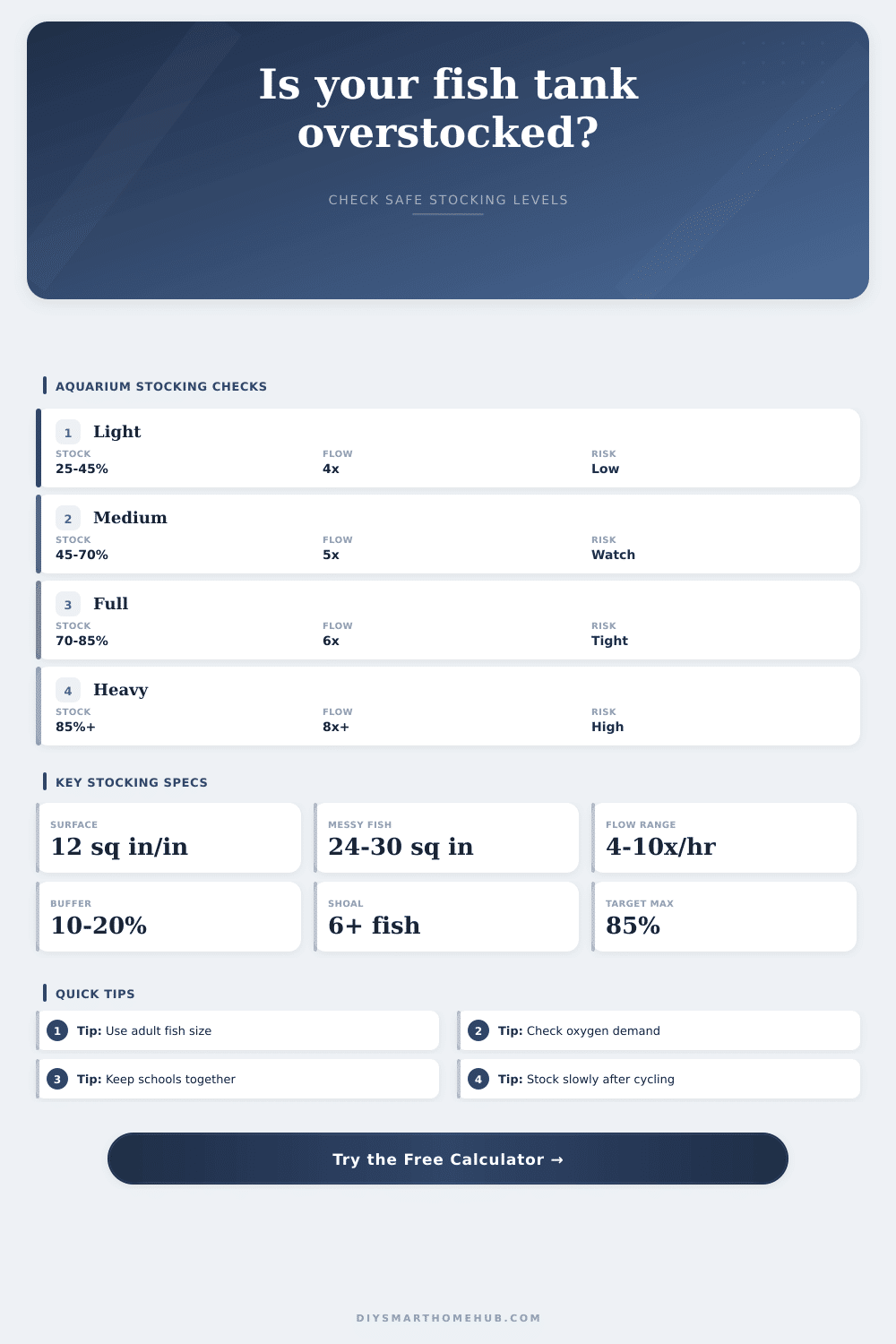
Check planned fish count against aquarium volume, open water surface, filter turnover, adult size, bioload, oxygen sensitivity, temperature, schooling allowance, and a safety buffer.
Detailed stocking breakdown
| Profile | Bioload factor | Surface rule | Typical use |
|---|---|---|---|
| Tiny schooling fish | 0.75x per inch | 12 sq in per inch | Neon tetras, chili rasboras, ember tetras |
| Community fish | 1.00x per inch | 12 sq in per inch | Small barbs, rasboras, peaceful mixed tanks |
| Livebearer group | 1.15x per inch | 13 sq in per inch | Guppies, platies, mollies with steady feeding |
| Bottom dwellers | 1.35x per inch | 14 sq in per inch | Corydoras, loaches, small catfish groups |
| Deep-bodied fish | 1.80x per inch | 16 sq in per inch | Angelfish, discus, deep-bodied gourami |
| Cichlid or territorial fish | 2.10x per inch | 18 sq in per inch | Dwarf to medium cichlids needing territory |
| Goldfish | 3.20x per inch | 30 sq in per inch | Fancy or single-tail goldfish stocking checks |
| Messy predator or pleco | 3.00x per inch | 24 sq in per inch | Oscars, large plecos, heavy-fed predators |
| Stocking situation | Turnover target | Filter-limited warning | Calculation role |
|---|---|---|---|
| Light planted community | 4x tank volume per hour | Below 3x is weak | Allows full light-load capacity |
| Average community tank | 5x tank volume per hour | Below 4x can limit stocking | Balances debris and biofilter flow |
| Deep-bodied or bottom-heavy tank | 6x tank volume per hour | Below 5x is tight | Reduces capacity when flow lags |
| Goldfish, plecos, predators | 8x to 10x per hour | Below 6x is high risk | Often becomes the limiting factor |
| Water condition | Capacity factor | Buffer used | Reason |
|---|---|---|---|
| Cool 68°F tank | 1.06x | 20% | Cool water holds more oxygen, but cold species often produce more waste |
| Tropical 76°F tank | 1.00x | 15% | Baseline for common community fish planning |
| Warm 80°F tank | 0.94x | 20% | Less dissolved oxygen margin for active fish |
| Very warm 84°F tank | 0.88x | 25% | Higher metabolism and lower oxygen capacity |
| Quarantine or grow-out | 0.96x | 30% | Extra safety for stress, medication, and feeding swings |
| Tank size | Typical surface | Light community range | Messy fish note |
|---|---|---|---|
| 10 gallon standard | 200 sq in | 8 to 12 small adult inches | Too small for goldfish or large plecos |
| 20 gallon long | 360 sq in | 16 to 24 small adult inches | Better gas exchange than a tall 20 |
| 29 gallon standard | 360 sq in | 20 to 28 small adult inches | Surface area limits before volume for active fish |
| 40 breeder | 648 sq in | 32 to 45 small adult inches | Wide footprint helps oxygen and territories |
| 75 gallon standard | 864 sq in | 55 to 70 small adult inches | Messy fish still need strong turnover |
| 125 gallon standard | 1296 sq in | 85 to 105 small adult inches | Large predators are limited by mass, not length |
Volume limit
Usable gallons or liters set the baseline waste dilution. The calculator converts adult fish length into bioload-adjusted inches so bulky fish use more capacity.
Surface limit
Open water surface controls gas exchange. Wide tanks can safely support more oxygen demand than tall tanks with the same volume.
Filter limit
Rated filter flow is converted to tank turnovers per hour and compared with the target for the selected fish profile.
How Many Fish Can I Put In My Tank? If this is your first experience with fishkeeping then there’s probably one simple question you’re asking, how many fish can go into my tank? Perhaps your mental picture of the tank is like a box or bucket with no other restrictions except for how full you can fill it.
That is a very bad mental image since an aquarium are not just some container and its volume isn’t the sole restriction on what keeps it going. The physical rules governing it is ignored if you only consider volume. The number of fish you get out of a tank depend on more than just the volume of water in it.
Why You Cannot Fill Your Tank With Fish
The calculator above do all the arithmetic for you when you input your tank size and fish profiles, so you don’t have to guess at the conversions and factors. Knowing why the numbers makes sense will help you avoid trouble.
Volume does not equal surface area. Oxygen is exchanged where air meets the water, so a shallow wide tank can support more oxygen demand than a tall narrow tank of the same size. For example, you could have a huge, two-hundred gallon tank…a pipe basically…but if the tank’s surface area is insufficient, then that two-hundred gallons won’t be able to breathe fast enough to sustain a school of tetras.
Tall tanks are cool looking, but they don’t increase the breathing space. The tool includes this which caps your stocking levels according to the amount of open surface area in the tank (i.e., you cannot exceed the tank’s physical ability to handle biology).
Waste production relative to mass (the second law). Not all fish are cubes of equal mass. For example, a one-inch neon tetra generate far less waste than a one-inch goldfish of the same length. Goldfish are messier animals and create a lot of waste. They need much higher levels of water moving through filter to maintain ammonia control.
There’s a reason why the reference table on the page give bioload factors for various species, it isn’t based off visual footprint but on the real-world metabolic impact. If you fail to account for this, nitrogen builds up slowly and kills stressed fish long before any obvious water quality problems appear.
The third lever is temperature. When your heater turns on, the warmer water hold less dissolved oxygen than cool water, so your tank effectively shrinks in size. This doesn’t mean your fish are larger (they aren’t), but that they have fewer margins for error.
A cooler system has more margin for error, whereas a high eighties degree F tropical setup have a tighter set of chemistry that is compensated by the safety buffer contained within calculation. By lowering the number of allowable fish, you’re protecting yourself against the worst-case scenario (the hottest day of the year). And ensuring stability under these conditions. It is a small change but it is important when you are edging close to your mature filter’s capacity.
Why? Many people mistakenly equate filter turnover with cleaning. However, it’s not a measure of cleanliness, but a flow rate demand. If your filter is rated for four times the tank volume but you stock it for ten times, you are relying on biological luck rather than mechanical capacity. So if you plan to stock at ten times the tank volume, but have a filter rated for four times that volume, you’re hoping for biological luck; not mechanical capacity.
The tool flags you when the combination of your fish profile and your stocking plans exceeds the hardware’s ability to handle it. That means no more purchasing a filter solely by the tank size and then wondering why you can’t keep anything alive in there!
There’s one last variable, schooling behavior… That doesn’t lend itself to an easy math equation. Fish aren’t just single animals; they’re social and comfortabley in numbers. However, as their numbers increase so does their overall burden. By reserving room for what is minimally necessary (and factoring in the additional stress of having 3 fish instead of 6), it acknowledges that having ten may be too many for your tank physically.
And you must strike a balance between environmental limitations and social requirements. That’s where the tool comes into play and could of find that small window within which both factors apply.
Setting up a tank is a test of self-control. It’s looking beyond the space and recognizing the unseen limits of flow, waste, and oxygen. If you treat it like an ecosystem instead of a showcase, you will create a system that survives and flourishes.
You have your boundary conditions provided by the math. Your patience with those limitations is what keeps you inside.
Begin small, honor the surface area, and allow the biology to stabilize. That’s how you make a box of water come alive.