Grow Tent Air Exchange Rate Calculator
Estimate tent volume, target air changes, exhaust airflow, fan rating after carbon filter and duct losses, heat BTU/hr, and the CFM needed to hold a chosen temperature rise.
Live formula preview
Your grow tent airflow result
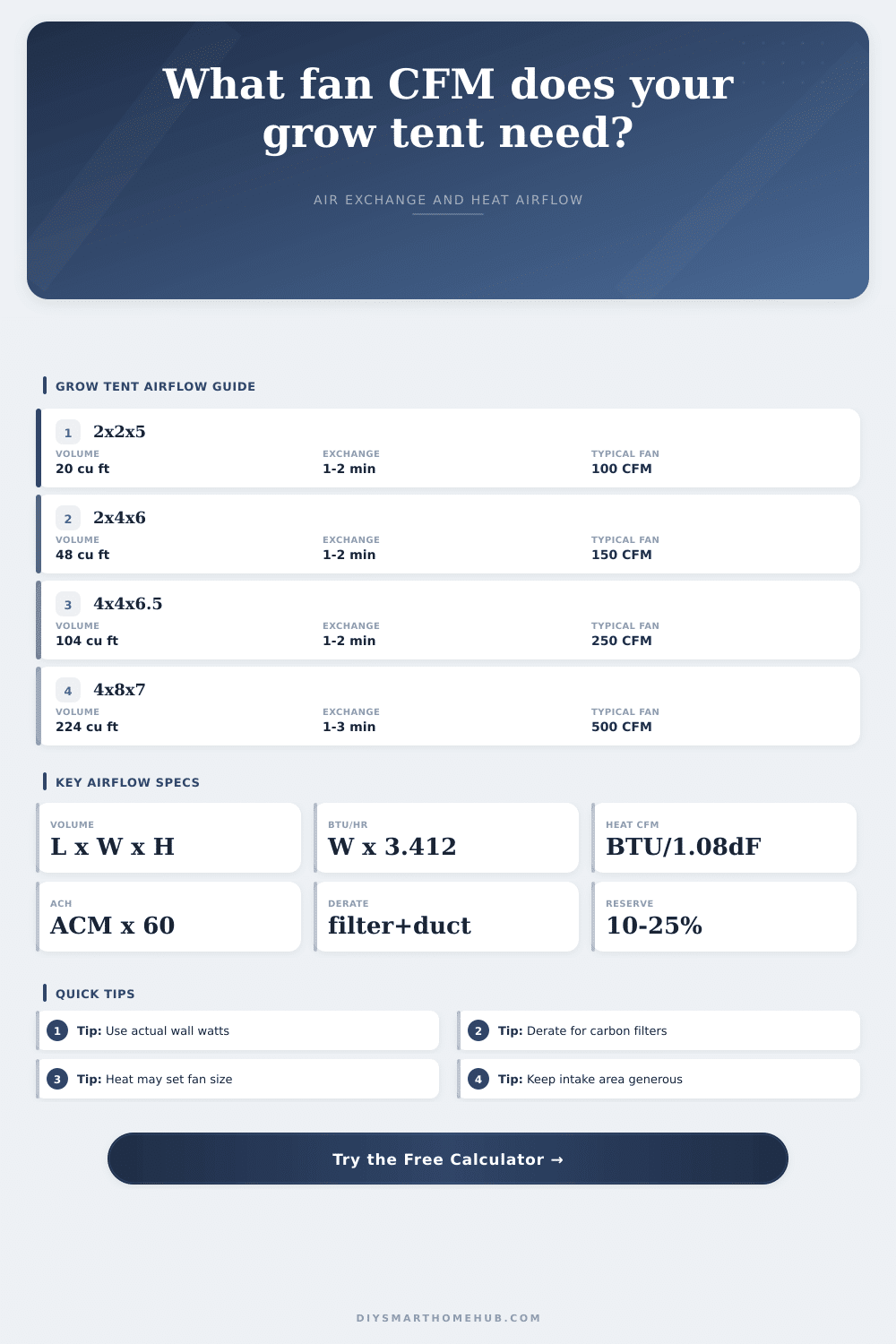
| Tent size | Volume | 1 exchange/min | 2 min exchange |
|---|---|---|---|
| 2 ft x 2 ft x 5 ft | 20 cu ft / 0.57 m3 | 20 CFM | 10 CFM |
| 2 ft x 4 ft x 6 ft | 48 cu ft / 1.36 m3 | 48 CFM | 24 CFM |
| 3 ft x 3 ft x 6 ft | 54 cu ft / 1.53 m3 | 54 CFM | 27 CFM |
| 4 ft x 4 ft x 6.5 ft | 104 cu ft / 2.94 m3 | 104 CFM | 52 CFM |
| 5 ft x 5 ft x 6.5 ft | 163 cu ft / 4.60 m3 | 163 CFM | 81 CFM |
| 4 ft x 8 ft x 7 ft | 224 cu ft / 6.34 m3 | 224 CFM | 112 CFM |
| Restriction item | Calculator estimate | Why it matters | Planning note |
|---|---|---|---|
| Oversized carbon filter | About 12% | More media area lowers static pressure | Best when odor control is needed |
| Standard carbon filter | About 22% | Common inline filter loading | Replace when airflow falls sharply |
| Dense or aging filter | About 32% | Dust and packed carbon add resistance | Use a pre-filter and clean it |
| Each tight 90-degree bend | About 4% | Bends add turbulence and pressure loss | Sweep bends are better than kinks |
| Duct length | 2% to 7% per 10 ft | Smaller duct loses more airflow | Short, straight runs keep CFM |
| Watts in tent | BTU/hr | CFM for 8 F rise | CFM for 5 F rise |
|---|---|---|---|
| 100 W | 341 BTU/hr | 40 CFM | 63 CFM |
| 240 W | 819 BTU/hr | 95 CFM | 152 CFM |
| 480 W | 1,638 BTU/hr | 190 CFM | 303 CFM |
| 720 W | 2,457 BTU/hr | 284 CFM | 455 CFM |
| 1,000 W | 3,412 BTU/hr | 395 CFM | 632 CFM |
What about air exchange? It’s the factor that determines whether your plants will thrive or wither away. You’ll adjust the light spectrum and nutrient pH for hours. Without proper airflow management, however, a grow tent becomes a trap for stale carbon dioxide, humidity and heat.
That calculator explain precisely what size fan to get for your set-up. Knowing why the numbers are important is the difference between a successful grow and failure.
Why Airflow Is Important for Your Plants
Most people think about tent size first. Everyone thinks the golden rule is to replace the air every minute. While this is a good starting place, it fails to account for resistance and physics involved. Air running through flexible ducting and a carbon filter has to overcomes static pressure. Not only does the filter greatly reduce actual output of the fan (well below its rating) but then you have to push that air through tight bends and restrictive media. So while the fan may be rated for 400 CFM, it may only be delivering half that when forced through restrictive media and tight bends.
To avoid buying a fan that appears powerful on paper but sucks in real life, use the tool. Enter the filter density, number of bends, and duct length so the tool can accounts for these factors.
Until temperatures spike at night, this is something most people overlook. More often than not, though, the ultimate fan size are driven less by volume exchange then it is by heat load. For every watt of electricity your lights burn up, that’s heat in the closed environment. And if you’re using a high-output LED array, then that energy need to go somewhere. Unless you move air fast enough to carry it away, it’s going to stay in the tent. That changes the calculation from a simple oxygen-refresh exercise into an active attempt to cool down the environment by controlling temperature rise over normal room conditions. In other words, you may have to exchange all that air every ninety seconds just to prevent the plants from overheating. Even though it might theoretically only take a two-minute cycle to refresh the oxygen.
The calculator accounts for this tradeoff by comparing your targeted exchange rate with required airflow to offset that heat load. It will recommend whichever demand is higher.
A frequent problem with tents is passive intake. If fresh air doesn’t have a way into the space, an exhaust fan won’t be able to push air out well. Sealing up all your ports (to manage odor) creates a vacuum, which stalls the exhaust motor while stressing the tent zippers. Ideally, you’d like double the surface area for intake openings as compared to the exhaust duct. That provides a nice balance between smooth laminar flow vs turbulent drafts. Too much draft will either dry the canopy out too fast (bad!) or damage foliage. A small thing, yes, but it matters so much when you’re aiming for uniform plant development.
Tents for drying and curing work differently. Gentle airflow is better because it helps maintain terpene profiles. This avoids hardened exteriors on your buds with still-wet interiors. Consistency matter more then speed here. In both cases, you’ll find that the tool’s presets accounts for this. With just a tap, you toggle between delicate drying settings and aggressive flower ventilation without having to manually recalculate. It simplifies a complex process into actionable data points.
The point of airflow management isn’t to create hurricane-force winds. It is to create just the right amount. You want enough to refresh CO2 levels and scrub away excess heat without evaporating too much water, which makes controlling relative humidity harder, or causing any “wind burn” on the foliage.
Running those variables… Tent size and configuration, wattage, and ducting… Through the numbers shifts you out of guess-and-check mode into precision mode. This moves you out of theoretical environmental management and into a real piece of equipment, which is a spec for a solution that will ensure your careful fine-tuning actualy yields something.