Mulch Depth Water Retention Calculator
Estimate bed area, mulch depth, cubic volume, evaporation reduction, retained soil moisture, and smart watering interval changes for vegetable beds, landscape zones, tree rings, and containers.
Calculation breakdown
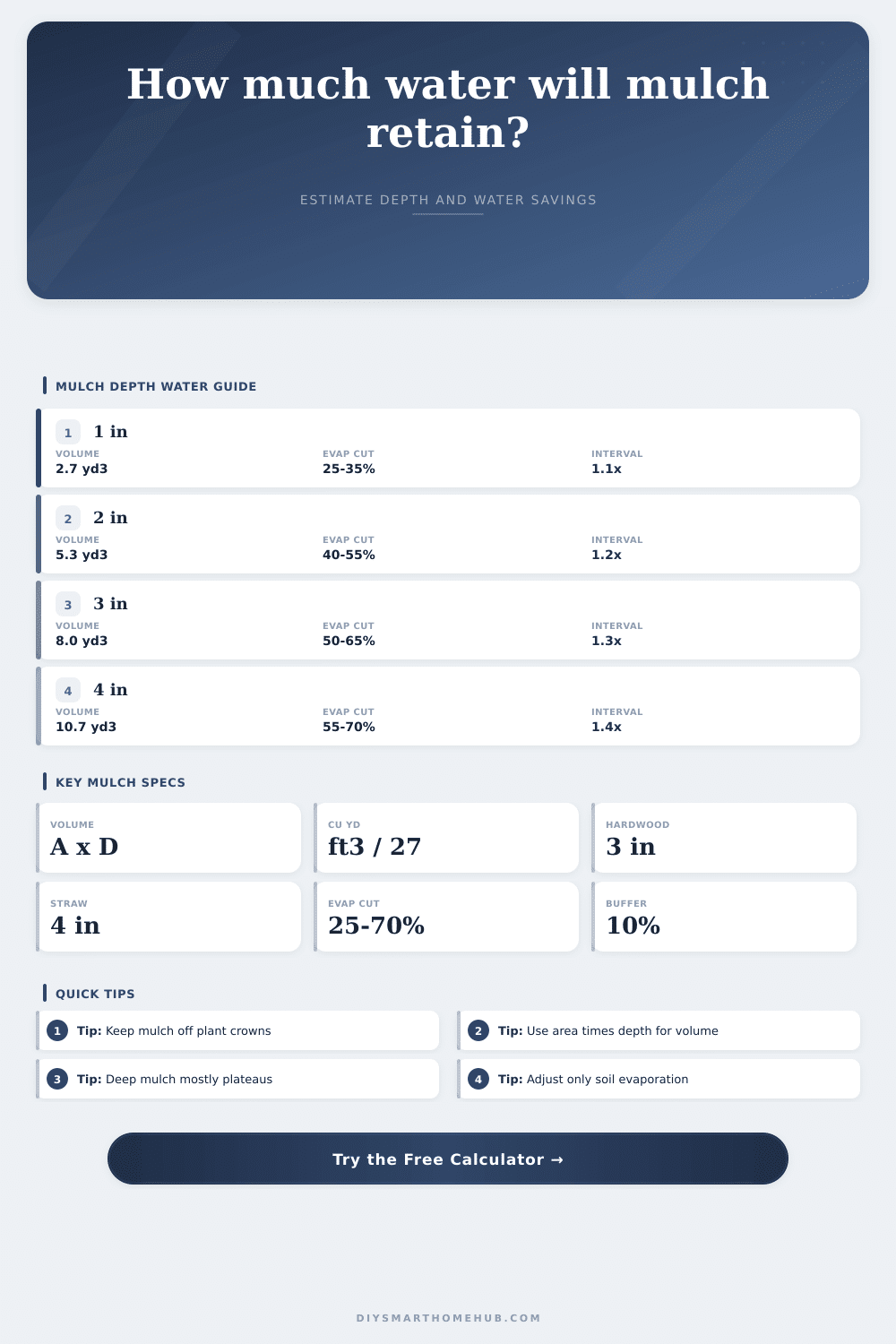
| Finished mulch depth | Volume for 100 sq ft | Water retention role | Practical use |
|---|---|---|---|
| 1 in | 8.3 ft³ / 0.31 yd³ | Light surface shading | Top-up layer where old mulch remains |
| 2 in | 16.7 ft³ / 0.62 yd³ | Moderate evaporation reduction | Small beds, compost, fine bark |
| 3 in | 25.0 ft³ / 0.93 yd³ | Strong water-saving layer | Common vegetable and landscape target |
| 4 in | 33.3 ft³ / 1.23 yd³ | High retention, slower drying | Hot sites, coarse chips, exposed soil |
| 6 in | 50.0 ft³ / 1.85 yd³ | Plateauing evaporation benefit | Coarse restoration chips, tree areas |
| Mulch material | Best depth band | Maximum evaporation cut | Volume behavior |
|---|---|---|---|
| Shredded hardwood bark | 2.5 to 3.5 in | About 64% | Interlocks well, moderate settling |
| Arborist wood chips | 3 to 5 in | About 68% | Coarse, durable, good air exchange |
| Pine bark nuggets | 3 to 4 in | About 58% | Chunky texture with air gaps |
| Clean straw mulch | 3 to 5 in | About 70% | Lightweight, compresses after watering |
| Shredded leaves or leaf mold | 2 to 3 in | About 60% | Fine texture, faster seasonal breakdown |
| Compost top-dress mulch | 1 to 2 in | About 45% | Moist surface, thin-layer material |
| Pine needles | 2 to 4 in | About 55% | Loose mat, good for acid-loving beds |
| Gravel or stone mulch | 1.5 to 3 in | About 40% | No decay, can store heat in sun |
| Soil profile | Available water per ft | Default soil evap share | Interval effect |
|---|---|---|---|
| Sandy soil, fast drying | 0.70 in/ft | 45% | Largest interval gain from surface cover |
| Sandy loam bed | 1.00 in/ft | 40% | Useful gain, still drains quickly |
| Balanced loam bed | 1.20 in/ft | 35% | Steady retention with organic mulch |
| Silt loam, high storage | 1.60 in/ft | 32% | Good storage, slower drying curve |
| Clay loam, slow intake | 1.40 in/ft | 30% | Retains water but needs split watering |
| Container potting mix | 0.80 in/ft | 50% | Mulch helps, but sidewalls still dry |
| Project area | Area | 3 in volume | Likely water result |
|---|---|---|---|
| 4 x 8 raised vegetable bed | 32 sq ft | 8.0 ft³ | Often adds 0.5 to 1.5 days |
| Small foundation bed | 72 sq ft | 18.0 ft³ | Good evaporation cut in full sun |
| Tree ring, 8 ft diameter | 50 sq ft | 12.6 ft³ | Longer interval for shallow roots |
| Open landscape border | 240 sq ft | 60.0 ft³ | Large weekly water savings |
| Whole-yard drip zone | 800 sq ft | 200 ft³ | Controller runtime may drop sharply |
Thin top-up
One inch refreshes old cover and shades soil, but exposed gaps can still lose water quickly.
Standard bed
Three inches is a strong default for many organic mulches because surface evaporation falls fast.
Coarse chips
Four to six inches suits rough wood chips where air spaces keep the layer from sealing tightly.
Containers
Small pots benefit from surface cover, but sidewall heat and wind can limit the interval gain.
Mulch gets treated as A decorative accessory by most gardeners… And yes, you put a thin layer of it down in your beds to make them all nice and tidy-looking. You probably never think about what the mulch really is: a complex piece of hydrologic equipment. What’s going on under there is what makes it tick, and once you get that, you’ll know how much to apply and why, no more guesswork when it comes to measuring depth.
After plugging in your soil type and bed dimensions, the calculator (above) will do all the math for you, saving you from having to convert square footage to cubic yards while simultaneously estimating water savings. Instead, it makes you think about two separate variables: volume and function.
How to Use Mulch Correctly
To get a proper physical and thermal barrier to reduce evaporation, you want mulch to be thick enough to completely cover soil. However, it should of not be so thick that it creates an area without oxygen beneath it. For example, piling fine bark as high as six inches on vegetable bed can suffocate shallow-growing plant roots. Half-an-inch deep will look good, but won’t do much to retain moisture. Most types of organic mulches has their sweet spot at around three-to-four inches. That’s thick enough to block UV rays and cool down the soil, but not so heavy that it stops water from soaking in or hurts breathing of roots below.
The second consideration is what it is made of. A mix of shredded hardwood bark are dense and forms a tight mat; this smothers weeds well but can let water in more slow (especially when used too thickly). Coarse-textured arborist wood chips is airy and let water soak in rapidly, though they also shade out the ground surface. Lightweight straw packs down quite a bit once wetted, especially during the initial heavy watering; often requires more at the outset than anticipated. The tool takes the settling factor into account to help you determine how much is actualy required, rather than just how high the loose pile will be.
Surprisingly enough, soil type figures into all of this. Sandy soils are quick-draining: Water escapes through rapid soaking below the reach of plant roots. Mulch becomes a brake here: It slows down evaporative losses at the surface, keeping moisture available in the rooting zone longer.
Conversely, clay soils holds onto moisture, too well! The water is released very gradually. However, there is no reason for it to escape because the mulch keeps the surface from baking, forming a crust, and closing off paths for incoming rain. For someone with a heavy-clay garden, sometimes a coarser-textured mulch applied in a thinner layer will be more effective than a finer one spread thickly. That’s why the calculator reminds you about the tradeoff with the interval adjustment feature.
So many folks forget because they focus only on water volume saved. They don’t realize they also need to think about how often you will be watering. Mulching will rarely reduce your overall water use by half; instead, it increases number of days before another watering is needed by 30-40 percent. That doesn’t matter as much with an automatic drip system as it does with manual hose-watering (where the mental effort of remembering to turn on the spigot makes us skip cycles or overwater when it gets hot).
Finally: There’s a common misconception that deeper mulch is always better, and the conventional wisdom is: “Deeper is better.” Well, yes, but only up to a point. You get huge bang for your buck when you go from an inch to three inches of depth. Big gains in moisture retention with less evaporation. But if you go from four to six inches, the diminishing returns outweighs the increased risk of pest shelter and stem rot.
Again, it’s a matter of reading the curves on the embedded reference tables within this page. And that’s really the key: Good mulching is a balancing act. What you want is to create a kind of microclimate for each plant, soil conditions stay relatively stable regardless of what’s going on outside. Mulch is not so much camouflage as it is a way to keep the soil steady and create a good environment for your plants. Used with that purpose in mind, mulch can become more than just a post-pruning cosmetic add-on. It becomes one of your best water-saving devices in the garden.