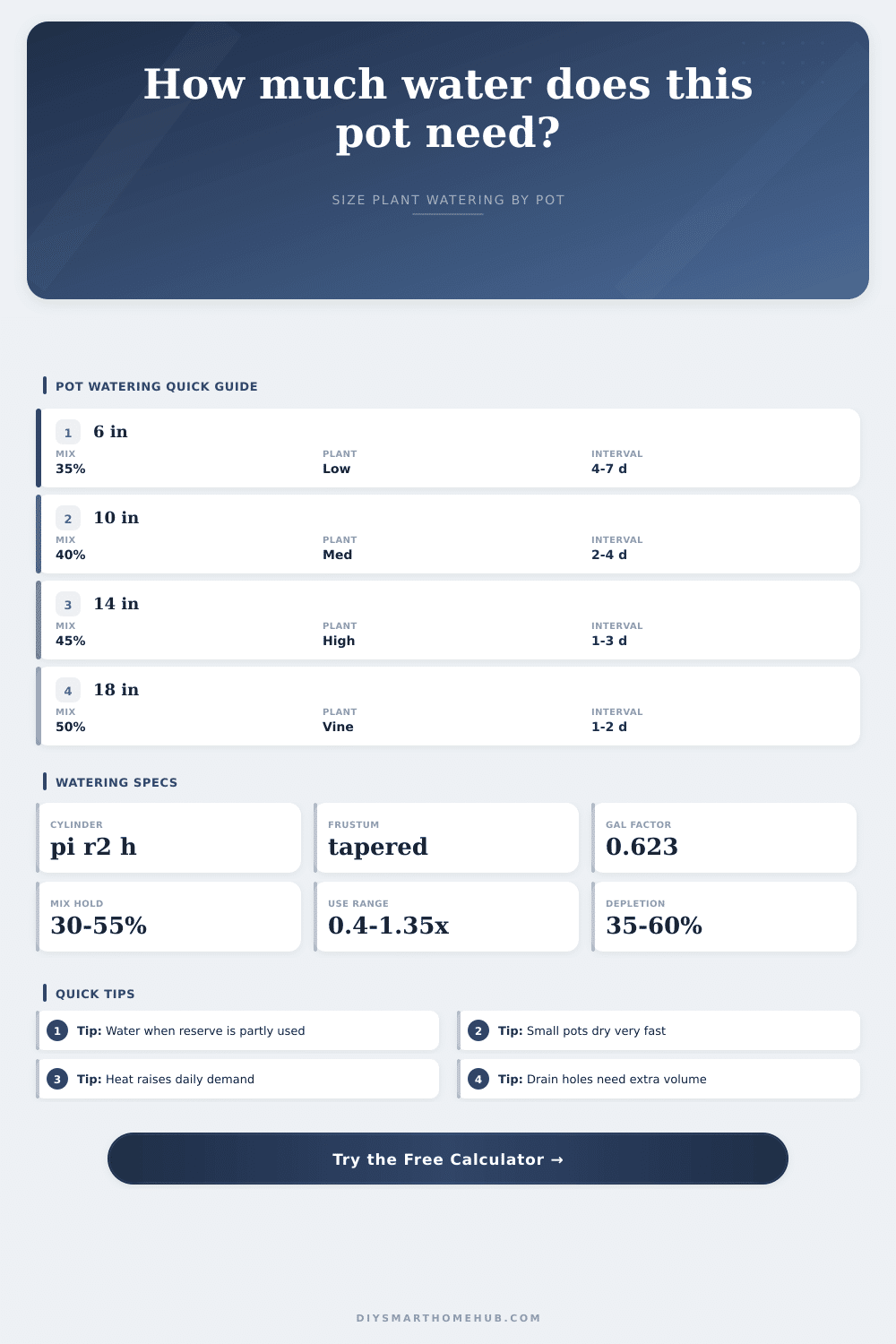
Plant Water Requirement By Pot Size Calculator
Estimate a container plant's pot volume, usable soil water reserve, daily water demand, gallons or milliliters per watering, and watering interval from the pot size.
Pot geometry
Demand settings
| Item | Formula used | Typical input | Why it matters |
|---|---|---|---|
| Round straight pot | pi x radius squared x soil depth | Diameter and depth | Finds cylinder soil volume |
| Tapered round pot | pi x h / 3 x (R2 + Rr + r2) | Top, bottom, depth | Models common nursery pots |
| Daily water demand | Top area x ET x plant coefficient x factors | 0.08-0.25 in/day | Turns weather and plant type into gallons |
| Usable reserve | Pot volume x holding % x depletion % | 35-60% depletion | Estimates how much can be used before watering |
| Watering volume | Usable reserve x drainage extra | 1.10x | Adds a small amount for drain-through |
| Interval days | Usable reserve / daily demand | 1-7 days | Shows when the reserve is expected to run low |
| Pot size | Approx soil volume | Reserve at 40% holding | Best fit | Likely interval |
|---|---|---|---|---|
| 6 in round | 0.5-0.8 gal | 0.08-0.14 gal | Herbs, small starts | 1-5 days |
| 8 in round | 1.1-1.5 gal | 0.20-0.27 gal | Foliage, small annuals | 2-6 days |
| 10 in round | 2.1-3.0 gal | 0.38-0.54 gal | Ferns, peppers, greens | 2-5 days |
| 12 in round | 3.5-5.0 gal | 0.63-0.90 gal | Annuals, compact vegetables | 1-4 days |
| 14-16 in round | 6-10 gal | 1.1-1.8 gal | Tomatoes, shrubs | 1-3 days |
| 18 in round | 12-18 gal | 2.2-3.2 gal | Large patio plants | 1-5 days |
| Setting | Calculator value | Use when | Watering effect |
|---|---|---|---|
| Succulent mix | 25% holding | Gritty, fast-draining media | Less stored reserve |
| Standard potting mix | 40% holding | Peat, bark, perlite blends | Balanced storage |
| Moisture control mix | 48% holding | High organic or gel-amended mix | Longer interval |
| Average houseplant | 0.75 coefficient | Pothos, philodendron, peace lily | Moderate demand |
| Flowering annual | 1.05 coefficient | Petunia, geranium, impatiens | Higher demand |
| Fruiting vegetable | 1.20 coefficient | Tomato, pepper, cucumber | Shorter interval |
| Scenario | Pot model | Estimated volume | Daily demand | Per watering | Interval |
|---|---|---|---|---|---|
| 6 in herb pot | Tapered round | 0.5 gal | 0.04 gal/day | 0.09 gal | 2 days |
| 10 in fern | Tapered round | 2.1 gal | 0.10 gal/day | 0.40 gal | 4 days |
| 14 in tomato | Tapered round | 6.2 gal | 0.42 gal/day | 1.23 gal | 3 days |
| Window box | Rectangle | 3.7 gal | 0.26 gal/day | 0.75 gal | 3 days |
If your peace lily (or other plant) appears sickly, like this one that’s droopy from dryness, you’ll freak out and figure it wants water right now because you haven’t been taking care of it lately. But adding water won’t help unless you add proper amount. A tiny container can hold far less liquid than you think; a big planter holds far more then meets the eye.
Use size of pot as your solution, so you never have to guess by looking at leaves again. It’s just basic geometry and biology: How big is the pot? How much soil does it hold? What’s more, most nursery pots are tapered (they’re fatter up top and narrower below), and a standard cylinder formula presume all that room for your roots’ use. Wrong! The tool consider what’s been subtracted from the bottom of any given pot. It then factors in a fill factor, because you don’t cram your soil to the brim, and uses that real-life cubic space for water and roots.
Why You Should Measure Your Pots
An inaccurate guess about volume lead to a wrong schedule for when to water. How long does it last? That depends on what’s in the soil. Heavy peat-moss mixtures will be spongy, holding onto water for days; bark-and-perlite mixture drain rapidly. You’ll see from the tool that you can choose your mix; it calculates based off how much water stays behind in the pot once gravity has pulled most of it from the drainage hole.
By default, standard potting mixes retain roughly forty percent by volume as usable water. Succulent mixes tend to be fast-drainers, retaining perhaps a quarter of that amount. If you’re using a moisture-holding soil in a smallish container, that number mean longer between waterings. That’s why two people watering the same fern may do so at opposite times: their soil holds different amounts of water.
Some plants are thirstier at some times of year than others; other species has lower transpiration rates regardless. A pepper plant in full sun, fruiting, is burning off moisture all day long, whereas a succulent in shade doesn’t lose much. That’s where the coefficient system comes into play: It compensates for the plants’ different metabolisms. A foliage houseplant growing slowly indoors would of not have as high a demand as a flowering annual does. Light exposure and temperature will multiply that demand.
Water evaporates not just from the soil surface, but from the leaves, too. At over eighty degrees, that rate spikes with heat. Each time you water, you’re cooling the plant down via transpiration. Forget about climate factors, and you’ll either under-water in summer or roast roots in winter.
This means it will output an interval recommendation and a corresponding daily demand rate. This is a physics-derived baseline, not a hard rule. Interval indicates what length of time the usable reservoir of water last until reaching the lower limit of safety. Ideally, most plants want to be watered before their water content reaches zero. Too little water stresses the root system. Based off the type of plant and your mix, calculation assumes how far away that critical low point lies. Treat it as a starting point, not a final word.
Real-world variables are nothing like what you find in a spreadsheet. Wind speed up evaporation; high humidity slows it down. Soil in direct sun, such as in a black pot, gets hot faster, which causes it to lose moisture more quickly. Watch those factors. Pick up the pot before watering and again three days later, and feel how heavy it is. Heavier? Lighter? That’s your clue, more then any app can provide. Run the clock according to the calculated period, but tune in with your hands, not just your head.
Your pot feels light when it was full, and feels empty or at least very light when an inch below the surface the soil are dry. That’s your sign. Perfect is the enemy of good, right? Knowing what your containers can hold makes water-watching less like a chore, and more like second nature. No more guesswork, but rather managing your resources through measurement. The peace lily will appreciate your moddern measurement-first approach.