Smart Water Heater Schedule Savings Calculator
Estimate tank heat energy, standby loss, off-hour recovery time, and schedule-based energy reduction for electric, gas, and heat pump water heaters.
⏱ Schedule presets
💧 Tank, water, and heater inputs
Formula constants
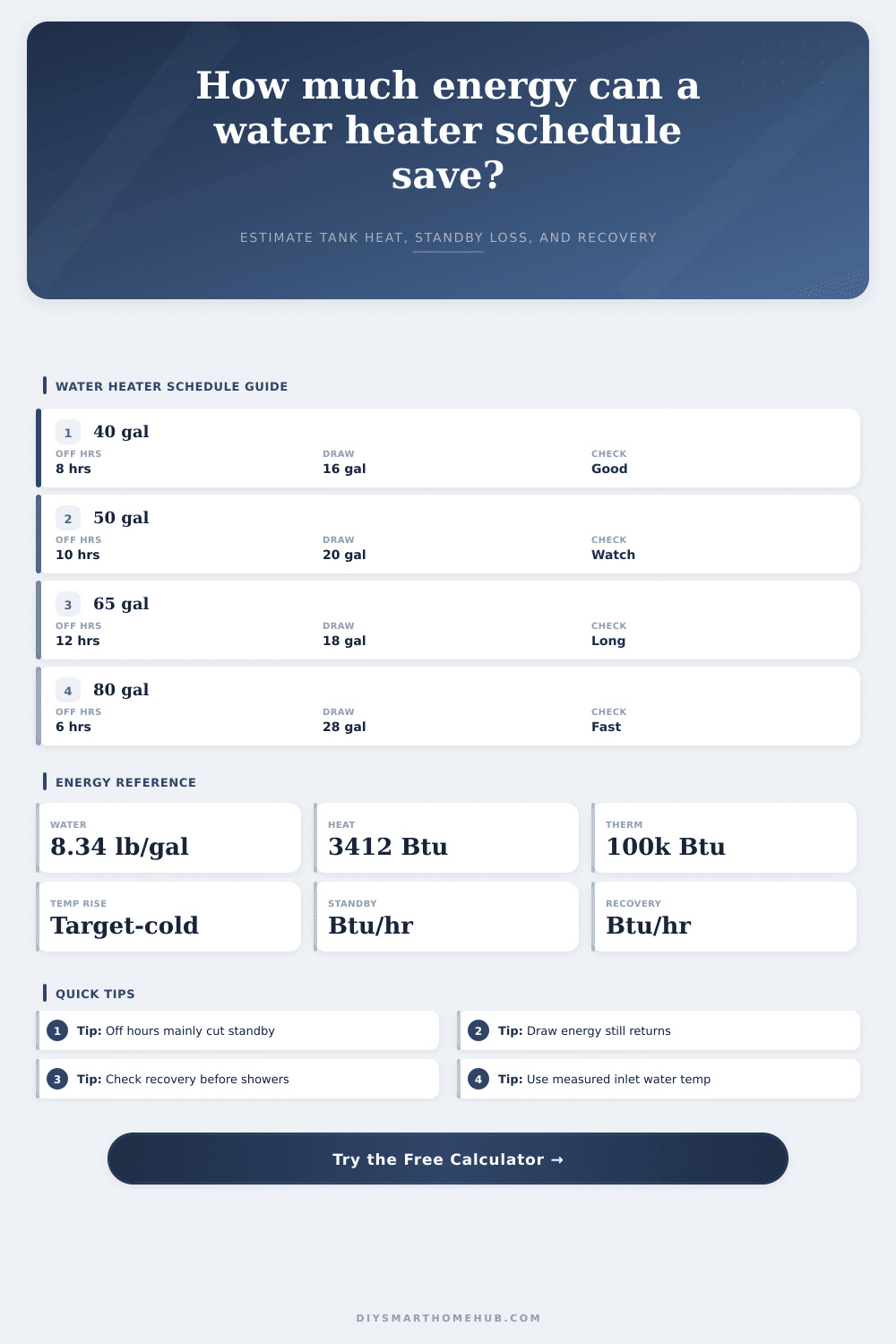
Heat formula: gallons × 8.34 × temperature rise = thermal Btu. Thermal kWh = Btu ÷ 3412.
🔌 Schedule and standby inputs
Schedule energy results
📊 Reference data
| Heater type | Typical input model | Common tank size | Schedule note |
|---|---|---|---|
| Electric resistance tank | 0.95 to 1.00 factor | 40 to 80 gallons | Recovery depends on element kW |
| Heat pump water heater | COP 2.0 to 3.5 | 50 to 80 gallons | Long recovery in efficient mode |
| Atmospheric gas tank | 0.58 to 0.67 factor | 40 to 75 gallons | Burner output usually recovers faster |
| Condensing gas tank | 0.85 to 0.96 factor | 50 to 100 gallons | Good standby reduction candidate |
🌡 Common tank and schedule checks
| Scenario | Tank gallons | Off hours | Recovery check |
|---|---|---|---|
| Small condo electric | 30 gallons | 6 to 8 hours | Keep off-window draw modest |
| Standard family tank | 40 to 50 gallons | 7 to 10 hours | Check morning draw overlap |
| Hybrid large tank | 65 to 80 gallons | 8 to 12 hours | Use longer recovery allowance |
| Large storage tank | 80 to 120 gallons | 4 to 8 hours | Standby loss dominates more |
✅ Formula notes
Your water heater’s thermostat can do just one thing, go UP. Twenty four hours a day/seven days a week/365 days a year. Even if no one use the water. Because most people think it cost little to heat their water and they want warm water whenever they need it; they don’t mind paying for the “comfort.”
What most people forget about is what we call standby loss, the invisible loss of heat from walls of the water tank. A smart schedule can cut down your standby loss. This provide the largest potential energy savings across the board.
Why You Should Schedule Your Water Heater
Turn the thing off (or turn it down) if nobody’s home. No heat bleed. You’re at work. You’re asleep. The calculator above will do the math for you.
That’s great, but what does it measure? More important, why? Cutting your standby loss is easy part. Managing what happens when you turn it back on are the hard part.
Specific heat capacity One characteristic of water is that it’s got a pretty high ability to hold heat. That is, it takes quite a bit of energy to change its temperature in either direction. A typical fifty gallon tank weigh approximately 417 pounds of water. So how much thermal energy does it take to raise that water temp from a fifty-eight degree cold inlet to a hundred twenty-degree warm? It is a pretty hefty chunk.
If you’re only running it during an eight hour on/off period, then yes, the water will cool while the heater is off. You’re not having to fight with your utility room’s ambient temperature for those eight hours. Good deal! When you get up for your morning shower though, guess who needs to start heating again? It has to reheat all the water you just pulled out plus the water that cooled while you were gone.
During this recovery period is also when scheduling goes wrong unless you take care. If your downtime is long (longer than what a schedule allows) or your tank is relatively small, the warm water may be lukewarm by the time you get into it. The calculation assumes that the water will recover at rate of your heater’s output rating.
In general, gas tanks with higher burner outputs recovers faster then electric resistance heaters. Heat pump water heaters are highly efficient but might recover more slowly depending on how you use them. You need to consider the inconvenince of having to wait versus the savings in energy.
The provided text does not contain any information regarding other water users; it only mentions checking your own daily draw habits. However, many people make a mistake by making their off times overly aggressive. They reason that more time saved the better. So, they turn the heater off for twelve hours. In doing so, they drop the tank below a comfortable level, maybe as low as ninety-five degrees. When mixed with the cold water coming into the tank, it becomes barely warm, hardly a savings plan at all. That’s simply a shower you’ll need to miss.
The table on the page provides typical scenarios for various sized tanks, which show how large ones holds heat for longer periods of time and can handle longer off periods before becoming uncomfortable. Then there’s the issue of incoming water temp. Your tank is going to work harder if you get water from groundwater in the wintertime and it’s still in the forties. That’s different than having inlet water at sixty degrees like most of us do in temperate climates. Physics will decide how hard it has to work to close the gap.
When you draw cold water, you pay for it. There’s no scheduling around it. What you CAN schedule is the length of time your tank will sit idly by. Thirty days of modest standby loss savings during off hours add up. And so does a year. And then it’s mostly knowing what you’re really measuring.
So you don’t turn it off entirely for one hour of every day. You align it with how and when you’ll be using it. Look at how you draw water each day. Do you take showers in the morning? Do you do laundry in the evenings? Then scheduling it to go off overnight makes sense. Or maybe you’ve got a bunch of people who are all over the place, in which case, maybe you want to make your off window a little smaller.
It isn’t maximum efficiency at any cost. Aim for reasonable efficiency without sacrificing basics. Begin conservatively. For a typical tank, four to six hours out of the day (work/sleep) is probably fine. Observe how long it takes you to recover. Is it telling you that you should of wait an hour to heat up? Make sure your morning routine accommodates that wait. Tweak accordingly.
It’s a little bit less comfortable now but you’ll save a lot more water. Your bill will finally match what you actualy do: you don’t use it all the damn time. And your water will be plenty warm when you need it.