Smart Plug Off-Peak Timer Calculator
Plan whether an appliance run fits inside an off-peak window by checking watts, required runtime, schedule start and stop time, duty cycle, smart plug amp rating, and kWh.
Off-Peak Timer Results
--
plug-on time--
plug-off time--
required runtime / usable window--
effective watts x runtime / 1000| Appliance type | Typical watts | Duty cycle input | Timer note |
|---|---|---|---|
| High-efficiency washer | 400 to 700 W running | 80 to 100% | Motor load, low heat draw |
| Dishwasher without heat dry | 800 to 1200 W active | 45 to 75% | Heater and pump stages vary |
| Battery or device charger | 60 to 350 W | 90 to 100% | Best estimated from required kWh |
| Dehumidifier or compressor | 350 to 800 W | 30 to 70% | Duty cycle changes with humidity |
| Small pump motor | 250 to 1000 W | 100% | Check motor startup surge |
| Resistive heater | 500 to 1500 W | 40 to 100% | Check continuous amp rating |
| Plug rating | 80% load at 120 V | 80% load at 230 V | Best fit |
|---|---|---|---|
| 10 A plug | 960 W | 1840 W | Chargers and electronics |
| 13 A plug | 1248 W | 2392 W | 230 V appliance circuits |
| 15 A plug | 1440 W | 2760 W | General smart plug loads |
| 16 A plug | 1536 W | 2944 W | EU smart plug loads |
| 20 A module | 1920 W | 3680 W | Dedicated higher load control |
| Scenario | Window length | Runtime used | Fit check |
|---|---|---|---|
| Short washer cycle | 7 hr | 1.2 hr + 15 min | Low window duty cycle |
| Battery top-up | 8 hr | 4.0 hr + 10 min | Fits with wide margin |
| Dehumidifier block | 6 hr | 6.0 hr + 15 min | Needs less buffer or lower runtime |
| Late-start dishwasher | 5 hr | 2.1 hr + 20 min | Latest-start schedule works |
You recieve your final electricity bill. And you’d like to have greater control over which times of day (or nights) your house use electricity. There are off-peak periods, when demand is low and pricing is lower. By shifting usage of heavy appliances into those off-peak periods, you’ll save money. But it all seems like a puzzle with some pieces missing.
You know what device needs charging, and roughly when. But you don’t know if this device and that period matches up. Maybe the dryer will take too long to complete before peak pricing kicks in. Or maybe plugging in charger trips the circuit because it’s got a big startup surge. It’s a question of scheduling; plus physics, plus safety. So what about running the math?
How to Use This Calculator Safely and Correctly
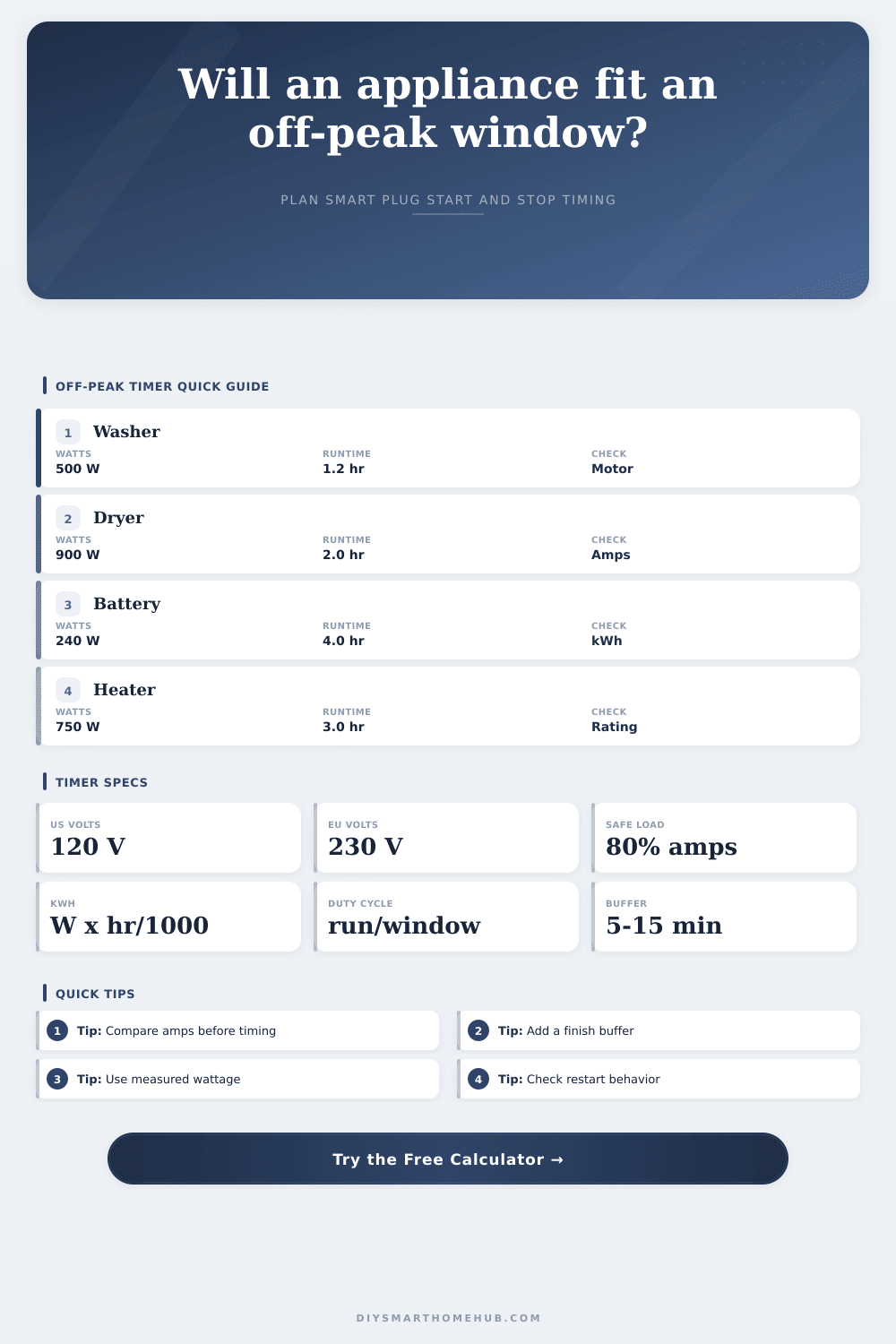
Well, if you put in your appliances into the calculator above it will crunch them for you without having to play around with conversions and coefficients. It begins with simple stuff most people miss. Watts is far more important than we realize within a strict time limit. If you run a high-efficiency washer that pulls five hundred watts for an hour and twenty minutes, the energy draw are manageable. But toss in a dehumidifier or space heater and things shift. Instead of being able to plug something in for an hour and forget about it, it’s going to be cycling on and off. That means it run at some fraction of its maximum output. You can put in a duty cycle percentage which covers that fact. If you’re thinking that a dehumidifier take four hours you may be over-estimating the runtime. In fact, it may only be running half of the time (closer to two). This distinction determine if the meter spikes during a full cycle.
A confusing variable is voltage… Particularly if you’re using gear sourced from elsewhere in the world, or are traveling. For example, a fifteen-amp plug may sound like it can absorbs quite a bit, but that number is meaningless without knowing voltage. At one hundred twenty volts, an amp is roughly half the wattage then it is at two-hundred-thirty volts. That means that a standard plug in Europe can typically support much higher loads than what we see here. When you choose your outlet voltage, the calculator automatically accounts for that and calculates the resulting amp draw based off those numbers. Then it compares that amp draw against some sort of safety limit (typically around 80% of max rated by the plug). Why? Because there is always a little heat produced by anything plugged into a smart plug. You don’t want to overload them, because then they fails, and if they fail while on a timed run, you end up with a battery bank full of water or wet laundry.
But then there’s the issue of startup surges. When motors start, they don’t begin softly. They takes a big draw for an instant as they turn over. An eight-hundred-watt dishwasher could spike up to fourteen hundred watts on start-up. With the smart plug maxed out anyway, that jump could be enough to trip and cut out the device, silently failing. By looking at the surge multiplier, you will know if it’s going to do that or not. And you want it to remain connected throughout the whole wash cycle. Not just the initial ten minutes.
Because time can be flexible, there’s also an input for when you want that finish buffer to happen. You don’t want to wake up and find the plug has turned off at 6:01 AM. There could of been an additional minute for the machine to finish draining, or another minute to get out from under the load. A few minutes leeway means that whatever the machine does mechanically will finish by the time the electricity turns off. It is just one little change, but it eliminates the frustration of leaving things halfway done.
Moreover, you’re free to try out various start strategies. If you need most time, you can begin at the very start of the off-peak period. If you prefer more sleep, you can begin as late in the day as desired. Depending on how much run time you need, the calculator display both scenarios. It’s like converting an inflexible utility schedule into a personal convenience tool.
And it isn’t just saving you pennies by using less energy … it’s giving you back some control of how your home run. A smart plug is only smart if it’s fed good information. Without knowing watts, amps, and true runtime, a smart plug isn’t much help for understanding your energy use. It’ll still be an act of faith that “it should work” rather than a matter of knowledge that “it will.” But what happens when it works and cycles through clean, quiet, and cheap modes? Then you know that planning matters because planning pays. It makes you a partner with your appliances instead of their opponent.