Pre-Cool Timing Before Peak Rate Calculator
Estimate when to start cooling before a peak window from thermal mass, target temperature drop, HVAC capacity, cooling runtime, rebound drift, and electrical energy use.
Home, setpoints, and equipment
Live formula checks
Start pre-cooling about 1 hr 58 min before peak begins.
The calculator is ready with an average-house preset. Adjust the values and recalculate for your zone.
| Thermal mass profile | Effective mass | Typical construction | Timing effect |
|---|---|---|---|
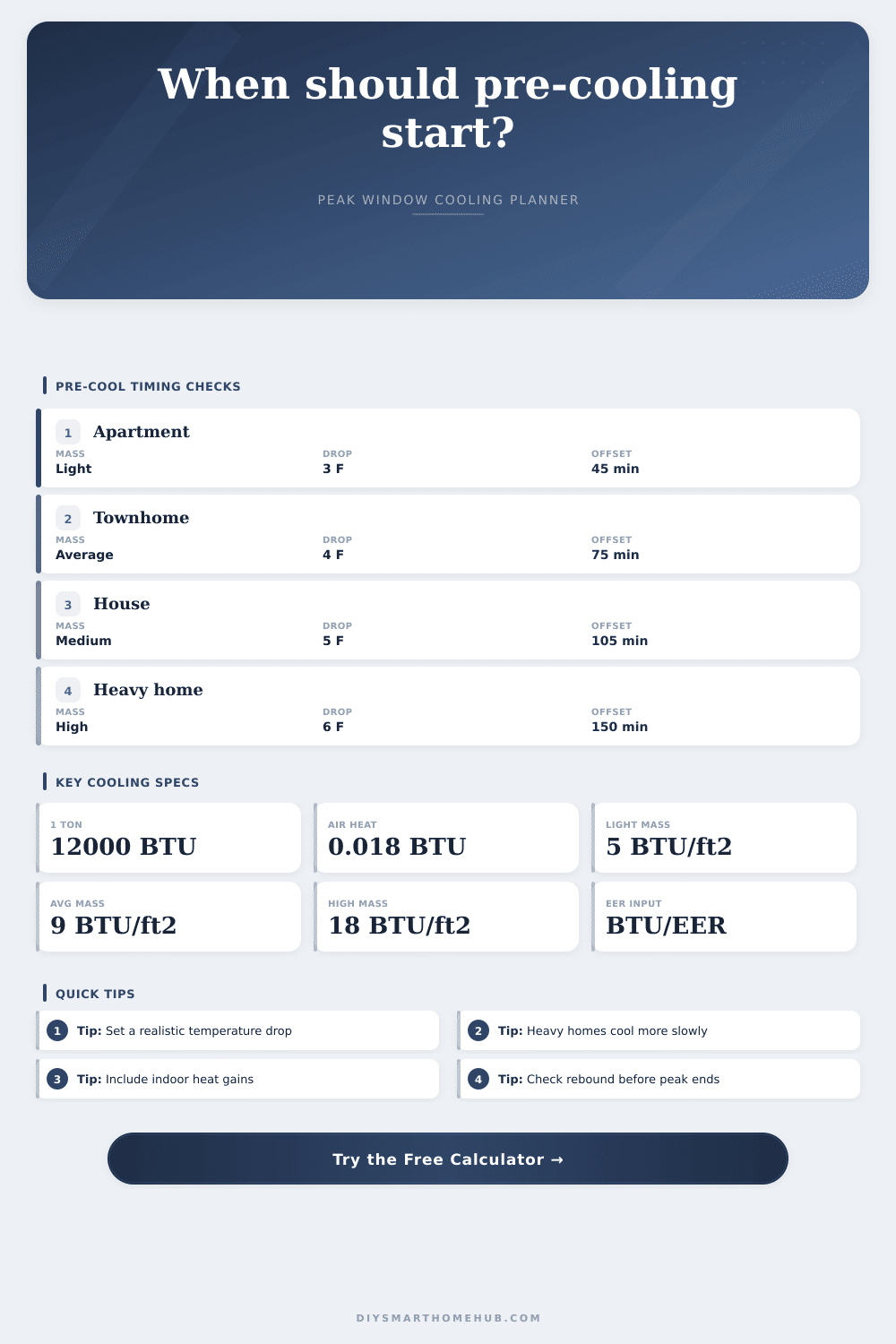
| Light frame | 5 BTU/ft²/°F | Small apartment, few contents | Fast cooling, fast rebound |
| Average furnishings | 9 BTU/ft²/°F | Typical framed home | Moderate runtime and drift |
| Medium-heavy | 13 BTU/ft²/°F | More contents, slab, tile | Longer pre-cool, slower rebound |
| Heavy masonry | 18 BTU/ft²/°F | Masonry, concrete, heavy slab | Slowest to move, best buffer |
| Cooling size | Rated output | Input at EER 10 | Input at EER 14 |
|---|---|---|---|
| 1.5 tons | 18,000 BTU/h | 1.80 kW | 1.29 kW |
| 2.0 tons | 24,000 BTU/h | 2.40 kW | 1.71 kW |
| 2.5 tons | 30,000 BTU/h | 3.00 kW | 2.14 kW |
| 3.5 tons | 42,000 BTU/h | 4.20 kW | 3.00 kW |
| 5.0 tons | 60,000 BTU/h | 6.00 kW | 4.29 kW |
| Rebound condition | Net heat gain | Drift rate | Peak-window result |
|---|---|---|---|
| Shaded tight zone | Low | 0.5-1.0°F/h | Small pre-cool buffer often holds |
| Average afternoon | Moderate | 1.0-1.8°F/h | Needs several degrees of buffer |
| West-facing sun | High | 1.8-3.0°F/h | May need allowed peak duty |
| Leaky older envelope | Very high | 2.5°F/h+ | Pre-cool alone may not last |
At this point, pre-cooling is no longer optional, it’s a financial necessity. The clock is edging towards the peak rate period for that evening. Your thermostat tells you it’s heating up, and you’re looking at a big utility bill. But you also don’t want to wait until now and end up stuck in a sweltering apartment.
Now you’re dealing with a particular type of anxiety: the anxiety that comes from knowing that you have to fight heat gain at 5 p.m., but you can avoid paying premium rates if you banked some temperature drops during cheap energy hours. It’s no longer about being comfortable; it’s about not overpaying.
How to Save Money on Your Electric Bill
It’s a matter of physics, even if it is very rigid and uncomplicated physics. Basically, your house is a thermal battery. In the afternoons, it soaks up mass and cool air. And its ability to do this is entirely dependent based off the nature of your house.
If you live in a lightweight apartment with little furniture and thin drywall walls, you basically have zero thermal inertia. When you turn on the system, it cools quickly. Sounds great right? This continues until you shut it off again. Because there’s not much of anything to absorb energy from outside, heat surges back inside within minutes.
Homes with heavy masonry or concrete slab floors behave different. They absorbs cold air slowly while running in pre-cool mode, so they take longer to run upfront. However, they hold the temperature much better once the compressor goes off.
To minimize your waste, first learn about your thermal mass. After plugging in your cooling capacity and construction type into the calculator (above), it does the rest of the math for you, without requiring you to guess how similar or dissimilar your house is to a brick fortress vs. A tin can. You might be surprised by how much your furnishings factor into the equation. Heavy curtains, bookshelves, carpets. All these items adds to how much heat the room can hold. Although they don’t feel insulating, they serve as heat stabilizers which slow down rapid changes in temperature.
Someone with a sparsely furnished condo might have the same HVAC units as a buddy with a fully loaded one. However, the person with less furniture will have to begin cooling earlier and more aggressively.
The second variable that trips folks up is timing. Exactly when? Exactly when. The page lays it out clearly in a table of reference times for various house types. For example: if your house is light, like an apartment, you may need a six-degree cushion to make it through the same peak window without flipping the AC back on. If your house is heavier, it might leak heat more slowly, requiring only a three-degree buffer.
Drift is inevitable. No matter how well-sealed your envelope, heat will find its way in (hot things move toward cold). The trick is figuring out exactly what amount of drift you’re willing to tolerate before the cheap rates are gone.
It’s all complicated by solar gain. Late in the day, west facing windows become heat cannons, they’re pumping energy straight into your livig space whether you have your thermostat cranked up or not. Your house is getting blasted with direct sun? You’ll have to pre-cool extra hard or just accept that you will need to use the air conditioning during peak hours.
To accommodate for this, the calculator lets you dial-in solar exposure levels, and it then estimates the amount of corresponding drift. Telling you how early to begin the cycle. It provides a rough estimate of kWh as well, so you can compare the upfront energy cost against possible savings by shifting usage away from high rates.
But people are guilty of thinking that every hour during the peak period is identical. This isn’t true. Sunlight gets hotter and then cooler. Electronics and cooking increase the internal heat, which builds up over time. Pre-cooling should be carefully targeted. It’s not just a matter of meeting some number on the thermostat; it’s managing the thermal momentum of your whole living space.
The key is to understand what you’re really measuring. The derate factor also shouldn’t be ignored. In real world conditions, your HVAC isn’t going to work at its rated capacity. Efficiency decreases as the outdoor temp rises, and duct losses rob output before it even reaches the room. So when you’re accounting for that, you need to get honest about how hard your system works before it struggles. Over-estimating your cooling capacity will make your start time too late, and cause the temperature to climb while the peak window passes.
It is a small detail, but it matters. Getting those inputs right turns the whole process from guesswork into a reliable strategy. Instead of waking up with a huge bill and wondering why the AC was running all night long, you get a comfortable house and a bill you can manage. The clock waits for no one, and neither does the sun.