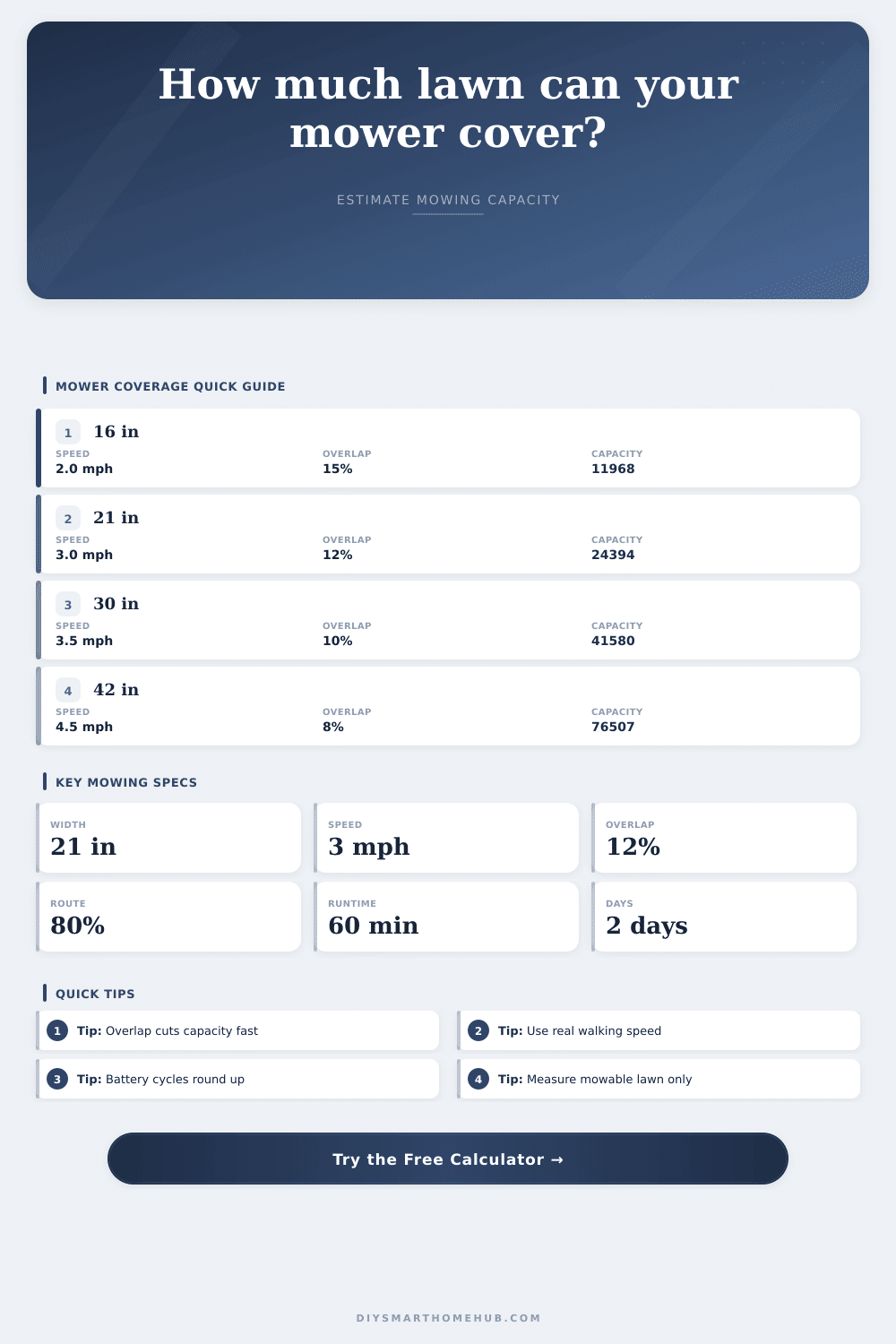
Mower Coverage by Cutting Width Calculator
Estimate mowing capacity from cutting width, ground speed, overlap, route efficiency, lawn area, battery runtime, charging cycles, and daily coverage sessions.
Formula breakdown
| Cutting width | Effective width at 12% overlap | Capacity at 3 mph and 80% | Best fit |
|---|---|---|---|
| 16 inches | 14.1 inches | 18,586 sq ft/hr | Small lawns, tight gates, narrow storage |
| 18 inches | 15.8 inches | 20,909 sq ft/hr | Townhome yards and compact suburban lawns |
| 21 inches | 18.5 inches | 24,394 sq ft/hr | Typical walk-behind mowing with moderate overlap |
| 30 inches | 26.4 inches | 34,848 sq ft/hr | Wide walk-behind or compact rider routes |
| 42 inches | 37.0 inches | 48,787 sq ft/hr | Riders on open lawns with fewer turns |
| Route condition | Overlap range | Route efficiency | Calculation note |
|---|---|---|---|
| Open rectangle lawn | 6% to 10% | 84% to 90% | Long passes keep turn losses low |
| Normal suburban yard | 10% to 15% | 75% to 84% | Edges, beds, and gates reduce straight-line capacity |
| Tree and bed-heavy yard | 14% to 22% | 62% to 76% | Short passes and obstacle loops dominate the time |
| Sloped or uneven route | 15% to 25% | 58% to 72% | Lower speed and wider overlap protect cut quality |
| Robot mower pattern | 20% to 35% | 45% to 68% | Frequent small passes trade speed for daily maintenance |
| Runtime per charge | At 15,000 sq ft/hr | At 25,000 sq ft/hr | At 45,000 sq ft/hr |
|---|---|---|---|
| 30 minutes | 7,500 sq ft | 12,500 sq ft | 22,500 sq ft |
| 45 minutes | 11,250 sq ft | 18,750 sq ft | 33,750 sq ft |
| 60 minutes | 15,000 sq ft | 25,000 sq ft | 45,000 sq ft |
| 90 minutes | 22,500 sq ft | 37,500 sq ft | 67,500 sq ft |
| Lawn type | Mowable area | Typical mower | Planning result |
|---|---|---|---|
| Townhome strip | 1,500 to 3,500 sq ft | 14 to 18 inch mower | Usually one battery cycle or short corded session |
| Small suburban lawn | 4,000 to 8,000 sq ft | 20 to 21 inch walk-behind | Often under one hour with normal overlap |
| Large suburban lawn | 9,000 to 18,000 sq ft | 21 to 30 inch deck | Battery runtime can become the first limit |
| Half-acre open lawn | 16,000 to 22,000 sq ft | 30 to 42 inch deck | Rider width reduces active time sharply |
| One-acre route | 35,000 to 43,560 sq ft | 42 to 54 inch deck | Speed and turning efficiency drive coverage days |
When you look out at your yard, you know: it needs to be cut down. How long will it take? If you’re an optimist, maybe an hour; if you’ve struggled with this before, maybe three. Because of the way your lawn is shaped, and the time it takes to turn around, usually it end up being something in between.
That’s why this mower coverage calculator measures the variable factors that tend to throw off plans. Once you input them, the tool calculate the adjusted cutting width and the lawn area covered. It also figures out the number of batteries needed, how many cycles those batteries contain, your actual mowing time, and total days required. From vague worry comes a clear schedule.
How the Calculator Helps You Plan Mowing Time
If you’re mowing, note that effective width of your mower will be less than the width of the deck advertised on the box. Even if it’s got a twenty-one-inch deck, it won’t slice a strip of turf that wide each time you move the mower forward. It can’t. Because you’ll overlap your passes slightly to ensure no long swaths of taller stuff remain standing in the middle of lawn.
The calculator uses your selected overlap percentage. A reasonable compromise between quick and neat is ten percent, though you might go up to fifteen or even twenty percent if you have uneven terrain or just want to be realy picky. We then subtract that amount from the raw width of the machine. That sounds like nothing…until you add up all those extra minutes, which equal lost time you were hoping to gain.
Another factor is that we think we mow faster then we actualy do. When asked about our ground speed, many will thinks they’re moving around three miles per hour. But that’s assuming you walk in perfectly straight lines. With real lawns, there are corners and gates and flower beds and trees, all the things that makes you come to a halt or slow way down.
That’s why route efficiency input matters. It factors not just how much time you spend cutting in a straight line, but also how long it takes to turn and trim and navigate the other elements in the lawn’s route. If your efficiency rating is 80 percent, for instance, then 20 percent of your time are eaten up by navigation like turning and repositioning. This is a mistake we see a lot. People figure out how fast they move when going forward, but fail to consider that actual lawns aren’t perfect rectangles.
With battery-powered mowers, all that changes. Besides knowing how much area each machine cuts within an hour, here’s another factor: How long does the battery last? And for how many cycles? The device calculates how many times you’ll have to swap batteries (or recharge them) to complete the task. Say your grass need two hours of mowing time… But your battery holds just forty-five minutes‘ worth. Plan accordingly; otherwise you’re setting yourself up for frustration. Maybe you want to mow the first half of yard early in the day, then return to mow the other half later in the afternoon, before anyone notices you’re plugging that thing back in.
Some comparison data comes from the reference tables, which includes speed comparisons by type of mower (e.g., zero-turn rider, compact push). It’s clear: more width mean you get more done each hour. Though pricier to buy and store, a rider makes sense if your property is large. On small yards, added width doesn’t save you more than proportionately. Match the tool to the terrain: A wide deck in a cluttered townhome yard is just as maddening as a skinny one on an open acre. You want to reduce turning time versus actual cuttime.
So does this save time? Yes. It saves you time from having to guess. When you measure the mowing area and account for overlap and realistic speed, you won’t underestimate again, or overestimate. You’ll make plans to do chores based off what’s actually required, not hoping for the best. A little math saves you from being disappointed come Saturday morning. That’s a big deal when the sun is high and the grass has grown tall. No more prayers; now you have a plan.