Listening Position Triangle Calculator
Plan a stereo listening triangle from speaker separation, listener distance, room width, center offset, target angle, and speed-of-sound delay checks.
Speaker line, listener position, and target angle
Live geometry checks
Formula breakdown
| Listening angle | Seat distance from speaker line | Ear-to-speaker distance | Common use | Placement note |
|---|---|---|---|---|
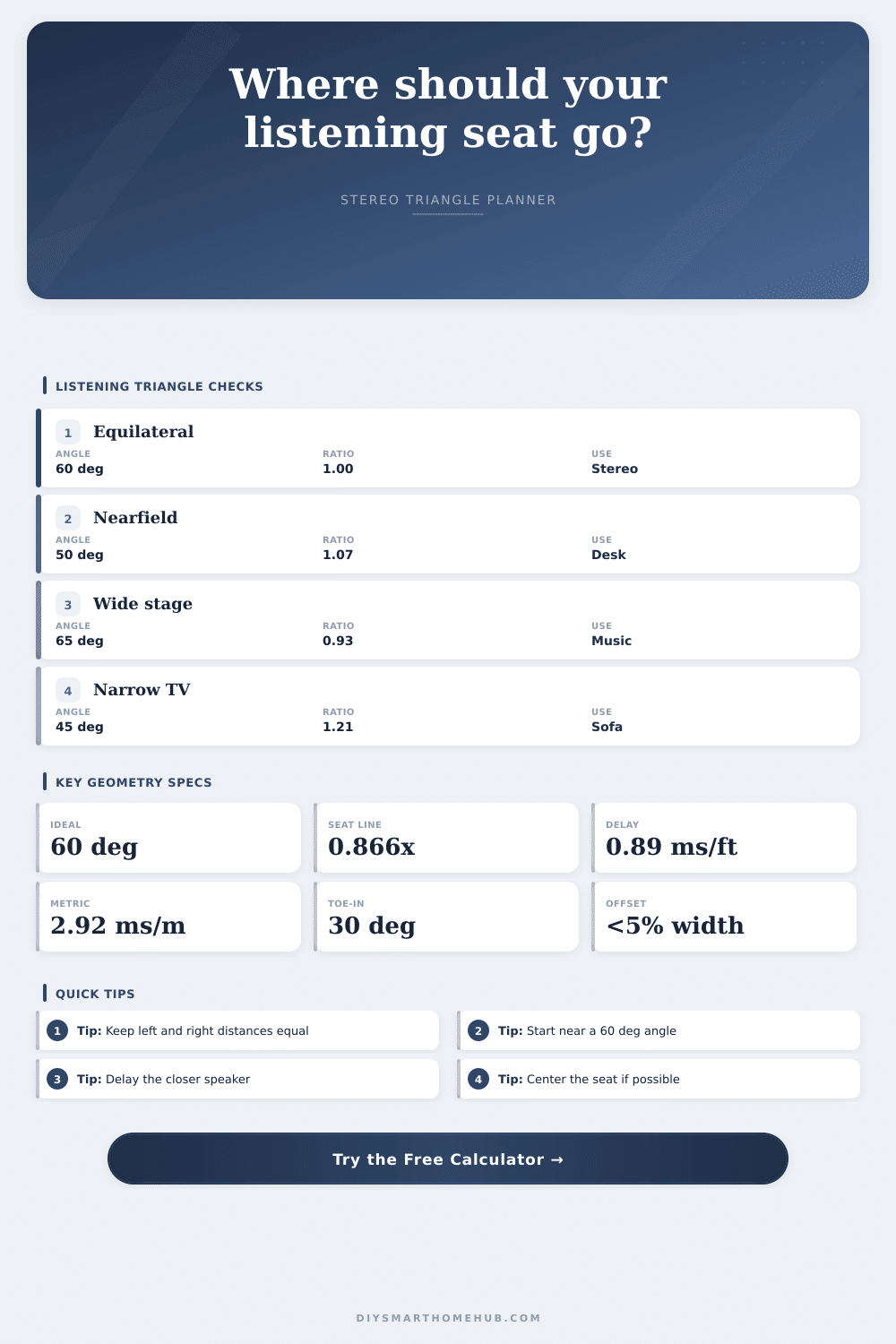
| 45° | 1.207 × separation | 1.307 × separation | Narrow TV console | Stable center image, smaller stereo width. |
| 50° | 1.072 × separation | 1.183 × separation | Nearfield desk | Often practical when speakers cannot spread wider. |
| 60° | 0.866 × separation | 1.000 × separation | Equilateral stereo | Classic starting point for two-channel listening. |
| 65° | 0.785 × separation | 0.937 × separation | Wider music stage | Can sound spacious but may weaken center focus. |
| 70° | 0.714 × separation | 0.872 × separation | Close wide pair | Works best with careful toe-in and symmetry. |
| Path difference | Delay at 68°F | Metric difference | Receiver action | Listening signal |
|---|---|---|---|---|
| 1 inch | 0.07 ms | 2.54 cm | Usually ignore | Below practical adjustment on most gear. |
| 3 inches | 0.22 ms | 7.62 cm | Fine trim only | Good target for careful stereo symmetry. |
| 6 inches | 0.44 ms | 15.2 cm | Small delay trim | Center image may begin to lean slightly. |
| 1 foot | 0.89 ms | 0.30 m | Add to closer side | Noticeable enough to correct in many systems. |
| 3 feet | 2.67 ms | 0.91 m | Correct strongly | Off-center seating becomes easy to hear. |
| Room condition | Triangle effect | Center offset signal | Symmetry target | Planning note |
|---|---|---|---|---|
| Centered pair and centered seat | Equal left and right paths | 0 percent room width | Best case | Use separation and seat distance to tune the listening angle. |
| Seat shifted right | Right speaker path shortens | Positive listener offset | Delay right speaker | Delay can fix arrival time, but room reflections may still differ. |
| Speaker pair shifted right | Wall clearances become uneven | Positive pair offset | Match side-wall spacing | Keep each speaker at least a practical distance from side walls. |
| Very wide speaker spacing | Angle grows beyond 60° | Usually still centered | Check center image | Move seat forward only if the stereo image remains stable. |
| Narrow console spacing | Angle drops under 50° | Often TV-limited | Use toe-in gently | Move speakers outward or move the seat closer when possible. |
With properly positioned stereo speakers, you’ve created an interesting type of silence. It is not no sound, but yes sound. An image smack dab in the middle that appears suspended in nothingness. You’re hearing a singer standing directly between the two cabinets and your brain conclude that’s where there has to be a microphone on a stand.
That phantom center image is what separates two channels from one, and it all hinges on geometry: how close your speakers are to each other, how far apart they are, and most importantly the shape of the triangle your ears make with the left and right speakers. While the calculator above run the numbers for you, knowing why that triangle shape makes a difference is what transforms a decent system into a great system.
The Best Way to Place Your Speakers
The equilateral triangle, this is how most of us start down the road toward being an audiophile. What does it mean? The distance from your listening position to each speaker are equal to the distance between two speakers. It makes a sixty-degree angle at your seat. Why does it work? Because it’s a good balance of direct sound with early reflections.
But no one lives in a perfectly square room. Bookshelves aren’t as wide as sofas. Televisions forces you to situate your speakers too close together. If you can’t make the magic sixty degrees, what do you give up? You trade something else for something else. And that’s where this tool come in. It allows you to enter your real-world constraints (fixed speaker separation, non-center seating) and it computes the rest: the delays, the angles.
Most of us do not think about symmetry; we have our chair a little over on the right so the sound comes out of the right speaker first and reaches our ear before the sound coming out of the left. Since your brain sees the timing difference between those two sounds as a sense of direction, it pulls the phantom center toward the closer speaker. Now, the music sounds like it is leaning to one side, off balance or muddy.
That’s where the calculator comes in and measures the path length difference and tells you how much of a delay adjustment to make on the closer speaker. A digital delay will hold back the sound coming from the nearer cabinet until it can be made to match so both signals reach your ears at the same time. It is a small fix for a big problem. However, it all depend on your receiver or processor having the ability to adjust delay per channel.
Another variable often overlooked is toe-in. Speakers aimed straight toward you can deliver clear vocals but may diminish the width of soundstage. Crossing them behind you will open up the scene to be wider and more ambient, but potentially blur the focus. This chart on the page shows how various angles affect your seating distance and organizes this information based off the reference table.
A tighter forty-five-degree angle makes the image remain fairly tight, perfect for dialogue and other TV stuff. A wider, say, seventy-degree angle open the space out. This is good for an orchestral selection, but it requires more careful attention to how the room is treated to prevent reflections from washing out the detail. It’s up to you: What do you listen to? Let that determine your geometry.
It may not seem like an odd thing to account for when you’re talking about placing speakers, but sound is affected by the temperature of the environment. Warm air transmits sound more quickly then cool air. A difference of even 10 degrees in the room will impact the delay amount by a fraction of a millisecond, which isn’t noticeable to most people. It does matter if you have a high-end setup and do some critical listening from close range; that’s what nearfield monitoring is all about. Instead of giving you ballpark numbers, the calculator bases its delay figures on the speed of sound at whatever temperature you input.
The bottom line: The technology must go away. You shouldn’t notice the speakers. All you’ll want to notice is the music. It is delivered as the artists envisioned it, right where they imagined it. If there’s something off about your soundstage, if the left and right images seem too close together or the center image feels soft, start with that triangle. Check those measurements; make sure things is symmetrical; tweak those delays. When the setup is in place, the other links in the chain can do their work. And then that phantom center appears, solid in the air, right where it belongs.