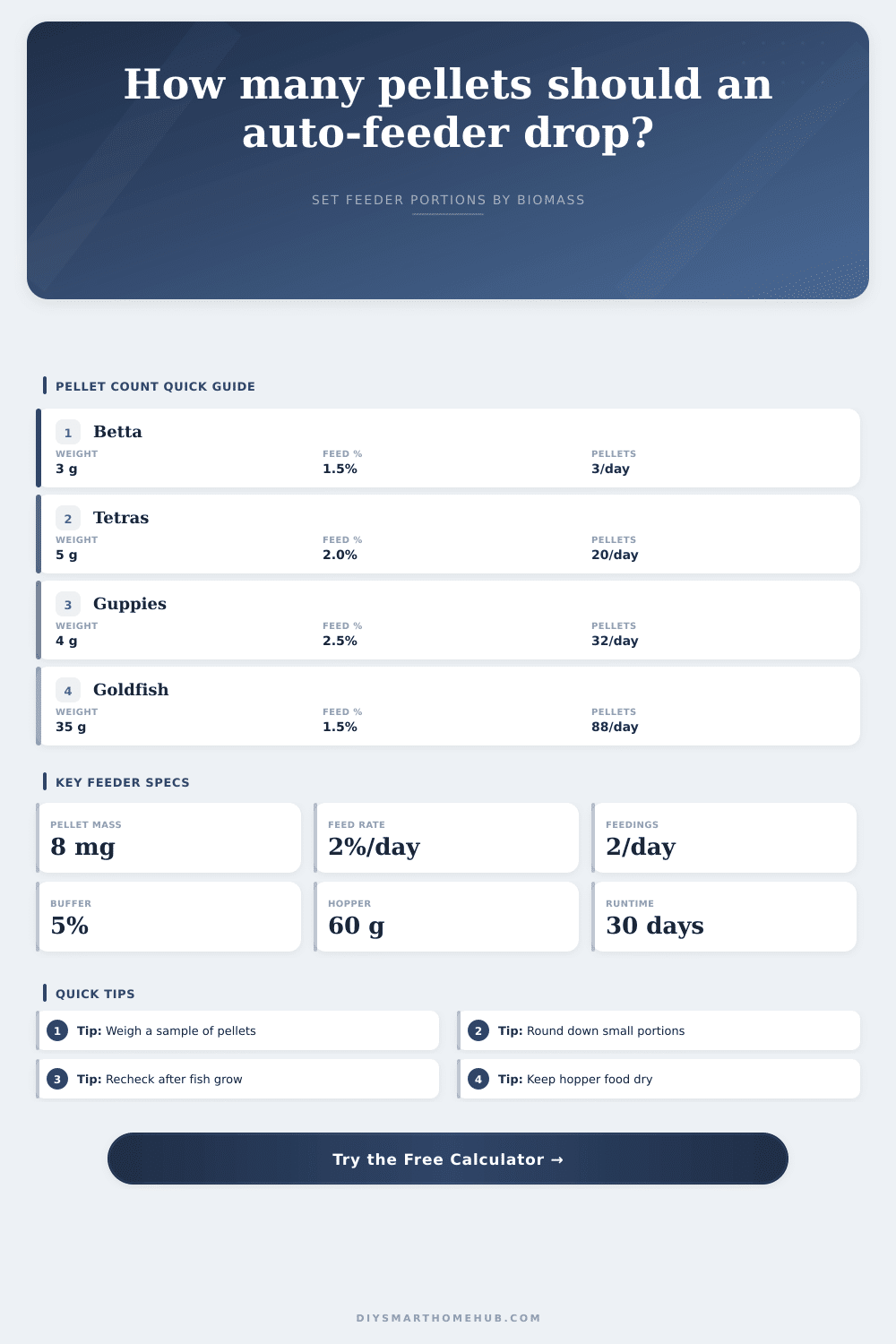
Aquarium Auto-Feeder Pellet Count Calculator
Estimate pellets per feeding from fish count, average body weight, daily feed rate, pellet mass, feeding frequency, and hopper capacity.
⚙Descriptive Presets
🐟Feeder Inputs
Calculation Breakdown
📊Key Formula Outputs
📋Pellet Weight Reference
| Food Format | Typical Pellet Mass | Best Count Method | Calculator Note |
|---|---|---|---|
| Micro pellet | 1 to 3 mg | Weigh 50 to 100 pieces | Small errors multiply quickly |
| Small tropical pellet | 4 to 8 mg | Weigh 30 to 50 pieces | Common for tetras and guppies |
| Medium pellet | 10 to 25 mg | Weigh 20 to 30 pieces | Useful for cichlids and goldfish |
| Large floating pellet | 30 to 100 mg | Weigh 10 to 20 pieces | Round carefully for small groups |
⚖Feed Rate Planning Table
| Fish Group | Typical Body Weight Range | Common Feed %/Day | Portion Style |
|---|---|---|---|
| Adult betta or gourami | 2 to 8 g each | 1.0% to 2.0% | Very small rounded counts |
| Small schooling fish | 0.3 to 2 g each | 1.5% to 3.0% | Higher count, tiny pellets |
| Livebearer community | 1 to 5 g each | 2.0% to 3.0% | Split across 2 feedings |
| Goldfish and larger cichlids | 20 to 150 g each | 1.0% to 2.0% | Pellet mass matters most |
🔧Auto-Feeder Setting Comparison
| Setting Type | Count Precision | Food Compatibility | Best Input To Track | Adjustment Method | Useful Check |
|---|---|---|---|---|---|
| Rotating drum | Medium | Dry pellets and granules | Pellets per opening | Slot size and rotations | Run 5 dry tests |
| Portion wheel | High | Similar pellet sizes | Pellets per chamber | Chamber fill level | Count each chamber |
| Screw auger | Medium to high | Uniform pellets | Grams per second | Run time per feed | Weigh 10 dispenses |
| Vibration feeder | Low to medium | Small dry granules | Pellets per pulse | Pulse length | Average many drops |
🏠Common Aquarium Scenarios
| Scenario | Fish Count | Avg Weight | Pellet Mass | Estimated Daily Pellets |
|---|---|---|---|---|
| Single betta nano | 1 | 3 g | 10 mg | About 5 pellets |
| Neon tetra school | 12 | 0.7 g | 2 mg | About 88 pellets |
| Community twenty gallon | 18 | 3 g | 5 mg | About 227 pellets |
| Fancy goldfish pair | 2 | 35 g | 15 mg | About 74 pellets |
💡Calculator Tips
Poor feeding habits cause cloudy water. You start with good intentions, but poor feeding habit often end up leading to cloudy water. For convenience, you purchase an automatic feeder. You set it on some random number, assuming the fish will figure out the rest. They won’t. Hardware isn’t the problem; it’s usually math associated with the portion size. Guessing at pellet counts means you’re effectively guessing at biological load that your filtration system must manage.
That’s where this calculator come in. It removes the guess work from the process by converting abstract biomass into concrete dispensing instructions. It’s all about weight of the fish not how many there are. Even though two big angelfish may only take up as much space in a tank as ten small neon tetras, they has very different feeding profiles.
How to Use the Feeding Calculator
What does it mean? It means you’re going to be asked how much an average fish weigh. In other words: What exactly do you have swimming around in your water column. That number, that average body weight per fish, is used in the daily ration formula. Adult tropical fish generaly eat between one and three percent of their body weight in food each day. Juveniles often hover at the top of the range; mature fish hang out closer to the bottom.
And why is that important? Overfeeding is leading cause of algae blooms and spikes in ammonia in otherwise healthy tanks. You know how many grams of food your fish requires (or at least you will once you’ve done this step). Now you must convert those grams into pellets. And here’s where a lot of folks stumble, there are some seriously diverse pellet weights out there among different brands and sometimes even within brands’ own lines! While one brand may offer a small fry pellet at 2mg each, another may produce a medium cichlid pellet weighing more than 20mg.
If you use a digital scale to weigh out a sample of fifty pellets, you can calculate an average which can be fed into the calculator. It sounds like a pain, but doing so ensures that you’re not accidently double-feeding due to switching brands. If you aren’t equipped with an exact scale to weigh pellets, this handy table found on the page breaks out those average masses based off format. This will also serve as a reminder of how small errors in pellet weight can multiply quick when you’re dealing with high counts.
Once you plug all that data into the calculator, it takes care of the math for you. All you have to do is enter your count, weight, and targeted feed frequency and it will tell you exactly how many pellets you should of aim for during each feeding. The other practical limit most people overlook is Hopper capacity. Then they return home from vacation only to discover their feeder was emptied (or even overfilled) at the end of its previous cycle.
The tool takes into account your hopper size and adds a little buffer. This accounts for mechanical variance or perhaps a bit of dust that reduces the capacity slightly. It converts feeding into a maintenance task instead of having to guess each day if your feeder needs filling. Based off actual consumption rate, you know exactly when you need to go add more. You no longer have to do a random once-a-week check.
You’ll want to fine tune the settings as well based off seasonal changes. As water cools, fish metabolism slows and they needs less food to be healthy. You can adjust this with a percentage using the tool. That way if it’s cold, you just dial the ration back a bit instead of having to go through and refigure the whole biomass formula. It is again a little thing. But it shows the biology. And static timers will never be able to account for that.
It all comes down to stability with precision feeding. If you can accurately determine how many pellets enter your tank then you can accurately gauge how many should exit the tank. And that understanding makes your tank a known system instead of a mystery box. The goal isn’t just to keep the fish alive, but to keep the water clear and the equipment happy. It’s about keeping the water clean and keeping your equipement happy. Precision feeding does that too, giving each pellet a job while preventing any from getting stuck in the substrate where they slowly rot away.