Pet Feeder Daily Meal Split Calculator
Split a known daily food amount into feeder-friendly portions, kcal per meal, meal spacing, dispense increments, and rounding remainders.
| Feeder step | Best use | 80 g / 4 meals | 95 g / 4 meals | Remainder range | Planning note |
|---|---|---|---|---|---|
| 1 g increment | Fine dry-food split | 20 g each | 23 g, 24 g mix | 0 to 0.5 g nearest | Most flexible for uneven totals |
| 2 g increment | Small bowls | 20 g each | 24 g, 24 g, 24 g, 24 g if rounded up | 0 to 1 g nearest | Usually clean for 2 to 6 meals |
| 5 g increment | Common hopper feeders | 20 g each | 25 g, 25 g, 25 g, 20 g | 0 to 2.5 g nearest | Watch small daily totals |
| 10 g increment | Coarser dispensers | 20 g each | 30 g, 20 g, 20 g, 20 g if rounded down | 0 to 5 g nearest | Remainders can become visible |
| 15 g increment | Large kibble hopper | 15 g, 15 g, 15 g, 15 g or extra steps | 30 g, 30 g, 15 g, 15 g if rounded down | 0 to 7.5 g nearest | Use fewer meals for cleaner splits |
| Meals per day | Example first | Example last | Window spacing | Overnight gap | Max gap |
|---|---|---|---|---|---|
| 2 meals | 7:00 AM | 7:00 PM | 12.0 hours | 12.0 hours | 12.0 hours |
| 3 meals | 7:00 AM | 9:00 PM | 7.0 hours | 10.0 hours | 10.0 hours |
| 4 meals | 7:00 AM | 9:00 PM | 4.7 hours | 10.0 hours | 10.0 hours |
| 6 meals | 6:00 AM | 10:00 PM | 3.2 hours | 8.0 hours | 8.0 hours |
| Daily grams | Kcal per gram | Daily kcal | Meals | Raw portion | 5 g feeder split |
|---|---|---|---|---|---|
| 60 g | 3.8 | 228 kcal | 3 | 20.0 g | 20 g each |
| 75 g | 3.6 | 270 kcal | 4 | 18.8 g | 20 g, 20 g, 20 g, 15 g |
| 120 g | 3.4 | 408 kcal | 3 | 40.0 g | 40 g each |
| 185 g | 3.2 | 592 kcal | 4 | 46.3 g | 45 g, 45 g, 45 g, 50 g |
| 260 g | 3.0 | 780 kcal | 2 | 130.0 g | 130 g each |
| Preset | Daily grams | kcal/g | Meals | Increment | Schedule purpose |
|---|---|---|---|---|---|
| Indoor Cat, 4 Meals | 80 g | 3.6 | 4 | 5 g | Even daytime split |
| Small Dog, 3 Meals | 120 g | 3.4 | 3 | 5 g | Morning, midday, evening |
| Workday Feeder Window | 150 g | 3.3 | 4 | 5 g | Spreads meals while away |
| Fine 1 g Dispenser | 73 g | 3.7 | 5 | 1 g | Handles uneven totals neatly |
| Coarse 10 g Hopper | 95 g | 3.5 | 3 | 10 g | Shows visible rounding remainder |
So you start with a bag of good kibble, and an automatic feeder that will feed your pet during the day while you are away at work. The vet tells you they need so many grams per day (e.g., 80), and you fill up the hopper confidentely. But then it dawns on you. The thing can only dish out food in five-gram increments.
It is perfectly divisible by four meals, which is fine. Eighty divided by four equals… Everything’s all well and good. Except what happens when your pet want 77 grams? And what if the math settles on 20.25 grams per meal, with the hardware snapping right back to whole numbers? That is where logic problem lies.
How to Feed Your Pet Correctly
Most humans think feeding is simply a matter of dividing up food evenly. Usually it’s not, since there are mechanical limitations that requires some sort of compromise between practicality and precision. To help with this, the calculator does all the math for you, no need to worry about conversions and coefficients. All you need to do is enter how much you feed each day (and however many meals) and it will do the rest.
The first thing you will notice is what your food’s energy density is. This can vary widely, even among dry foods. Some grain-free formulas may be denser and hold more calories per gram of kibble. Other brands may have fillers and hold fewer calories. Failing to know this will cause you to fall into the trap of feeding by volume instead of by nutrition. This could result in unintended weight loss or slow weight gain in the long term.
Once you know this number, you’ll know how many calories you’re giving your pet per meal, and whether the split matches their metabolic needs. Keep in mind, it’s not just about keeping them fed. It’s about meeting their energy target properly and consistent.
The other problem. The mechanical one, is the feeder itself. All feeders aren’t made alike. Some are precise to within a gram (like some higher end ones), and others has a coarse hopper mechanism that dispenses food in 10-gram increments. So if your total per day isn’t divisible by this step size of the feeder, you’re left with a remainder.
Where does this remainder go? Use the calculator to make a choice. Do you want to add it to the morning meal? Do you want to add it to the final meal? Or do you want to spread out the difference throughout the day? If you spread out the difference, each meal will be relatively uniform, which aids digestion. Adding all extra grams to one big evening meal may result in late-night digestive upset or a spike in blood sugar.
You should also consider timing. Maybe you feed your cat every few hours throughout the day, but the longest time between meals will likely be the time between dinner and breakfast the following morning. Because cats are natural grazers, going too long between meals, like an overnight fast, has potential consequences such as hepatic lipidosis in some cases. Checking the maximum gap helps ensure no single interval is dangerously long.
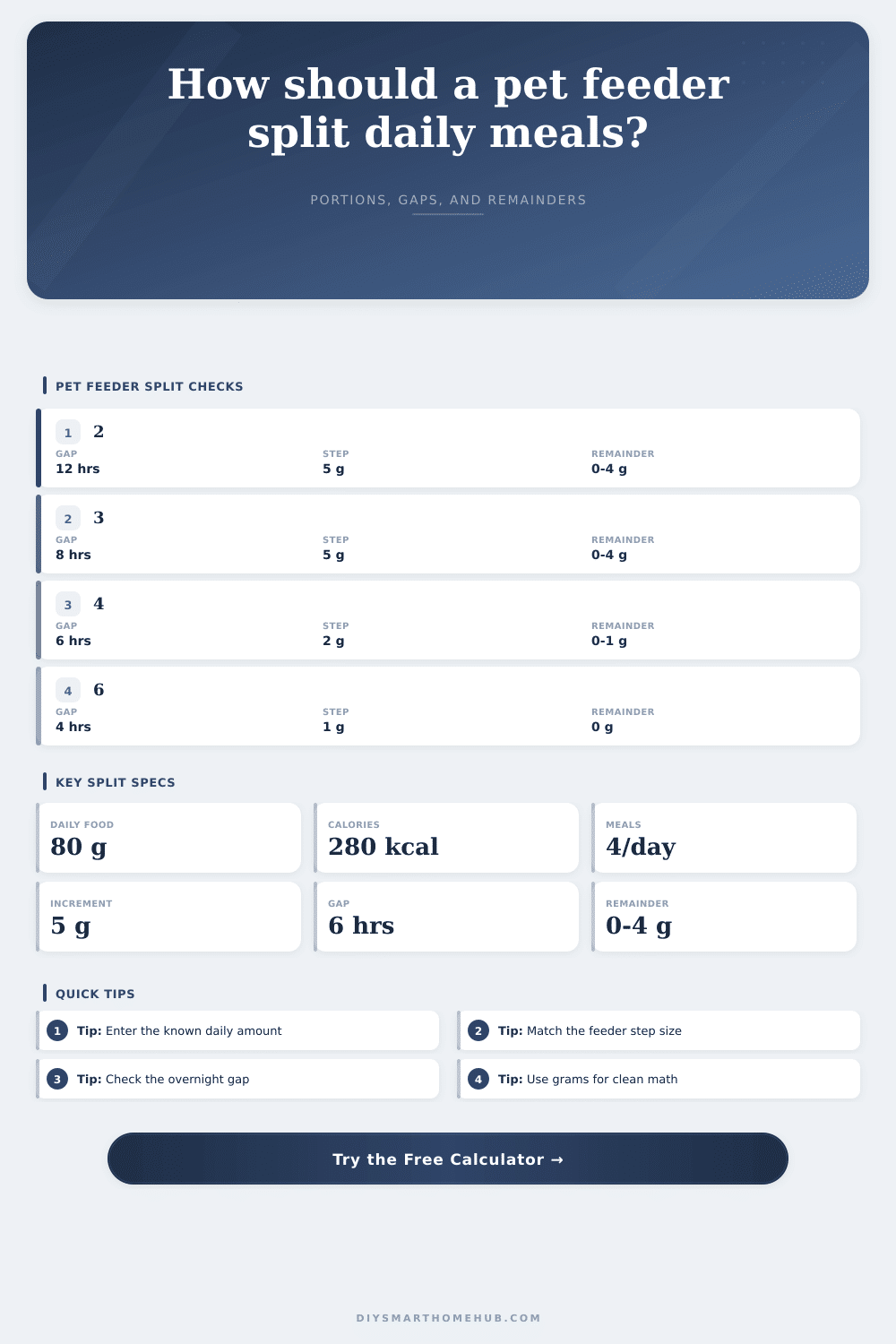
Here’s a clear visual representation from the reference table on the page (click to enlarge): As you can see, increasing one additional snack throughout the day (even while keeping overall caloric intake constant) can significantly shorten the longest span between meals. The numbers add up.
A rounding error per week turns into fourteen grams less food per week. This happens if you try to match the math with your feeder by underfeeding by two grams each and every day. That totals almost half a pound over just a month. Small differences matter. This tool will help calculate them out for you so you can tweak your daily value up or down to meet the capacity of whatever hardware you’re using.
Use it as an aid to work with what you’ve got (not what you wish you had). Maybe going from three meals a day to four will give you better divisions within your particular step size? Or maybe moving the initial meal time back a half hour helps bridge the night easier without reducing any portions. Consistency is king. Whether it’s good food or routine, pets love both.
While half-and-half may seem like a mess on paper, it can be golden in practice if the changes aren’t too large and spread equally. Before heading off to work each day, know your constraints. Whether the delivery is via a motorized chute or a bowl, you don’t want the animal to recieve anything less than they need, the difference between hope and knowledge.
You should of known the math plays out and trust the machine, but first understand the bounds and begin with the grams. Let the rest slide into place.