Pet Feeder Portion by Weight Calculator
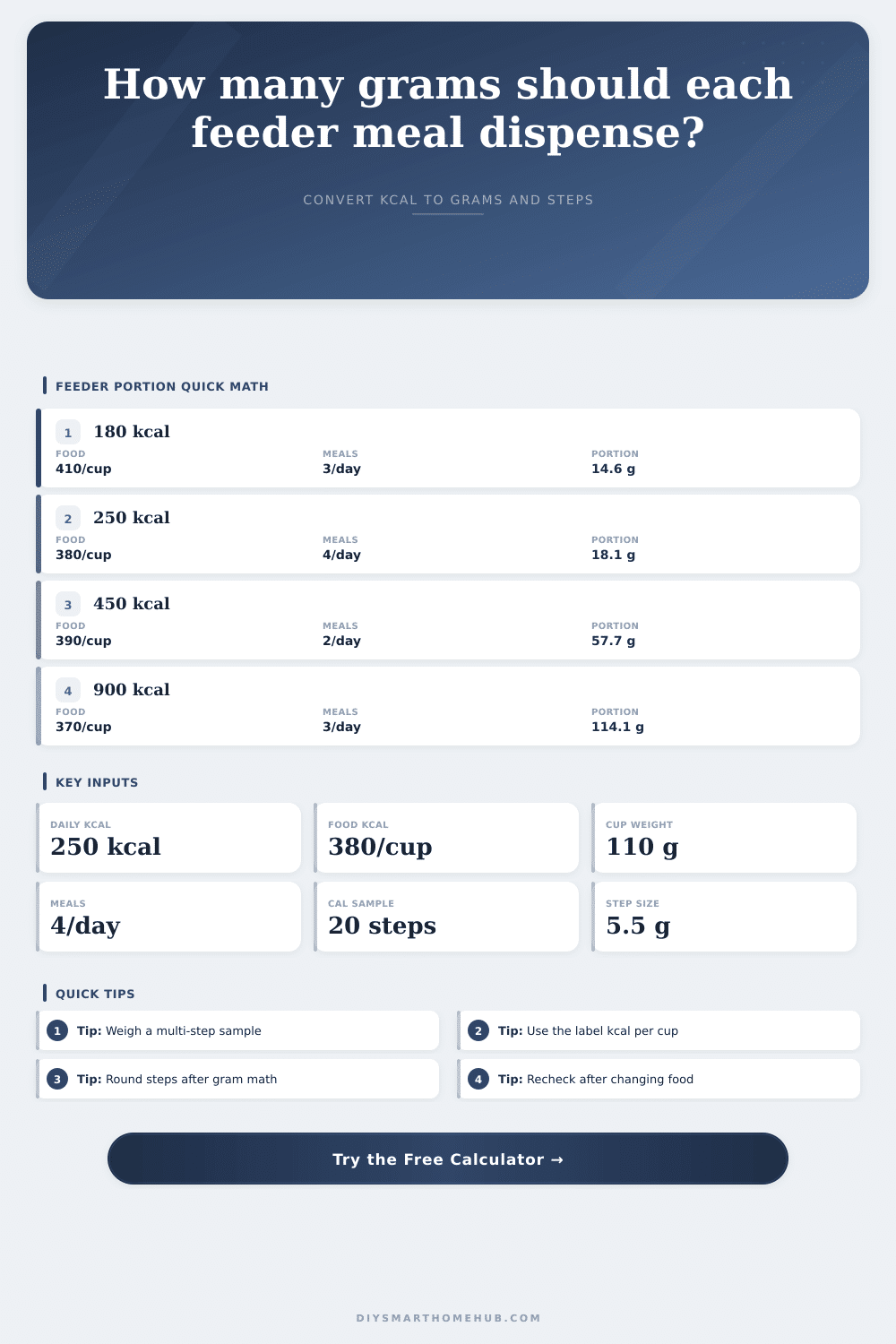
Convert a daily calorie target, food kcal per cup, grams per cup, meals per day, and feeder calibration sample into portion grams and dispense steps.
Detailed portion breakdown
| Food label example | Food weight | Calculated kcal per gram | 150 kcal portion |
|---|---|---|---|
| 330 kcal per cup | 100 g per cup | 3.30 kcal/g | 45.5 g |
| 360 kcal per cup | 105 g per cup | 3.43 kcal/g | 43.8 g |
| 390 kcal per cup | 110 g per cup | 3.55 kcal/g | 42.3 g |
| 420 kcal per cup | 115 g per cup | 3.65 kcal/g | 41.1 g |
| 450 kcal per cup | 120 g per cup | 3.75 kcal/g | 40.0 g |
| Sample run | Sample weight | Grams per step | Steps for 30 g |
|---|---|---|---|
| 10 steps | 42 g | 4.20 g/step | 7.14 raw steps |
| 15 steps | 75 g | 5.00 g/step | 6.00 raw steps |
| 20 steps | 110 g | 5.50 g/step | 5.45 raw steps |
| 25 steps | 160 g | 6.40 g/step | 4.69 raw steps |
| 30 steps | 210 g | 7.00 g/step | 4.29 raw steps |
| Daily grams target | 2 meals/day | 3 meals/day | 4 meals/day |
|---|---|---|---|
| 40 g/day | 20.0 g/meal | 13.3 g/meal | 10.0 g/meal |
| 60 g/day | 30.0 g/meal | 20.0 g/meal | 15.0 g/meal |
| 90 g/day | 45.0 g/meal | 30.0 g/meal | 22.5 g/meal |
| 120 g/day | 60.0 g/meal | 40.0 g/meal | 30.0 g/meal |
| 180 g/day | 90.0 g/meal | 60.0 g/meal | 45.0 g/meal |
| Scenario | Daily kcal | Food kcal/cup | Meals/day |
|---|---|---|---|
| Small cat dry food | 180 kcal | 410 kcal/cup | 3 meals |
| Average cat split meals | 250 kcal | 380 kcal/cup | 4 meals |
| Toy dog four meals | 320 kcal | 360 kcal/cup | 4 meals |
| Small dog two meals | 450 kcal | 390 kcal/cup | 2 meals |
| Shared two-pet bowl | 620 kcal | 400 kcal/cup | 4 meals |
When you bought an automatic feeder for your pet, it was probably to let them eat on schedule when you’re at a meeting or eating dinner uninterrupted. It looked easy: set the portions in cups, follow the directions, and you’re done! Simple automation of care. But there are calories, and kibble density vary by brand. And a cup isn’t always a cup. So the math gets messy if you rely on volume.
However, the problem is that while pets consumes based off biology (burning calories), automatic feeders dispense mechanically. To close this gap, you has to use weight as the middle step. The calculator converts your daily calorie target into exact grams. Then it converts those gram into the correct steps for your machine. Now you don’t have to guess how many cups are represented by each setting on the label instructions. That’s how you turn a vague goal of “feeding” correctly into a concrete amount you can dial-in.
How to Measure Food Weight Correctly
First, scan food bag and see what it says about energy density (per cup). It’s typically in range of three hundred to four hundred fifty kilocalories per cup. Kibble shapes is all over the place, which means that volume isn’t a good proxy for mass. For example, a bag of small dense pellets will have a lot more mass than a bag of big crunchy cubes, despite having exact same volume when measured into same scoop. Because of this variability in kibble shape, you need to weigh out a known volume of the food you’re using. The tool then computes true energy density per gram, using that gram-per-cup ratio. This removes the variable of kibble shape and provides a pure measure of its biological target.
Then there’s the calibration process. Here’s where most folks skimp. You need to run a batch through 20 or 30 times and weigh the results to calibrate against what you’re actualy feeding. Otherwise, you won’t know if the manufacturer’s claim of ‘x’ grams per dispense really matches. Because kibble will change moisture content over time, plus a few tenths of an inch difference between kibble pack density can alter weight per dispense cycle. Do a quick test run to establish a solid gram-per-step baseline. This saves you from gradually drifting away from the right portion size and gaining too much weight or not getting enough calories over time.
With that information about calories, density, and how fast your specific feeder actualy feeds, it all works out as a certain number of steps per meal. Dividing the total daily goal across those meals spaces out the feeding throughout the day, because smaller doses is easier on blood sugar than one big dump. Also, most feeders do not take fractional values for the step size so there is some rounding built into the tool. Round up or down? That will add/subtract a little from the overall daily amount fed, but just by a meal at a time. It is a big deal over time (a month), but it has minimal impact on any given meal.
This is something most owners do once then never think of again. Food companies sneakily change their foods and even within a bag, there are likely different batches that will have slightly different densities. To be accurate, recalibrate each time you take a long break or try a different brand. Small differences in food density can make big differences in the end-portion size. See reference tables on this page. A difference of just 50 calories may not add more than a couple of grams, but it can mean an extra step before reaching your goal.
Perfect isn’t as important as precision. Measuring each individual grain of kibble with laboratory scale isn’t necessary. All that’s required is a reliable system that takes away the guesswork. That’s where the tool come in, helping to set up a way for objectively recording subjective feeding behaviors. Instead of estimating and letting numbers float over time, it helps you know exactly how much your pet are eating.
Adjusting the feeder properly isn’t about asserting dominance over your pet. It’s about providing food that supports good health and allows for steady nutrition without guessing or second-guessing yourself. You should of used a scale sooner. Knowing that no matter what time you’re away from home, it will spit out exactly what was calculated gives you a sense of comfort that they’re eating as they should be. All that work spent getting those first few steps dialed in pays off with good health and managed weight for years.