Seasonal Watering Adjustment Percentage Calculator
Scale a smart irrigation controller from reference ET, plant coefficient, useful rainfall, catch-can application rate, and root-zone soil storage.
Detailed watering breakdown
| Hydrozone type | Typical Kc or LF | Root depth band | Best controller use | Adjustment note |
|---|---|---|---|---|
| Cool-season turf | 0.75 to 0.85 | 6 to 12 in | Lawn spray or rotor zone | Responds quickly to weekly ET changes |
| Warm-season turf | 0.60 to 0.75 | 8 to 16 in | Summer lawn programs | Lower Kc than cool-season turf at similar ET |
| Mixed ornamental bed | 0.45 to 0.65 | 10 to 20 in | Spray, micro-spray, or drip | Use the thirstiest plant group in the zone |
| Established shrubs | 0.30 to 0.50 | 12 to 24 in | Drip or bubbler zones | Deep roots allow longer intervals |
| Low-water native planting | 0.15 to 0.35 | 12 to 30 in | Smart drip schedules | Rainfall may satisfy many cool weeks |
| Vegetable bed | 0.80 to 1.05 | 8 to 18 in | Frequent drip irrigation | Use higher Kc during fruiting growth |
| Soil or root zone | Available water | Root depth used | Allowable depletion | Usable storage |
|---|---|---|---|---|
| Sandy loam turf | 1.20 in/ft | 8 in | 45% | 0.36 in |
| Loam turf | 1.70 in/ft | 10 in | 50% | 0.71 in |
| Silt loam lawn | 2.20 in/ft | 12 in | 50% | 1.10 in |
| Clay loam shrubs | 1.70 in/ft | 18 in | 55% | 1.40 in |
| Deep tree basin | 1.50 in/ft | 30 in | 55% | 2.06 in |
| Raised vegetable bed | 1.35 in/ft | 12 in | 40% | 0.54 in |
| Controller week | Reference ET | Rain credit | Turf seasonal percent | Shrub seasonal percent |
|---|---|---|---|---|
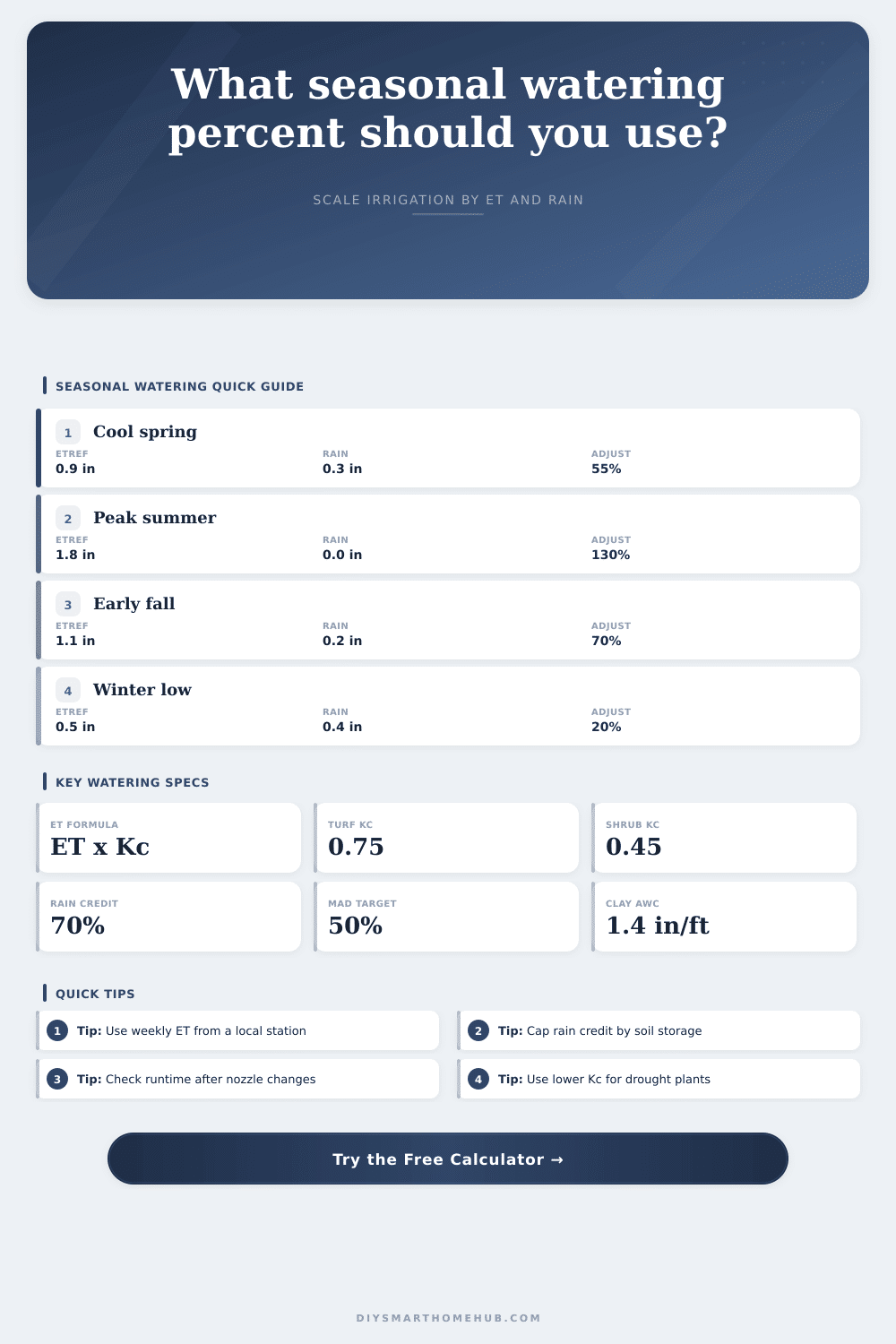
| Cool spring | 0.8 to 1.0 in/wk | 0.2 to 0.5 in | 45% to 70% | 25% to 45% |
| Late spring | 1.1 to 1.4 in/wk | 0.1 to 0.3 in | 75% to 100% | 40% to 65% |
| Peak summer | 1.5 to 2.1 in/wk | 0.0 to 0.2 in | 105% to 160% | 65% to 105% |
| Early fall | 0.9 to 1.2 in/wk | 0.1 to 0.4 in | 50% to 85% | 30% to 55% |
| Winter low | 0.3 to 0.7 in/wk | 0.2 to 0.8 in | 0% to 35% | 0% to 20% |
| Project zone | Typical runtime base | Application rate | Weekly ET target | Likely seasonal range |
|---|---|---|---|---|
| Small front lawn spray zone | 45 to 75 min/week | 1.0 to 1.5 in/hr | 0.6 to 1.4 in | 40% to 120% |
| Rotor backyard turf zone | 80 to 150 min/week | 0.35 to 0.70 in/hr | 0.8 to 1.7 in | 65% to 150% |
| Drip shrub foundation bed | 60 to 160 min/week | 0.15 to 0.45 in/hr | 0.3 to 0.9 in | 25% to 95% |
| Raised vegetable smart valve | 75 to 180 min/week | 0.25 to 0.60 in/hr | 0.8 to 1.5 in | 80% to 160% |
| Tree bubbler hydrozone | 40 to 120 min/week | 0.40 to 1.20 in/hr | 0.4 to 1.1 in | 35% to 110% |
It’s July on a Tuesday morning. Your lawn look parched. Your smartphone alerts you: Time to set your sprinkler system. Hit Start? Not so fast. That will cost you money and damage plants.
Your controller is smart enough to know when to run, just not how long. No controller knows how much moisture the root zone can holds before it dries out or becomes soaked. So what? Seasonal adjustment closes the gap between basic timer mode and naturaly hydrating things right.
How Seasonal Adjustment Saves Water
More than just cranking the dial back in winter and forward in summer, it converts weather needs into exact minutes of water-on per type of soil and plant. Feed it your local rainfall information and evapotranspiration data (the calculator above will handle the rest). You don’t have to memorize complicated equations about hydrology. You just enter some information and ask the question: What does it mean?
Here’s where it gets interesting: It’s all based off reference ET, which refers to the amount of moisture that would be lost to evaporation from a standard grass surface in existing weather conditions. Chances are your landscape isn’t standard grass. Native plants and well-established shrubs requires far less water than turf. That’s where the plant coefficient comes into play.
A number such as 0.75 for cool-season turf signals the system to go easy; 0.35 for drought-tolerant landscapes reduces run time by a huge margin. Why? Because who wants to water their rock garden like golf course?
Not all rain is created equal, and that’s where it gets complex. A brief heavy downpour may wash off before ground has time to soak up moisture. In contrast, a slow soaking rain can penetrate deeper, wetting the root zone. The tool reflects this reality with an efficiency discount applied to any rainfall amount you measure. It assumes maybe only seventy percent of what falls will benefit your plants. That’s conservative to prevent overstating its moisture-holding capacity, which could cause roots to rot in poorly drained clay soils.
How much a type of soil holds (its usable storage capacity) is based on that factor, reflected in the reference tables on the page. More frequent but lighter applications is needed on sandy loam soils different than on silt loam ones, or else water is wasted and runs off.
And most of us homeowners skip right past the part about the runtime in the first place. So we go ahead and turn the seasonal percent dial, not bothering to check whether starting schedule even made sense. If you guessed at how long you need for a week’s worth of watering when you started out, then turning it up or down just magnifies that guesswork.
Your starting point has to be set according to depth of your root zone and what your particular sprinkler nozzle’s watering rate is. Then use the seasonal adjustment as a multiplier; a good one, not a fudge factor. The calculator explains it all by showing you current values compared to that starting point. This way, you’ll never burn plants during a heat wave or drown them in cool springtime weeks.
But how does it know? And here’s the catch: It knows what you don’t need water for. You’re not watering the air; you’re replenishing what was take up by plants and evaporated from soil. The reading of a low number in winter-dormant zones means just that biologically: Roots aren’t running at top speed when the soil around them is cold. Wasting energy pushing full-on summer runtime on frozen ground isn’t good conservation.
In high-heat summertime, though, the system may well recommend more than 100 percent of your baseline. That doesn’t mean there’s anything wrong with the machine or the program. It’s because the air demand is going past your initial cautious settings, something the system recognize.
It’s not about sticking to schedules; it’s about tuning into responsive irrigation management. It’s about recognizing that each week, with changes in weather patterns, the numbers change and static programming doesn’t work. It’s about letting data make the decision instead of habit, about being mindful with our water use so we conserve resources, but also maintain healthy landscapes.
Instead of wondering if they need a drink (or do they?), you know exactly what it will take to have a green lawn. That transition. From guesswork to calculation; is what changes a sprinkler system that just runs, into one that cares for the land. You should of used this sooner to avoid wastng water.