Smart Irrigation Zone Schedule Calculator
Estimate zone runtime from real precipitation rate, plant water target, soil intake, cycle-soak limits, valve flow, schedule days, and smart rain-skip adjustment.
Detailed schedule breakdown
| Outlet type | Typical rate | DU planning range | Best schedule shape |
|---|---|---|---|
| Fixed spray heads | 1.3 to 2.0 in/hr | 60% to 75% | Short runtimes, often split into cycles |
| Matched precipitation sprays | 1.4 to 1.8 in/hr | 70% to 80% | Short runtimes with better head balance |
| Gear rotors | 0.35 to 0.75 in/hr | 65% to 80% | Longer starts, fewer runoff problems |
| Rotary nozzles | 0.35 to 0.70 in/hr | 70% to 85% | Longer runtimes with lower application rate |
| Micro spray beds | 0.7 to 1.5 in/hr | 65% to 80% | Moderate cycles based on mulch and soil |
| Point-source drip | Depends on emitter count | 80% to 90% | Longer slow watering for root zones |
| Inline drip tubing | 0.4 to 1.0 in/hr | 80% to 90% | Long steady runs unless slope causes surfacing |
| Tree bubblers | High local flow | 70% to 85% | Deep cycles with long soak separation |
| Soil / slope condition | Planning intake | Max water per cycle | Suggested soak gap |
|---|---|---|---|
| Sandy soil, level grade | 1.50 in/hr | 0.50 in per cycle | 15 to 25 minutes |
| Sandy loam, level grade | 0.75 in/hr | 0.35 in per cycle | 20 to 30 minutes |
| Loam, level grade | 0.50 in/hr | 0.25 in per cycle | 25 to 35 minutes |
| Clay loam, mild slope | 0.30 in/hr | 0.15 in per cycle | 35 to 45 minutes |
| Clay soil, level grade | 0.20 in/hr | 0.10 in per cycle | 45 to 60 minutes |
| Clay soil, noticeable slope | 0.12 in/hr | 0.07 in per cycle | 60 minutes or more |
| Compacted high-runoff zone | 0.10 in/hr | 0.05 in per cycle | 60 minutes or more |
| Landscape type | Cool week target | Warm week target | Hot dry week target |
|---|---|---|---|
| Established cool-season turf | 0.6 to 0.8 in | 0.9 to 1.2 in | 1.2 to 1.5 in |
| Warm-season turf | 0.4 to 0.6 in | 0.7 to 1.0 in | 1.0 to 1.3 in |
| Established shrubs | 0.3 to 0.5 in | 0.5 to 0.8 in | 0.8 to 1.0 in |
| Vegetable beds | 0.7 to 0.9 in | 1.0 to 1.3 in | 1.3 to 1.7 in |
| New seed or sod | 0.8 to 1.0 in | 1.0 to 1.5 in | 1.5 to 2.0 in |
| Smart profile | Depth adjustment | Runtime effect | Controller behavior |
|---|---|---|---|
| No adjustment this week | 0.00 in | Uses full target | Runs the calculated baseline schedule |
| Light rain expected | Subtract 0.15 in | Small runtime reduction | Keeps watering unless target is already met |
| Moderate rain expected | Subtract 0.30 in | Often removes one start | Reduces weekly runtime before splitting days |
| Heavy rain expected | Subtract 0.60 in | Large reduction or skip | May cancel low-water landscape zones |
| Hot and windy week | Add 20% | Runtime increases | Evapotranspiration adjustment raises target depth |
| Cool and cloudy week | Reduce 15% | Runtime decreases | Seasonal adjust lowers target depth |
| Controller rain skip | Set to 0.00 in | Cancels the week | Rain sensor or forecast skip prevents watering |
Spray zones
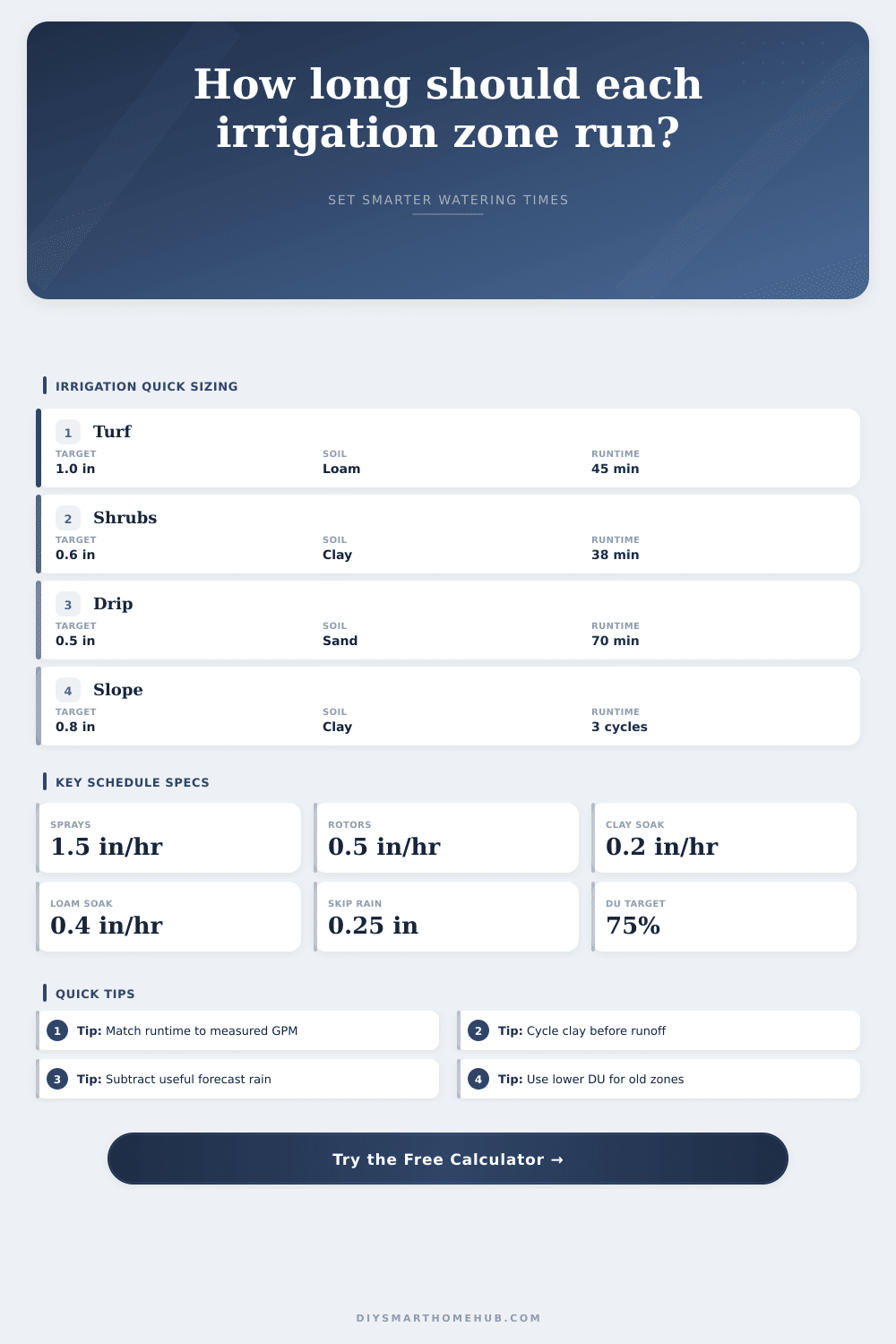
High precipitation rate, usually limited by soil intake before weekly water volume.
Rotor zones
Lower precipitation rate, longer runtimes, better fit for larger turf areas.
Drip zones
Flow is based on outlet count, so runtime depends heavily on emitter spacing.
Clay soils
Use more starts with shorter cycles because intake rate is the limiting factor.
Smart skips
Rain and ET adjustments change target depth before runtime is split by days.
Thirty minutes, three times a week, says manual. That’s what you put on irrigation controller. And so you watch water bill rise and hope for the best.
Landscape math is seldom straight line stuff. Local weather patterns and soil texture influences how water moves. Other things also matter, such as what kind of nozzles the sprinklers has. What seemed like a reasonable plan may turn out to be soggy runoff or parched grass.
Why Your Watering Schedule Needs to Change
The calculator above run the numbers for you. It makes idea of variables real. It does not just tell you what time to do something but how to make a strategy based on how water will actualy move around in your particular yard. Knowing the precipitation rate, how fast your sprinklers are applying water… Is first key to building any solid schedule.
In inches per hour, that’s how fast they’re going. On sandy soil, maybe you can gets away with a quick-dri rotor; on clay, exact same nozzle will leave you with standing water before cycle completes. To figure it out automatically, the tool needs to know how much flow you have and how many head there are.
With that, it figures out how fast the water’s falling, and then it compares that rate different than how fast the soil below absorbs it. If the rate of application is faster than the rate of absorption, it’ll divide up the run time into soak-in-between-cycles period. There is no runoff, but there isn’t less water for the roots, either.
It may seem like a tiny detail, but for efficient watering, it is more important then anything else. Finally, consider uniformity of distribution. Nothing covers a surface perfectly evenly. Nozzle wear, head misalignment and wind cause some spots to be hit harder than others. The efficiency input is there to adjust the overall run time up to compensate so even the driest locations still gets their desired depth.
If you ignore it you can have chronic dry spots, even though everything seems watered well enough on average. There’s a table on the page with typical ranges for various equipment, but in real world you’ll probably be somewhere in middle. Be conservative here so you don’t try to save thirsty spots by overwatering the lush ones.
The device add another level of smartness by making weather-based adjustments on the fly, which is beyond what manual controller can do. For instance, if it’s calling for rain, it’ll back off that number by whatever amount and then tell you how long to run so that you don’t water things that are already getting wet from above. That sort of dynamic adjustment, while maintaining good plant health, doesn’t waste any resources in the case of an impromptu storm.
It makes you think of water as something you put in as needed, not just a set-in-stone thing you do automatically. And there’s one thing folks do wrong most often: they forget to take into account what kind of soil they have. Soil that’s mostly sand will drain fast and need lots of little cycles; soil that’s mostly clay will hold onto moisture tightly and absorb it slowly… So it needs longer intervals between starts. In-between loamy soil is happy right where it is.
Do everything once and for all and you’ll either overwater or underwater (at minimum) someone’s zones. By allowing you to designate separate settings for every zone, the calculator keeps those factors distinct. Maybe your backyard uses rotors and your front lawn use spray heads? Get a custom prescription for both.
The bottom line: Respecting the laws of physics trumps following a schedule. The way water behaves when it hits the ground, and how quickly it reaches there, matter. Targeting treatment with real-world data like soil types and specific hardware details replaces haphazard guesswork based off a timer set at some number pulled out of the air. Not only will your utility bill be happy, but your plants would of too.