Smart Pet Water Fountain Refill Interval Calculator
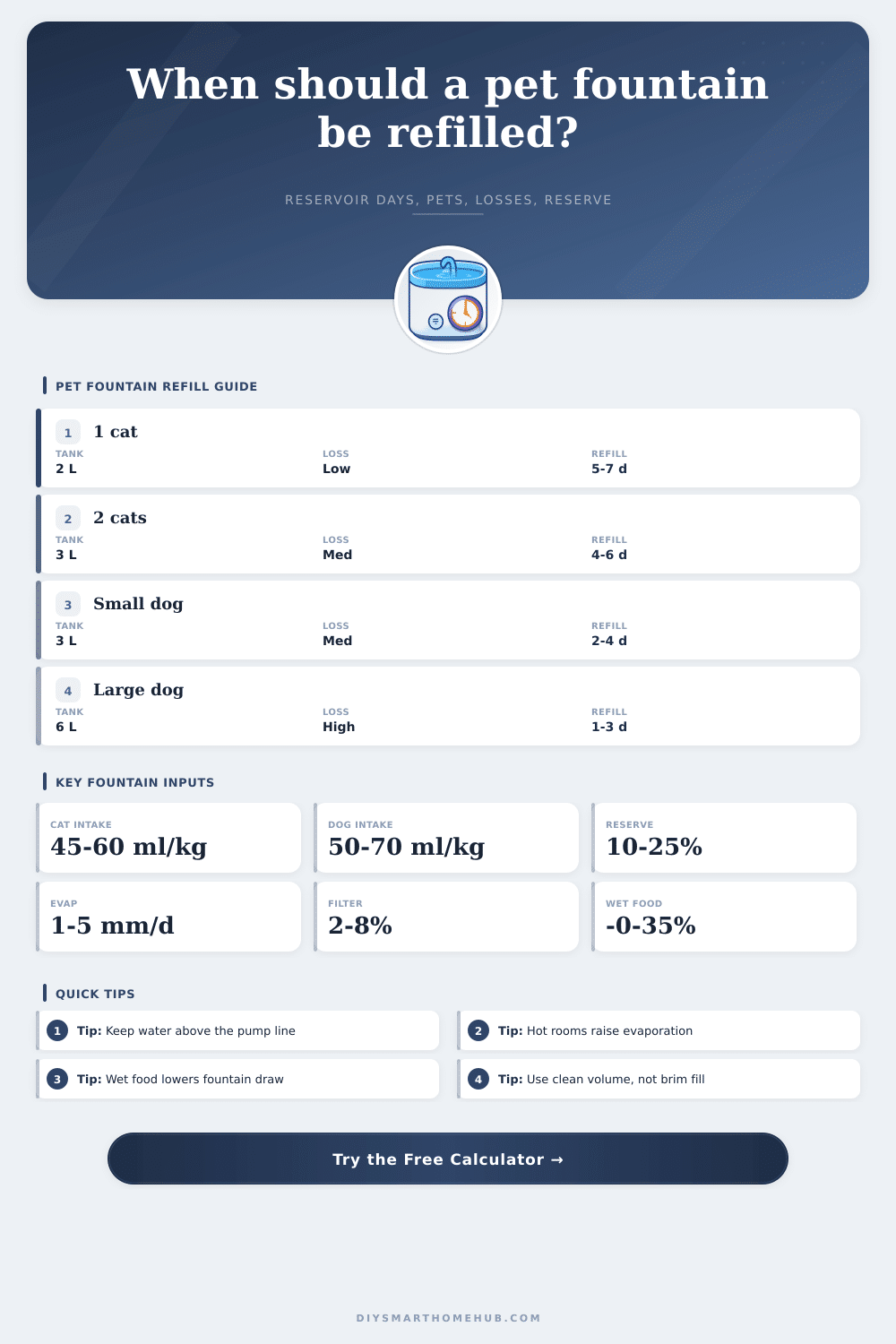
Estimate how many days a pet fountain can run before refill by combining reservoir volume, pet weight, daily intake, wet-food adjustment, evaporation, filter loss, splash loss, and pump-safe reserve.
📌Quick fountain presets Choose a starting point
⚙Fountain inputs Metric or US units
🧮Formula model What is included
📊Refill results Daily draw and safe days
📘Reference specs Planning ranges
| Pet type | Planning intake | Typical fountain draw | Note |
|---|
| Fountain style | Loss range | Evap exposure | Use case |
|---|
| Scenario | Reservoir | Daily draw | Safe refill |
|---|
If it’s quiet in your home, then it’s likely that one of two things are going on: Your pet is sleeping, or they want out when you’re still asleep. Or maybe you have a ceramic fountain because your pet doesn’t like stale water sitting still in their dish…or because it smells bad. Whatever the reason, the unit was supposed to ensure your pet had access to fresh water all the time. And then you realize there isn’t much water left by the pump. Hmmm, this can’t be good. Should I refill now? Is this okay? Do I want my pet drinking from such a small amount of water?
No worries; the calculator does all the work based off your pets’ habits & tank size. But it doesn’t stay the same, cats drink different amounts depending on what’s in their bellies (wet vs dry) as well as seasonally and based on other environmental factors. For example, if they eats mostly wet food, they will need less water than a cat that eats only dry kibble because wet food already has water in it while dry food does not. If you ignore that fact, you’ll overestimate how frequently to top up the water dish.
Why Your Pet Needs Fresh Water
Maybe your cat drink 3 cups a day? But that’s assuming he’s eating almost no wet food. If he gets even a tiny fraction of his calories from something moister, then his total water consumption will be much lower. To adjust for that, the tool lets you enter the percentage of wet food, which turns generalized guidance into volume predictions specific to your individual situation.
Any appliance that is left open-top will evaporate some amount of water from it. Radiators, particularly in winter, get hot and make the water dissapears fast from the fountain. The water does not go down your pet’s throat; it goes up in the atmosphere as vapor. How much depends greatly on humidity. Even with a comparable pet, you’ll have less evaporation from your fountain in a humid coastal location than in a dry desert town. That’s why there are surface area inputs. If you have a shallow bowl (lots of width), you expose more water to the air then if you had a narrow deep reservoir (lots of height). This speeds the water loss, whether or not your pet’s doing anything about it.
Beyond that, there are inefficiencies from the machine itself. Water gets soaked up by filters as if they were sponges. Moisture get trapped inside carbon media even during a cleaning. Pumps require some level of submersion depth to operate without noise and potential damage. None of these can be 100% efficient, none of it can account for every single milliliter in your tank. There needs to be a safety buffer.
The calculator asks you to set a reserve. How long do you want to plan for before exposing the pump? What’s the longest number of days without a pump running? There will always be days where the pump isn’t operating, so you don’t want to plan on zero days with the pump out. Engineering limitations becomes scheduling choices.
But lots of people just fill according to a schedule. Bad idea! Filling once a week whether you need it or not is wasteful and dangerous. You could run out of water and damage pumps. Learn how much water you use each day for filter retention, drinking, and evaporation. This helps you know when you are getting close to being out of “safe” territory. Most homes are not represented in this chart; they change based off regional humidity or habits (pets, for example). Enter conservative figures at first. If your pets is playful or anxious types, assume more activity. Take into account heavy lapping from dogs (splash loss). This margin guards against dietary changes and heatwaves.
Four days shows up in the calc? View this number as the MAXIMUM (not a recommendation). Better safe than sorry: refill on day three rather than risk going dry on day five. It is all about peace of mind. That is what matters most. You want pets hydrated and the fountain running quietly in the background. There is no stress or fuss. Keep the pump underwater and the water flowing and you’ll be able to rest easy with the numbers backing your plan.