Robot Lawn Mower Boundary Wire Length Calculator
Estimate total mower wire from lawn perimeter, area shape, obstacle island loops, guide wire runs, dock lead length, connector allowance, and planning slack.
Shape formulas
| Shape | Area formula | Perimeter formula | Best use |
|---|---|---|---|
| Rectangle | length x width | 2 x (length + width) | Most lawns, side yards, simple zones. |
| Circle | pi x radius squared | pi x diameter | Round courtyard or island-like lawn. |
| Triangle | 0.5 x base x height | base + side A + side B | Corner lots and wedge-shaped lawns. |
| Custom | entered area | measured perimeter | Irregular lawns measured with wheel or map. |
Wire components
| Component | Calculator formula | Included in loop limit | Planning note |
|---|---|---|---|
| Boundary perimeter | shape perimeter | Yes | Main mowing edge that defines the working area. |
| Obstacle islands | count x (island perimeter + 2 x lead) | Usually yes | Lead pair is physical wire, even when paired wires cancel signal. |
| Guide wires | guide count x guide length | No | Separate return path for docking and remote areas. |
| Dock lead | entered dock lead length | Partial | Use for station approach, connector pigtails, and extra service wire. |
| Project layout | Typical area | Boundary estimate | Added wire focus |
|---|---|---|---|
| Small front lawn | 1,000-1,800 sq ft / 93-167 sq m | 130-190 ft / 40-58 m | Dock lead and one guide wire. |
| Suburban backyard | 2,500-5,000 sq ft / 232-465 sq m | 220-360 ft / 67-110 m | Tree rings, beds, and guide wire length. |
| Large open lawn | 8,000-14,000 sq ft / 743-1,301 sq m | 400-600 ft / 122-183 m | Spool count and mower loop limit. |
| Complex garden | 4,000-9,000 sq ft / 372-836 sq m | 350-700 ft / 107-213 m | Island leads, corridor routes, and slack. |
I bought mower to get my weekends back, but I guarantee I’ll spend at least one weekend on my knees in the grass, holding wires and staples.
It is not exactly an engineering exercise; it is as much about geometry as anything else. Run short of wire by twenty feet from the finish line? Underestimated the length needed. Run too far long? Half a spool of pricy cable that never sees the light of day ever again. The boundary wire are the marker for the whole working area. Get the math correct first thing, before you go stapling and save yourself many frustrating hours.
How to Calculate Wire Length for Your Robot Mower
The first error most folks make: They measure their lawn in square footage… And then they quit. Sure, knowing the square footage help determine the proper size mower, but it won’t tell you how much boundary cable you’ll need. A long, skinny stretch covering exactly the same amount of ground will require many more yards of perimeter wire than a short, fat, compact square yard. Think of it this way: Surface isn’t linear; neither is your wire requirement.
Plug your dimensions and shape into calculator above, and math gets done for you. No more guesswork about turning area into linear length. It also takes into account all the hidden expenses that come with installing a system. This includes extra boundary wire needed to reach an out-of-the-way tree trunk, plus the slack necessary for any sharp corners. Projects typically get wonky at those obstacles.
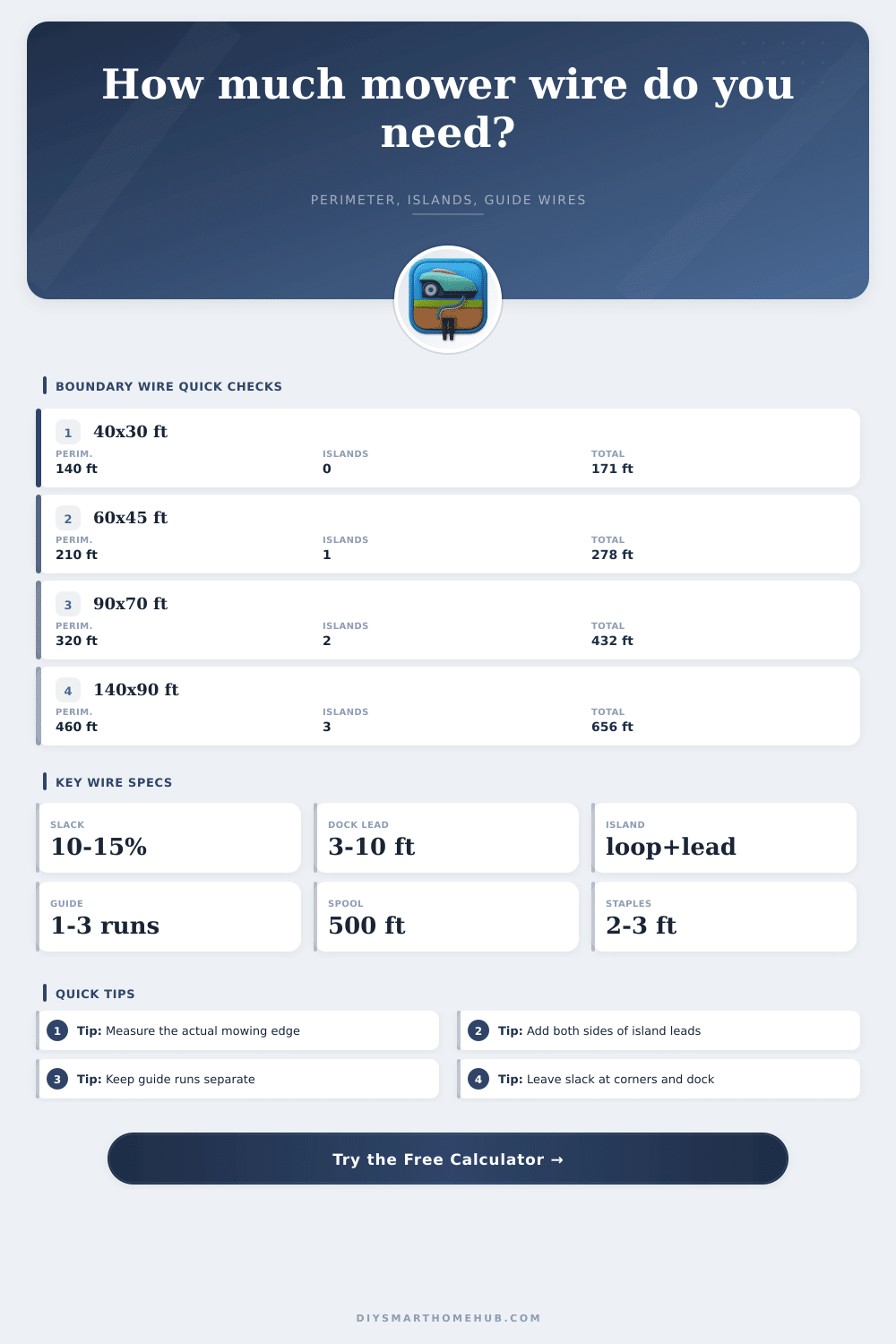
An island loop is something you create when you have a big oak that you want to protect, or maybe a rose bed that needs protecting. It’s not just the perimeter of the circle surrounding the tree; you’ll run some sort of lead wire from the main boundary to the island and then return to complete the loop. I’ve seen other guides reference this out-and-back necessity but they don’t always point out how it effectively doubles the linear cost of each obstacle. What looks like a minor island may be small until you consider that you’re going to be running two feet of wire for every solitary foot approaching it.
If you input number of islands and their average distance from the main line, the tool will factor all that in automatically and turn what would otherwise be a complicated routing puzzle into a straightforward multiplier.
The other thing that trips folks up is guide wires. These don’t count toward the limit for size of your boundary loop, so they won’t change how much lawn area you can mow. But they still use some of your spool. If you have a tricky docking angle or a split yard, you are going to need those guides to lead your robot back home. Imagine them as highways cutting across the noise. Use them sparingly. You won’t need a lot, but just enough to cross over places where the robot could possibly get confused by nearby parallel wires.
Similarly, the dock lead (the shorter piece of wire running between the charging station and the rest of the perimeter loop) shouldn’t be so short as to create a sloppy mess right next to the charger or so long that it gets stretched out and wonky during installation. A few feet… Three to ten in most cases, will allow you to run it neatly and still give yourself some wiggle room if you need to make a repair down the road. Don’t forget to account for any connector cables and add a little extra for potential future repairs. You can manually adjust this using calculator so you don’t accidently cut your dock lead too short.
The last safety net is Slack. It is not waste. It is insurance against measurement error, soil settling, and the occasional need to tweak the position of a wire six months from now. Standard practice is to leave 10 to 15 percent slack. It has very little up-front cost, but prevents an expensive hardware-store run if it turns out you measured short by two feet. This is something that will sit in the ground for years, so a bit of redundancy pays the price of admission.
How much to get: Before making a purchase, check the amount of line per roll. Many are standard at 500 feet. It’s important to know exactly what you’re looking for beforehand to avoid overspending. You should of always try to be on the safe side. The chart on the page shows typical lot sizes to give you a ballpark estimate. You can fill in the blanks from there. Usefulness always meets accuracy here. No need to be perfect. Just functional.
A tidy loop confines the mower to stay within your intended area, not in your flower beds. After all, once the wire is stapled down (and then buried) it will no longer even be seen. Yet if the math was off by even one foot, you’ll know about it with each following episode where the robot becomes wedged at the perimeter of lawn life. The less digging required, the fewer staples, the sooner you get back to listening to the sweet sound of a self-sufficient yard. It is tedious business now, but it is a purchase in freedom later.