Smart Window Opener Stroke Length Calculator
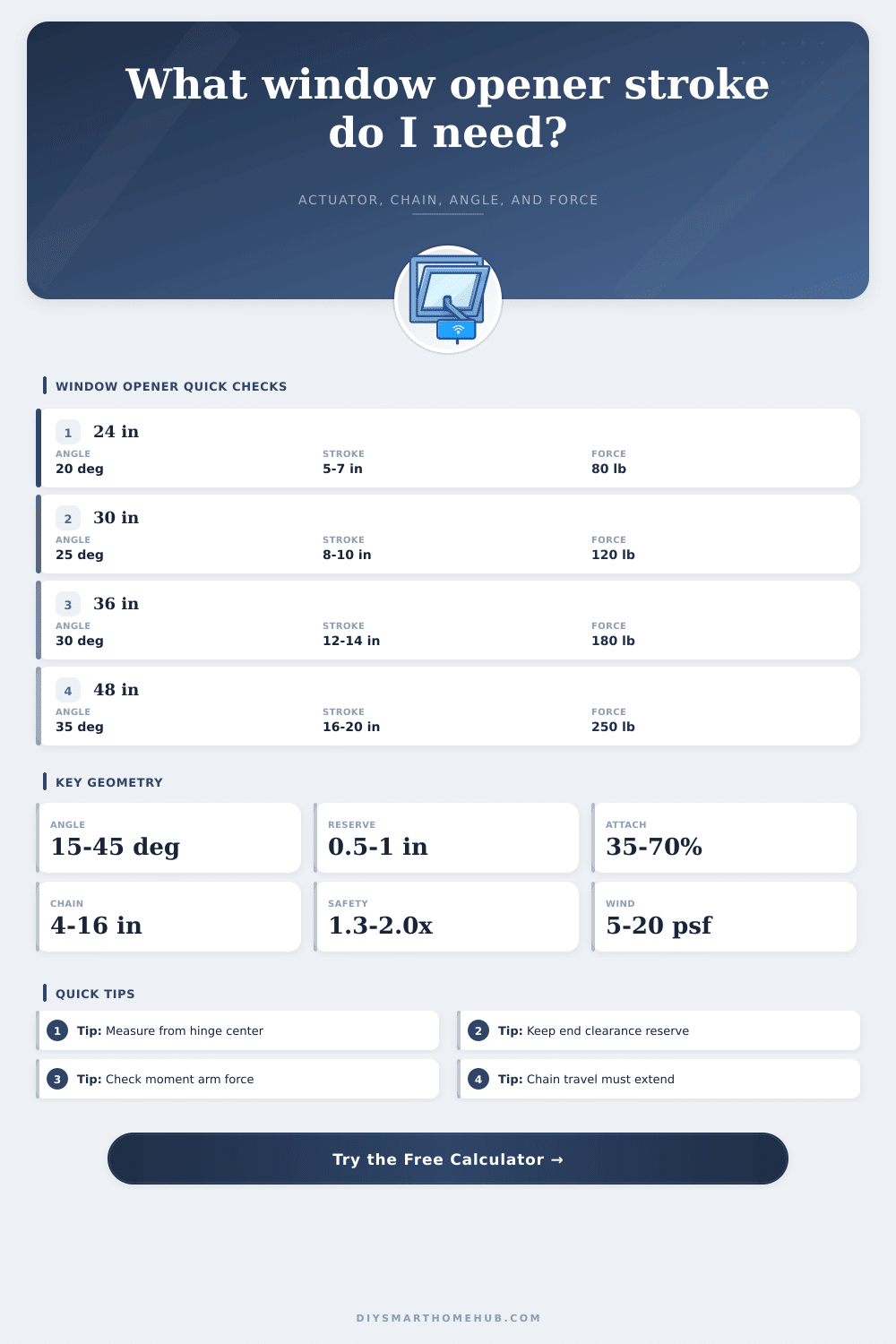
Size a smart window opener from real sash geometry: hinge distance, bracket coordinates, opening angle, chain travel, actuator reserve, clearance, wind load, and maximum force.
Calculated opener geometry
Stroke, chain travel, clearance, angle, and force are calculated from hinge coordinates.
| Window type | Common angle | Geometry focus | Force risk | Practical sizing note |
|---|---|---|---|---|
| Top-hinged awning | 15-35 deg | Attach point 45-70% down sash | Medium, rises with angle | Check free-edge gap and bottom-out reserve. |
| Bottom-hinged hopper | 10-30 deg | Shorter opening for safety | Medium to high | Use a positive hold-open or rated actuator lock. |
| Side casement | 20-60 deg | Bracket angle and side clearance | Often wind-led | Gravity torque is lower, but wind load can dominate. |
| Roof vent or skylight | 10-40 deg | Large moment arm needed | High near closed | Use conservative safety factor and verify hinges. |
| Formula check | Expression | What it tells you | Watch-out |
|---|---|---|---|
| Sash anchor at angle | x = a sin(theta), y = a cos(theta) | Open bracket coordinates from hinge center. | Use the same units for every length. |
| Actuator length | L = sqrt((xF - x)^2 + (yF - y)^2) | Closed and open pin-to-pin distances. | Stroke is the difference between max and min length. |
| Free-edge gap | gap = sash depth x sin(theta) | Approximate clear opening at the far edge. | Frame stops and seals can reduce usable gap. |
| Moment arm | m = |P x F| / L | Leverage of actuator line about the hinge. | Small moment arms create high force demand. |
| Force demand | F = torque / moment arm x safety | Minimum static force rating target. | Add margin for binding, wind, and cold seals. |
| Actuator class | Common stroke | Typical force rating | Best fit | Commissioning check |
|---|---|---|---|---|
| Compact chain opener | 4-12 in | 20-80 lbf | Light awning, hopper, and small casement windows | Verify chain compression and closing pull-in force. |
| Linear DC actuator | 2-18 in | 100-400 lbf | Heavy sash, deep awnings, and retrofit brackets | Check end-limit reserve at both closed and open positions. |
| Rack or spindle opener | 6-24 in | 80-300 lbf | Roof vents, greenhouse panels, and high-friction seals | Confirm bracket geometry does not side-load the drive. |
| Twin actuator pair | 8-24 in | 2 x actuator rating | Wide skylights or long louver banks | Synchronize travel so the sash does not rack. |
A lot of times the first clue that your automated window project didn’t go so well is when you hear the motor straining to move a heavy sash and then stopping because it couldn’t push any harder. On paper the opener look like it’s got some juice under the hood, but there were some geometric factors wrong here. People think all you have to do is ensure the stroke matches the window size… but there are physical laws at play here.
Half of formula is stroke length, the other half is force. And force is all about the location of brackets’ mounts in relation to the hinge axis. If you gets those coordinates wrong, you will burn out the mechanism in a year or two, no matter how strong you are. You don’t have to work out any angles and sine curves in your head or on paper, the calculator does all that for you. By understanding why it’s asking for what it’s asking for, you’ll avoid running into problems with your install.
Why Your Window Motor Might Fail
Begin with the hinge distance (how much do you want the sash to move through space?) It goes from axis of rotation to the edge of opening glass. Next is bracket placement. Here’s where many DIYers gets tripped up. The closer to the hinge you attach the actuator, the less force will be required to raise the sash. However, more of the travel distance will also be consumed. There’s no getting around it, there’s always a tradeoff between short stroke and low force. If your mounting choices is quite generous, then maybe…
It also accounts for environmental loads, something the purely mechanical calculation systems tend to neglect. An open window isn’t just an annoyance caused by wind pressure; when the opener tries to pull the sash shut against a strong wind, it puts a lot of twisting force on the mechanism. A gentle breeze still provides leverage all along the surface area of glass. For any given sash size and angle, the calculator will apply that wind load (along with the static load of glass and frame) and adjust accordingly. It could mean that two otherwise-identical-sized window need wildly different actuators due to their orientation (one facing a protected courtyard, the other an open field). That’s exactly how it’s designed to work: The math changes to match reality.
Lastly, there’s the issue of clearance. On both ends of the actuator’s travel, it requires space in order to operate. If you calculate how far the actuator must go but leave no wiggle-room in either direction, it will hit its physical limit. This will cause it to bang into the end of its travel and cause premature wear and tear on the limit switches and internal gears. The reserve field of the calculator exists for exactly this reason: so you know your selected hardware won’t be without a few millimeters of play when at full extension or retraction. It’s the difference between something lasting a decade versus grinding to a halt within six months.
The force rating values you see on manufacturers’ datasheet is often inflated, however, as they’re based off best-case scenarios. Weather, temperature fluctuations, small bracket-mounting misalignment, or even some resistance from imperfect weather sealing will add to the work load that the motor has to performs. Adding a cushion is worth doing to account for the factors above. To do this, the calculator lets you choose a multiplier depending on how cautious you want to be. Choosing a higher multiplier (or being conservative) results in selecting a stronger unit then strictly necessary. Which costs a bit more initially, but saves you the worry about whether the unit’s up to a particularly nasty night out.
To make this all contextual, the tool includes reference tables that outline various types of window and the leverages associated with each type (e.g., side-casements vs. It is a top-hinged awning. All have their own set of leverage challenges. Casement windows face more of a challenge laterally with wind load; whereas awning windows is fighting gravity head-on as they open up and out. Knowing what dominates your specific application will help you know where to focus your inputs. Are you primarily concerned about wind? Then pay attention to the pressure settings. Is it more about weight? Then you’ll want to pay attention to the center of gravity percentage.
Selecting a motor for your Smart Window Opener isn’t as much about choosing strength as it is finding the right size. How do you apply that strength? That’s where the math come in. Picture yourself drawing a triangle between the three elements: your sash bracket, your frame bracket, and your hinge. Control that triangle and you’ll have control over this system’s effectiveness. Get the three points in alignment and a moderate actuator feels like nothing. Get them out of whack and even the strongest one will tire. You should of respected the arc of motion before you drill a single hole.