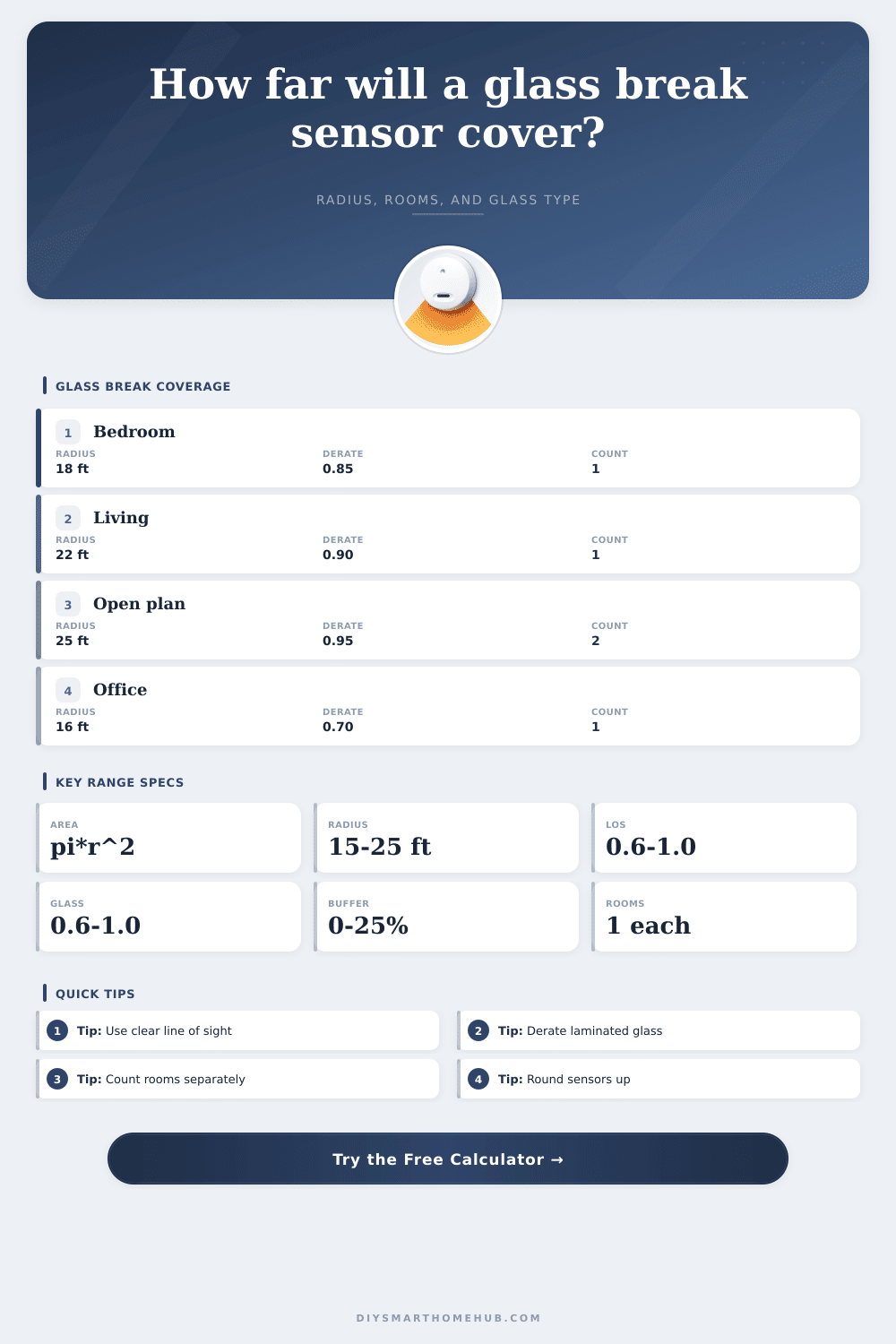
Glass Break Sensor Coverage Radius Calculator
Estimate effective glass break sensor range, circular coverage area, room attenuation, line-of-sight derating, glass type sensitivity, and room-by-room device count.
🎯 Room coverage presets
⚙ Sensor, room, and glass inputs
Coverage geometry and acoustic derates
Live planning assumptions
📐 Current setup spec cards
📊 Coverage and formula reference
| Formula part | Calculator logic | Example | Meaning |
|---|---|---|---|
| Circular area | pi x radius squared | 3.1416 x 20 x 20 | Base acoustic coverage area. |
| Effective radius | Listed range x derates | 20 x 0.76 | Range after glass, room, and line-of-sight losses. |
| Room count | Room area / coverage area | 540 / 430 | Rounded up per separate room. |
| Room attenuation | Acoustic condition factor | 0.78 to 1.00 | Soft or noisy rooms reduce useful range. |
| Range margin | Effective radius - farthest glass | 15.2 - 14 | Positive margin means the farthest pane is inside range. |
| Glass type | Range factor | Planning note | Typical use |
|---|---|---|---|
| Single pane or plate | 1.00 | Most favorable acoustic signature. | Older windows and interior glass. |
| Tempered glass | 0.90 | Slightly reduced sensitivity allowance. | Doors, sliders, and safety glazing. |
| Double-pane insulated | 0.80 | Air gap and frame mass reduce transfer. | Modern exterior windows. |
| Laminated security | 0.65 | Interlayer can reduce break signature. | Impact glass and security panes. |
| Film, coating, drape | 0.70 | Added layers and fabric absorb energy. | Privacy film or heavy curtains. |
🔊 Room attenuation and line-of-sight table
| Line-of-sight condition | Factor | Calculator effect | Placement meaning |
|---|---|---|---|
| Clear direct path | 1.00 | No line-of-sight derate. | Sensor can hear glass without barriers. |
| Curtains or light furniture | 0.88 | Modest radius reduction. | Soft materials absorb some sound. |
| Partial wall or tall furniture | 0.75 | Material radius reduction. | Direct sound path is partly blocked. |
| Around corner or alcove | 0.60 | Strong radius reduction. | Use caution for cornered glass. |
| Separate room through doorway | 0.45 | Severe radius reduction. | Count rooms separately when possible. |
| Room profile | Factor | Coverage result | Use in calculator |
|---|---|---|---|
| Hard surfaces | 1.00 | Full room factor. | Tile, drywall, sparse furnishings. |
| Typical furnished | 0.92 | Normal planning derate. | Most bedrooms and living rooms. |
| Soft furnishings | 0.82 | Lower effective radius. | Carpet, heavy drapes, dense furniture. |
| Noisy appliances | 0.78 | Lower confidence allowance. | Kitchen, laundry, HVAC adjacent rooms. |
| Divided room | 0.68 | Strong attenuation. | Half walls, archways, or alcoves. |
🏠 Common room examples
| Room example | Typical area | Common derate | Planning result |
|---|---|---|---|
| Bedroom with two windows | 120 to 220 ft2 | 0.78 to 0.92 | Often one sensor if glass is inside effective radius. |
| Living room with slider | 250 to 500 ft2 | 0.70 to 0.88 | One or two sensors depending on farthest glass distance. |
| Open plan first floor | 600 to 1100 ft2 | 0.65 to 0.85 | Multiple sensors may be needed for room area and edges. |
| Sunroom or glass wrap | 250 to 650 ft2 | 0.75 to 0.95 | Area can be easy, but farthest pane margin matters. |
| Separated rooms | Multiple rooms | 0.45 to 0.70 | Count each acoustic room independently. |
💡 Calculation notes
A glass break sensor, on the other hand, is often assumed to operate similar to a motion detector. In reality, most people imagine an invisible bubble around the sensor, expecting it to detect any broken pane inside that sphere. Which is exactly why alarms fail when people actualy attempt this: Sound doesn’t behave like a ball bouncing in your livig room. It’s absorbed into thick curtains and reflected by bookshelves. It also becomes less intense when passing between various kinds of glass.
To put it simply: the calculator above will do the math for you; knowing how to understand the physics behind those numbers is what keeps you safe. But here’s the key variable: Line of sight. The acoustic sensor are listening for those exact same super-high-frequency sounds we know as breaking glass. If there are thick curtains in front of the window or even just a large piece of furniture like a tall sofa, that sound will get muffled before it reaches mic. Sure, you may be inside the advertised distance range, but your effective range will be much lower. It’s less about how close you are and more about having a clear line of sight.
How Glass Break Sensors Work
This is why installation guidance often recommend mounting the thing high up on a wall (or even the ceiling). Looking down from up above means the sensor can see the glass without crossing any obstacles. There’s one other variable that most installers don’t consider: glass type. Windows treated with heavy privacy film or made from laminated security glass create a unique sound pattern different than traditional single-plate glass. Specifically, the interlayer in laminated glass dulls that characteristic crackling sound that these sensors are attuned to pick up on. As such, when you choose your glass type in the calculator, it will apply a reduction factor to compensate for the decreased sensitivity.
Yes, it sounds complicated, but the takeaway is quite straightforward: if you live in a house with moddern impact-resistant windows, then the sensor should of be closer to the window than it would otherwise be in an old house with flimsy single-pane sashes. The same applies to room acoustics. Hard bare walls in a sparse room reflect sound waves well. They help the sensor hear more effectively. On the other hand, a plush den full of carpets, velvety curtains and soft furnitures is like a anechoic chamber built for recording studio work. It will swallow up the very sounds you wish to pick out.
The calculator also factors in this loss. You’re not just calculating distance but also amount of surviving energy that made the trip from break to receiver. One more important rule: Sensors typically don’t penetrate walls. Many of us attempt to install one central unit to serve both our master bedroom and room next door. Why? Because we assume that sound will pass through drywall and interior doors without issue. Nope! The attenuation across a doorway is so extreme that the signal is completely lost in background noise. Each unique acoustic room require its own device.
So yes, you’ll probably end up with more than expected, but this is how you get coverage. With your inputs established, check the margin. Is it a positive figure? That means all your windows are within their effective radius. This holds true even after accounting for glass damping and furniture absorption, including for the most distant window. Is it negative? Too bad; no matter how much you tweak sensitivity settings, you’re sunk. Time to use an additional device near unprotected glass. Two devices with comfy margins is better then one pushed to its limits.
This takes some planning, and patience. First, sketch out your line of sight. Where do pieces of furniture obstruct your vision? What’s the glazing material on every window? Next, try to put things away using the numbers instead of going based off gut instinct. Because while the plan might look complete, will it actualy detect anything if needed? Until math matches the real world of your environment, you’ll never have that sense of peace.