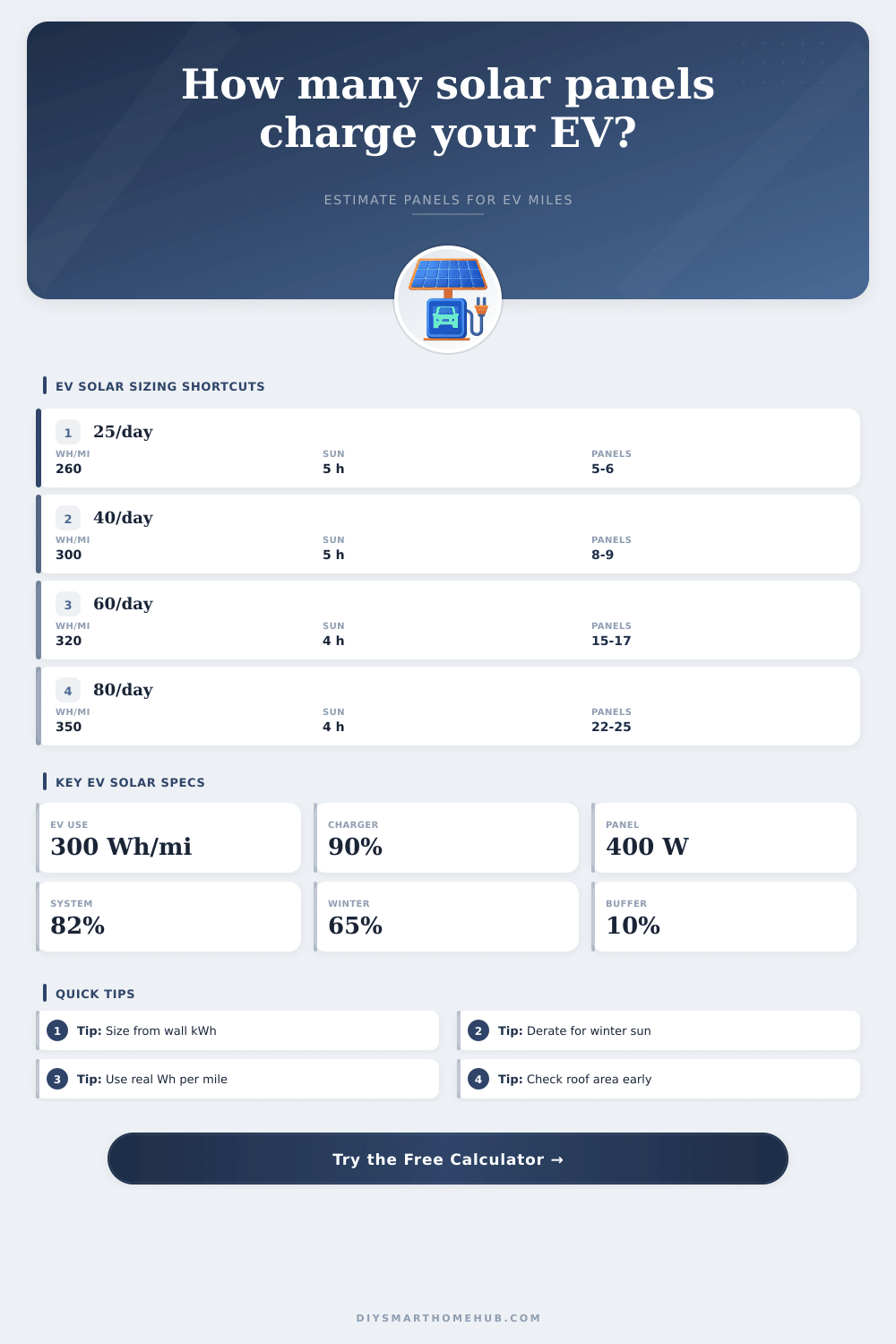
Solar Panels to Charge EV Calculator
Estimate how many solar panels are needed to cover EV charging from daily miles, vehicle efficiency, charger losses, panel wattage, peak sun hours, system efficiency, and seasonal derating.
Detailed EV solar breakdown
| EV type | Typical Wh/mi | 30 miles/day | 50 miles/day |
|---|---|---|---|
| Small efficient EV | 240 to 280 Wh/mi | 7.2 to 8.4 kWh battery | 12.0 to 14.0 kWh battery |
| Midsize sedan | 280 to 330 Wh/mi | 8.4 to 9.9 kWh battery | 14.0 to 16.5 kWh battery |
| Crossover or SUV | 320 to 390 Wh/mi | 9.6 to 11.7 kWh battery | 16.0 to 19.5 kWh battery |
| Pickup or van | 400 to 550 Wh/mi | 12.0 to 16.5 kWh battery | 20.0 to 27.5 kWh battery |
| Panel rating | 4 sun hours at 80% | 5 sun hours at 82% | 6 sun hours at 85% |
|---|---|---|---|
| 350 W panel | 1.12 kWh/day | 1.44 kWh/day | 1.79 kWh/day |
| 400 W panel | 1.28 kWh/day | 1.64 kWh/day | 2.04 kWh/day |
| 450 W panel | 1.44 kWh/day | 1.85 kWh/day | 2.30 kWh/day |
| 500 W panel | 1.60 kWh/day | 2.05 kWh/day | 2.55 kWh/day |
| Home charging level | Power range | Wall energy for 40 miles | Charging time clue |
|---|---|---|---|
| Level 1 outlet | 1.2 to 1.4 kW | About 13.3 kWh at 90% | Often overnight or longer |
| Low-power Level 2 | 3.3 to 5.8 kW | About 13.3 kWh at 90% | Useful for modest daily miles |
| Common Level 2 | 7.2 to 9.6 kW | About 13.3 kWh at 90% | Usually a few hours |
| High-power Level 2 | 11.5 kW plus | About 13.3 kWh at 90% | Fastest home refill when supported |
| Scenario | Daily EV miles | Daily wall kWh | Likely panel range |
|---|---|---|---|
| Short city commute | 20 to 30 miles | 6 to 10 kWh | 4 to 7 panels |
| Typical suburban commute | 35 to 50 miles | 12 to 18 kWh | 8 to 13 panels |
| Long daily commute | 60 to 80 miles | 20 to 32 kWh | 14 to 25 panels |
| Two-EV household | 70 to 110 miles | 24 to 45 kWh | 17 to 34 panels |
| Winter conservative sizing | 40 to 60 miles | 15 to 25 kWh | 14 to 28 panels |
EV energy
The calculator first converts driving into battery energy with miles multiplied by Wh per mile, then divided by 1000 for daily EV kWh.
Charger loss
Wall energy is higher than battery energy because charging is not perfectly efficient. Wall kWh equals EV battery kWh divided by charger efficiency.
Solar yield
Each panel's daily kWh uses panel watts, peak sun hours, and system efficiency. Seasonal sizing applies the low-month derate before rounding panel count.
Renewable energy becomes a very particular kind of math when you decide to power an electric car from sunlight. This is a game of squeezing in your everyday driving onto available space on your roof. Miles translate into watts and square footage. Marketing claims come off; the real-world physics of your energy consumption become clear.
Begin with the car, but that can be misleading. You might know how many miles you drive, but perhaps not how much energy those miles actualy consume in your home. Power isn’t perfectly conserved from wall socket to your batteries. There’s some loss along the way: through the charger, not all electricity convert well into charging juice. Even if you have top-of-the-line chargers, some of it gets converted to heat. This inefficiency can amount to a few hundred more kilowatt-hours annually, and the tool accounts for that loss so you can tweak to match. Otherwise, you’ll underestimate what size solar system you actualy need.
How to Size Your Solar System for an Electric Car
Seasonal factors is important. The sun doesn’t perform consistently every day. During the summer months there are long days, with the sun high overhead. In the winter the days are shorter and the sun is low. What trees cast shadows in July might shadow your roof in October. Use the calculator to adjust the seasonal derate factor. That way, your system will function even on bad weather days rather than only during the summer. If you size for July, you will rely on the grid in January. Better to have an oversized array then one that fails when you most need it.
Most plans are limited by roof space. Your available unshaded roof area limits the size of system you can run. The tool computes how efficient such a system will be … and then factors in how much area it requires (for air flow and maintenance). Assuming that an average panel is roughly twenty square feet, what do you do if you need fifteen panels… Yet only have space for ten? There are two options. First, you can purchase some grid power while accepting that you’re only partly covering your usage. Second, you can increase panel efficiency to pack more watts into fewer square feet. Higher-efficiency panels are more expensive up front; it’s a tradeoff between energy independence and cash flow.
How much solar do I need? That depends on how you drive. Do you commute twenty miles around town or do you haul tools all over town? Four panels may be enough for one person’s needs; another person may need twenty. Driving at highway speed will also eat up your battery more quickly, since there’s aerodynamic drag involved. If it’s cold where you live, that will reduce your range because of heating and battery chemistry. In fact, if you live in a cold climate, you will notice that your “effective” miles per kilowatt hour declines in winter. Use conservative numbers for efficiency on the calculator. Better safe than sorry!
But that’s just it: Your set of circumstances are different. You’ve got an east facing roof or an old charger. Those factors alter things. Enter them as inputs into the calculator and tweak other assumptions, such as sun hours. What if they were only 4 instead of 5? This allows you to adjust for those factors. What happens when you raise your buffer percent by 10%? How does that affect your system size? That’s where the vulnerability analysis comes in. Rather than one static number, it helps you understand where you’re vulnerable.
When sizing solar for an EV it’s all about matching production to consumption, plus some margin of error. It’s building a personal power plant on your house. And doing so in such a way that can achieves off-grid for those miles. Use real driving data as a starting point. Be realistic about roof limitations. Trust the math to lead you to a solid system. Seeing how many solar panels equal ten gallons of gas helps you understand the scale. You regain control over your daily commute.