Microwave Wattage Calculator
Estimate cooking energy in watt-hours, effective output watts, circuit amps, and inverter or UPS surge headroom from the microwave nameplate and cooking time.
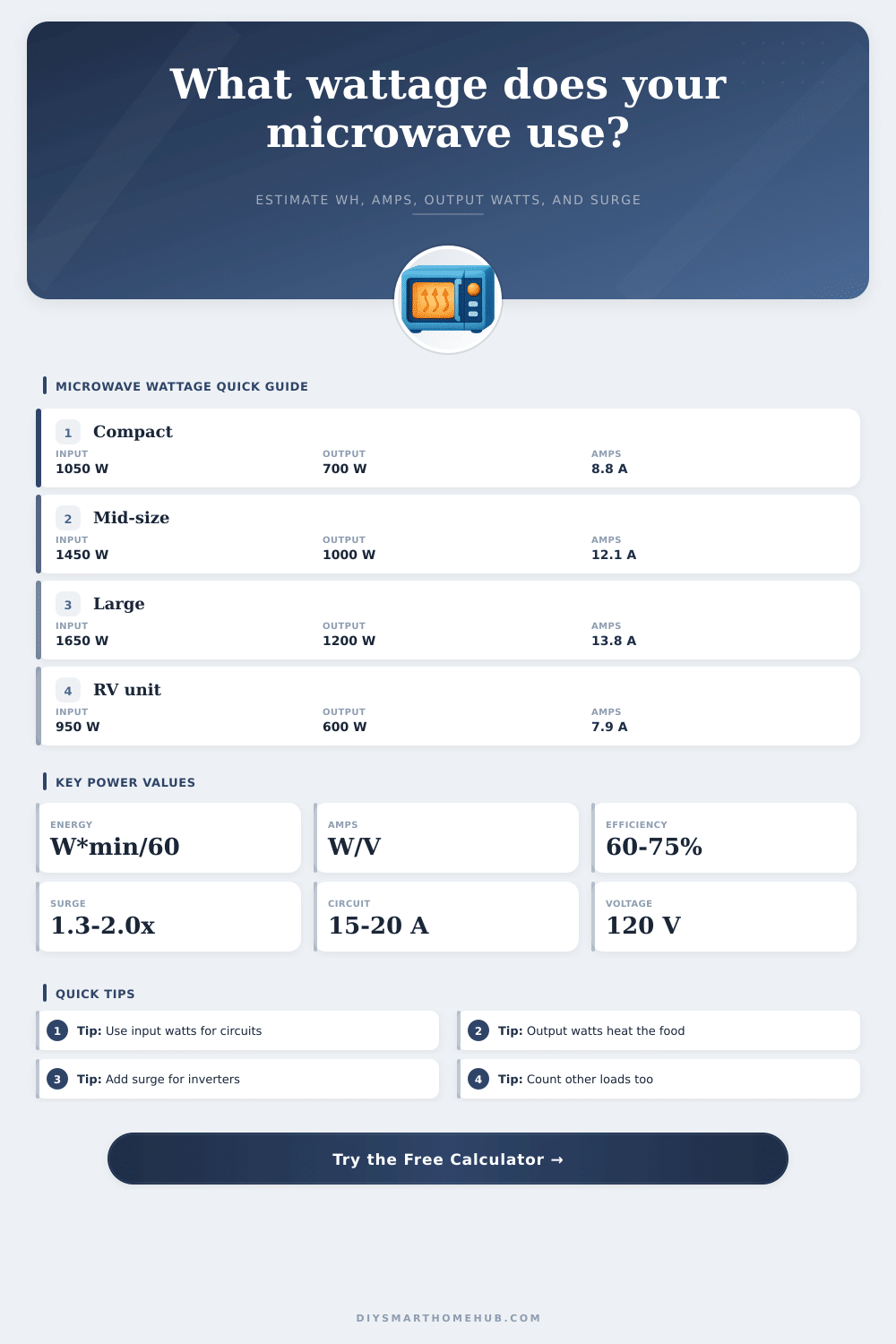
Microwave electrical input is usually higher than advertised cooking output. For circuits, inverters, and UPS sizing, calculate with input watts. For heating comparisons, use output watts.
| Label value | What it means | Formula used | Example | Result meaning |
|---|---|---|---|---|
| Input watts | Outlet electrical draw | Input W times minutes / 60 | 1450 W for 3 min | 72.5 Wh from outlet |
| Output watts | Heating power into food | Input W times efficiency | 1450 W at 69% | 1001 W cooking output |
| Power level | Average duty during cycle | Output W times level | 1000 W at 50% | 500 W average heat |
| Cook time | Total energized duration | Minutes plus seconds / 60 | 3 min 30 sec | 3.5 minutes |
| Input watts | Amps at 120 V | 15 A circuit share | 20 A circuit share | 1.5x surge watts |
|---|---|---|---|---|
| 900 W | 7.5 A | 50% | 38% | 1350 W |
| 1100 W | 9.2 A | 61% | 46% | 1650 W |
| 1450 W | 12.1 A | 81% | 60% | 2175 W |
| 1650 W | 13.8 A | 92% | 69% | 2475 W |
| 1800 W | 15.0 A | 100% | 75% | 2700 W |
| Scenario | Input watts | Power level | Time | Input energy |
|---|---|---|---|---|
| Coffee reheat | 1050 W | 100% | 1 min | 17.5 Wh |
| Leftover plate | 1450 W | 100% | 3 min | 72.5 Wh |
| Frozen meal | 1500 W | 100% | 6 min | 150 Wh |
| Defrost cycle | 1400 W | 50% | 12 min | 140 Wh average |
| RV warm-up | 950 W | 80% | 5 min | 63.3 Wh average |
| Check | Input needed | Formula | Good range | Watch item |
|---|---|---|---|---|
| Output efficiency | Input W and output W | Output / input | 60-75% | Low value means more heat loss |
| Circuit amps | Input W and voltage | W / V | Under breaker | Other loads reduce headroom |
| Inverter running | Input W and inverter eff. | W / efficiency | Rated above load | Battery current can be high |
| Surge rating | Input W and multiplier | W times margin | 1.5x typical | Some units need more headroom |
When you look at a microwave’s label, most of us only notice one set of watts. We don’t realize that there is actualy two sets of watts. One is for the amount of electricity the microwave consumes and the other is for the amount of heat it outputs into your food. Confuse the two and you’ll either burn out the microwave or trip a circuit breaker or drain your RV battery in the process.
To get a handle on household electricity, you has to know the difference between output power in watts and input power in watts. The power drawn from wall outlet is called input wattage. If you are looking at an inverter capacity or circuit breaker sizing, this will be important. The power that gets applied to your food is called output wattage.
Input vs Output Watts in Microwaves
Microwaves is about sixty to seventy-five percent efficient. That means the rest of the power becomes heat within cabinet and makes the back side of the operating microwave warm to touch. You’re paying for input watts; you’re getting benefit of output watts for your meal.
To avoid having to do any mental calculations while staring at a still-warm dinner plate, this calculator splits those two numbers apart. It use your cooking time and nameplate info to guess how many watt-hours your appliance use in total. As we all know, this usage costs money. Spending an extra few bucks on an efficient model will save you cash if you use a high-power microwave for half an hour every day. Over the course of a year, that can realy add up.
The other number it calculates, the circuit’s amperage, is important from a safety standpoint. Most kitchen outlets is wired with a fifteen-amp breaker. So if your microwave pulls down twelve amps, you don’t have much leeway for plugging anything else (like a coffee maker or toaster). Many homeowners think that if they buy a 1000-watt output heater, it take 1000 watts off the electric grid. Nope. Often these heaters takes 1450 input watts to get that much heat. If you plug that into a normal 120-volt outlet, it pull almost a dozen amps. Add in some older wiring or long extension cord resistance and you’re pushing the limit of what your house can handle for electricity.
The calculator lets you put other loads on the circuit and shows you how close you are. Got a microwave running on the same breaker as a space heater? The calculator will tell you just how close you are to tripping the breaker.
They also make costly errors on inverters that end up costing them money. An inverter is what take the electricity from your batteries (DC) and converts it into household current (AC). Inverters has trouble handling power surges. When your microwave starts its magnetron to fire up, it send a spike in power that for a split-second can be 50-100% more than its running wattage. If your inverter is precisely matched to the running watts, it’s going to die as soon as the microwave turns on. You want some headroom. With this tool, you can set a surge multiplier, which is typically 1.5x, 2.0x. This keeps your backup power system humming along while you are trying to prepare lunch during a storm.
And then there’s efficiency. The older ones is going to be rated with a lower efficiency rating then the new ones. So you put it in for 2 minutes and it takes longer to heat it than a newer one that is more efficient. They uses more electricity for less heating output. So your electricity bill goes up. And so does your wait time.
You should of always check the small print on the side or back of the unit, not just the big marketing number on the front door. Knowing these things will save you money and keep your wallet and your gear safe. You won’t have to guess about what is okay to plug into an extension cord. You will no longer wonder what the big energy guzzlers are. No more thinking that defrosting for 20 minutes at half-power consumes less overall energy than running at full power for five. Defrosting might be more or less efficient compared to other cycles.
It’s not that we shouldn’t be using electricity. It’s that we should be using electricity on purpose. By knowing why an appliance is plugged in, and which one it is, you gain control of the flow of power through your house. Your appliances stop being mysteries and become things you understand. This knowledge helps keep your food hot when you want it hot and keeps your breakers from tripping. It turns a confusing label into a helpful guide to livig.