Appliance Energy Cost by Schedule Calculator
Estimate appliance energy from running watts, cycle length, scheduled cycles, standby load, peak hours, and local kWh rates so you can compare monthly and yearly use.
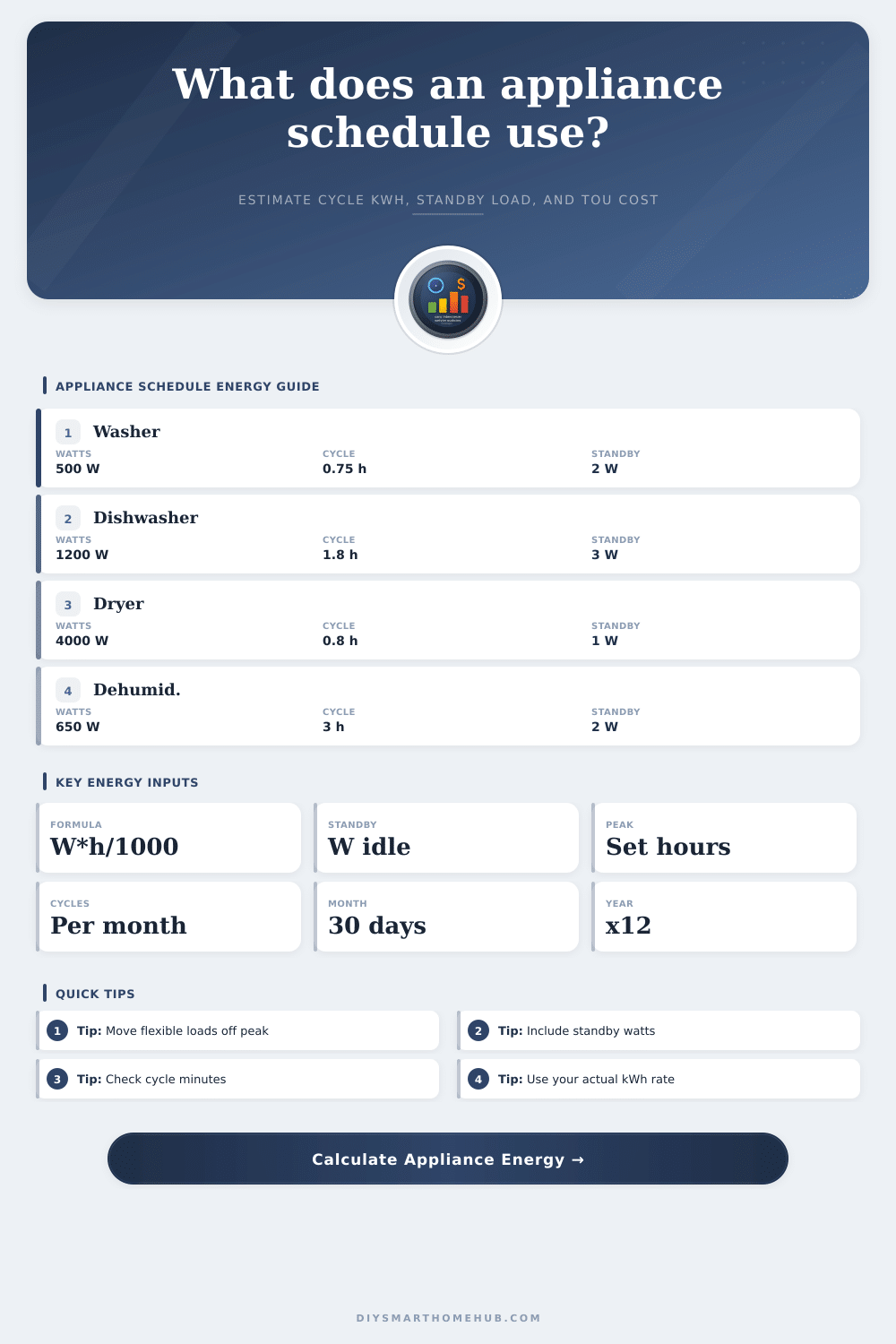
Moderate cycle power, short daily standby, and flexible schedule timing for off-peak operation.
Longer cycle with heating stages; start time strongly affects peak-period energy share.
High running watts make even one peak cycle visible in the monthly energy cost.
Small appliances with charging bases often combine short active cycles and all-day standby.
| Formula item | Formula | Example | Output |
|---|---|---|---|
| Cycle energy | W x h / 1000 | 1200 W x 1.5 h | 1.8 kWh |
| Monthly cycles | weekly x days / 7 | 3 x 30 / 7 | 12.9 cycles |
| Standby energy | W x idle h / 1000 | 2 W x 710 h | 1.42 kWh |
| Yearly energy | monthly x months | 20 x 12 | 240 kWh |
| Schedule | Cycles | Month factor | Best use |
|---|---|---|---|
| Daily | 1/day | 30 cycles | Dishwasher |
| Three weekly | 3/week | 12.9 cycles | Laundry |
| Weekdays | 5/week | 21.4 cycles | Coffee |
| Monthly | 2/month | 2 cycles | Oven clean |
| Appliance | Typical watts | Cycle time | Standby range |
|---|---|---|---|
| Washer | 350 to 700 W | 35 to 70 min | 1 to 4 W |
| Dishwasher | 900 to 1500 W | 90 to 150 min | 2 to 6 W |
| Dryer | 3000 to 5000 W | 35 to 70 min | 0 to 3 W |
| Robot vacuum | 25 to 80 W | 120 to 240 min | 2 to 6 W |
| Peak window | Hours/day | Effect | Check |
|---|---|---|---|
| Short evening | 3 to 5 h | High shift value | Start time |
| Afternoon | 6 to 8 h | More standby peak | Idle draw |
| Overnight | 6 to 10 h | Good for delay start | Cycle length |
| Flat rate | 0 h | No TOU split | kWh total |
Take a glance at your electricity bill. Why do the numbers seem a little high? Did you add any major appliance? Did you use more in general? Nope, you just used some of those appliances at peak times. Knowing how much energy appliances uses at different times can help account for the variation.
When do they draw off the wall socket? How long are they sitting idle until someone hit the start button? This is where the site’s calculator kicks in and does it for you. It takes into account your local rates and your cycle time. That way you don’t need to estimate based off peak usage.
Save Money by Changing When You Use Appliances
People generally only look at amount of active power used by an appliance. For example, they see their dryer pull 4,000 watts and assume that is the total cost. But there is also standby load. Your smart module or even a simple clock might draw two or three watts. But that runs all day, every day. And over the course of a year, those small idle loads adds up and can be significant expenses.
This is particularly true if you are like most homes today with lots of connected but always-on device. Here’s the thing about time of use: It alters the way we pay for electricity. During set periods, usually four to nine in the evening, your utility will charge you extra. Turn on a high-watt dryer at six PM, and you’ll pay much more then if you turn it on at two AM. Both instances use the same amount of energy, measured in kilowatts. But they don’t cost the same amount per kilowatt. That price varies depending on demand on grid within each window.
Suddenly, scheduling isn’t just convenient; it also becomes financially helpful. By moving flexible loads, such as laundry, to off-peak times, you lower your monthly bill without altering your lifestyle very much.
Below is an example of how different schedules maps to energy shares and corresponding cycle counts. Think about the shape of your energy use. Not just its magnitude. An oven on self-clean mode pulls like crazy. It only last for a short time (hours, rather than days) and perhaps no more than once or twice monthly. In contrast, a coffee maker is in keep-warm mode during the entire day, but consumes barely any electricity. The trickle of standby power adds up over weeks and months.
The point is to distinguish between slow leaks and intense bursts of energy. The former bleeds money slowly; the latter spikes the meter immediately. A lot of people don’t realize that appliance cycles also coincide with peak rate times. A long washing machine cycle that starts at five thirty could end around seven fifteen. That’s outside of the peak window. But the bulk of its motor work occur during peak hours (when your prices is highest).
The calculator breaks out how much of that washing machine cycle occur in the cheap bracket vs the expensive one. And it can tell you exactly what percentage of its energy consumption was during the premium rate. That really brings home what otherwise is an abstract idea: time-of-use pricing.
Then there are seasonal appliances. In the summer, a dehumidifier’s running hard while it hibernates in the winter. Working out its annual cost as if it were used for all 12 months would of resulted in an incorret figure. Adjust for the real operating period: how many months a year does it run? That’s its true contribution. Inputs for both cycle frequency and seasonality allows you to refine your annual estimate with realism.
The key, though, is learning those schedules, because once you do, your power bill becomes less mysterious, a series of options under your control instead of something beyond your reach. It’s not that you shouldn’t use appliances; it’s that you should be smart about when you use them. And be strategic about how long they stays plugged in while doing nothing. A little adjustment in the time the washing machine starts means a few fewer crazy jumps on your bill. Awareness isn’t perfect, but it’s the goal. When you learn that running the dishwasher at 1 pm costs more than running it at midnight, you adjust automaticly. Which translates into actual dollars saved.