Home Battery Backup Runtime Calculator
Estimate battery runtime from amp-hours, voltage, usable depth of discharge, inverter efficiency, real load watts, surge demand, reserve, age, and temperature derating.
Battery bank
Load and surge
Runtime Estimate
Formula Breakdown
Typical Backup Load Ranges
| Load type | Running W | Surge note | Runtime impact |
|---|---|---|---|
| Router and ONT | 15-35 W | Minimal | Long runtime |
| PoE cameras and NVR | 45-140 W | Low | Steady draw |
| Refrigerator | 80-180 W | High start | Cycling load |
| Sump pump | 400-900 W | Very high | Duty driven |
| Home office | 120-350 W | Low-medium | Work hours |
Battery Bank Examples
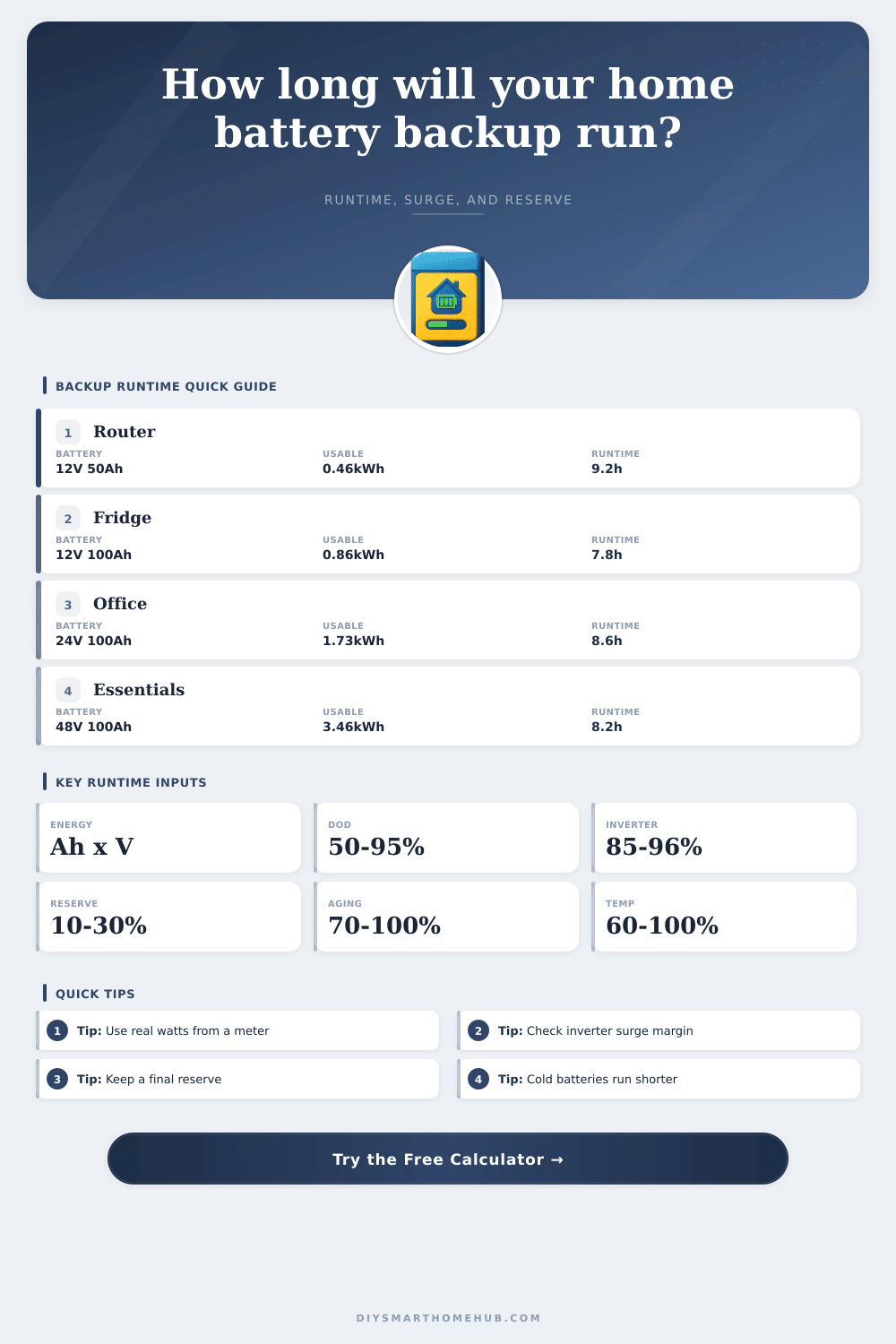
| Bank | Rated Wh | Usable AC | Best fit |
|---|---|---|---|
| 12V 50Ah LFP | 600 Wh | 460-500 Wh | Network gear |
| 12V 100Ah LFP | 1200 Wh | 920-990 Wh | Fridge mix |
| 24V 100Ah LFP | 2400 Wh | 1840-1980 Wh | Office loads |
| 48V 100Ah LFP | 4800 Wh | 3680-3970 Wh | Essentials |
| 12V 100Ah AGM | 1200 Wh | 430-510 Wh | Short reserve |
Derating Guide
| Condition | Factor | Use when | Effect |
|---|---|---|---|
| New warm LFP | 95-100% | Healthy bank | Full runtime |
| Mature bank | 80-90% | Several years old | Shorter |
| Cold garage | 60-85% | Low temperature | Shorter |
| Lead-acid cold | 50-75% | Winter outage | Much shorter |
| Reserve holdback | 10-30% | Protecting bank | Intentional spare |
Common Planning Targets
| Scenario | Avg W | Target | Usable kWh |
|---|---|---|---|
| Internet only | 25 W | 12 h | 0.30 kWh |
| Fridge cycle | 110 W | 8 h | 0.88 kWh |
| Office work | 220 W | 6 h | 1.32 kWh |
| Camera stack | 95 W | 24 h | 2.28 kWh |
| Essentials | 450 W | 8 h | 3.60 kWh |
It’s Tuesday night, and it happens: the power goes out. There’s a click as the fridge compressor turns off. Then you wait. It is silent. LED lights on the router blink out. Your phone still has charge. But you don’t.
And that’s when most homeowners discover what they realy don’t know: How many hours will they have power if the grid goes down? They bought the system for peace of mind, but they is only learning during their first outage that the marketing specs don’t match the real world. In battery back-up, runtime isn’t simply a matter of capacity. It’s a matter of physics, of thermodynamics, and of behavior of moddern appliances which draw power in fits and starts.
Why Your Battery Does Not Last as Long as You Think
You look at watt hours. Most folks do. A 4kWh battery seems adequate for everything … right? Well, not really. It’s not that easy. When you enter your chemistry and load into the calculator, it crunches numbers for you. And it does so without requiring you to guess how much of that stated amount is consumed with efficiency losses.
What are you actualy drawing? Just your internet gear keeping you working remotely? Or maybe fridge turning on every half hour to ensure the last bits of that pot roast don’t go bad? Those aren’t equivalent loads. One is continuous, lower draw. The other is a piece of equipment that wakes up, draws a surge (three times its rated value) and then returns to slumber. Failing to account for those peak starts is one of the quickest ways to blow an inverter breaker before dawn.
There’s also the fact that chemistry is important and no one talks about it enough. You cannot get all stored energy out of lead acid batteries if you use them. In fact, deep discharging kills their lifetime. You essentially only have half the rated capacity written on the box. With lithium iron phosphate, you can get down deep and typically tap into 90% of that stored energy without any harm to cells. The distinction between lead acid and lithium changes your runtime estimate by nearly double. This isn’t because anyone likes it; it is an absolute limit of electrochemistry. The tool takes it into account and automatically applies depth of discharge factors depending on which battery types you choose.
Oh, and there’s the environment. Cold is not friendly to batteries. Leave your system outside in an unheated garage in January and its capacity will be greatly reduced. Below freezing temperatures hurt lead acid batteries very quickly. Even lithium doesn’t fare well. You may think 20% isn’t much, but now your 8-hour backup is only 6.5-hours. That half-day loss can mean the difference between maintaining frozen foods or seeing your ice cream ooze out onto brown puddles on the floor. When weather gets nasty, it pays to plan for worst case temperature.
But also aging does play a role. A brand new battery is not the same as a three year old battery that’s been cycled many times. It will lose capacity with age. With the calculator, you can account for age so that your estimate is realistic even years later after install. You aren’t planning just for tonight, you’re planning for this coming winter. And the winter after that. Most of us forget about degradation until it’s too late.
Another common catch is surge capacity. When a device starts to run, like a refrigerator or sump pump, there will be a brief increase in demand of perhaps five times normal usage. Your inverter has to manage this without flipping over completely. So even though your low average use might be okay, the inverter may trip out when a device draws five times the current. No go, no power. This means surge margins must match your device specs so you don’t blow the inverter unexpectedly.
But don’t run down the battery to zero. Aim to use about 85-90% of your capacity and leave a 10 or 15% cushion as a reserve. This gives you a bit of breathing room on those surprise loads and also extends the cycle life. That’s insurance that a human might make an error such as forgetting about a space heater cranking in the livig room. That little bit of reservation holds things together.
In the end, it removes the unknown. It makes you commit to the things that actually matter. It removes the guesswork from understanding surge loads, temperature and depth of discharge. And suddenly, all the magic comes off and you just know. You won’t fret over whether the lights is going to be on or not. It’s not about having hours. It’s about knowing that those hours will be good because you can trust the numbers. You’ll know how long it would of lasted when the next outage happens.