Alarm Siren Decibel Coverage Calculator
Estimate whether an alarm siren will stay above your target sound level after distance loss, walls, doors, ambient noise, and combined siren gain.
Siren coverage result
| Area profile | Target at far point | Common use | Note |
|---|---|---|---|
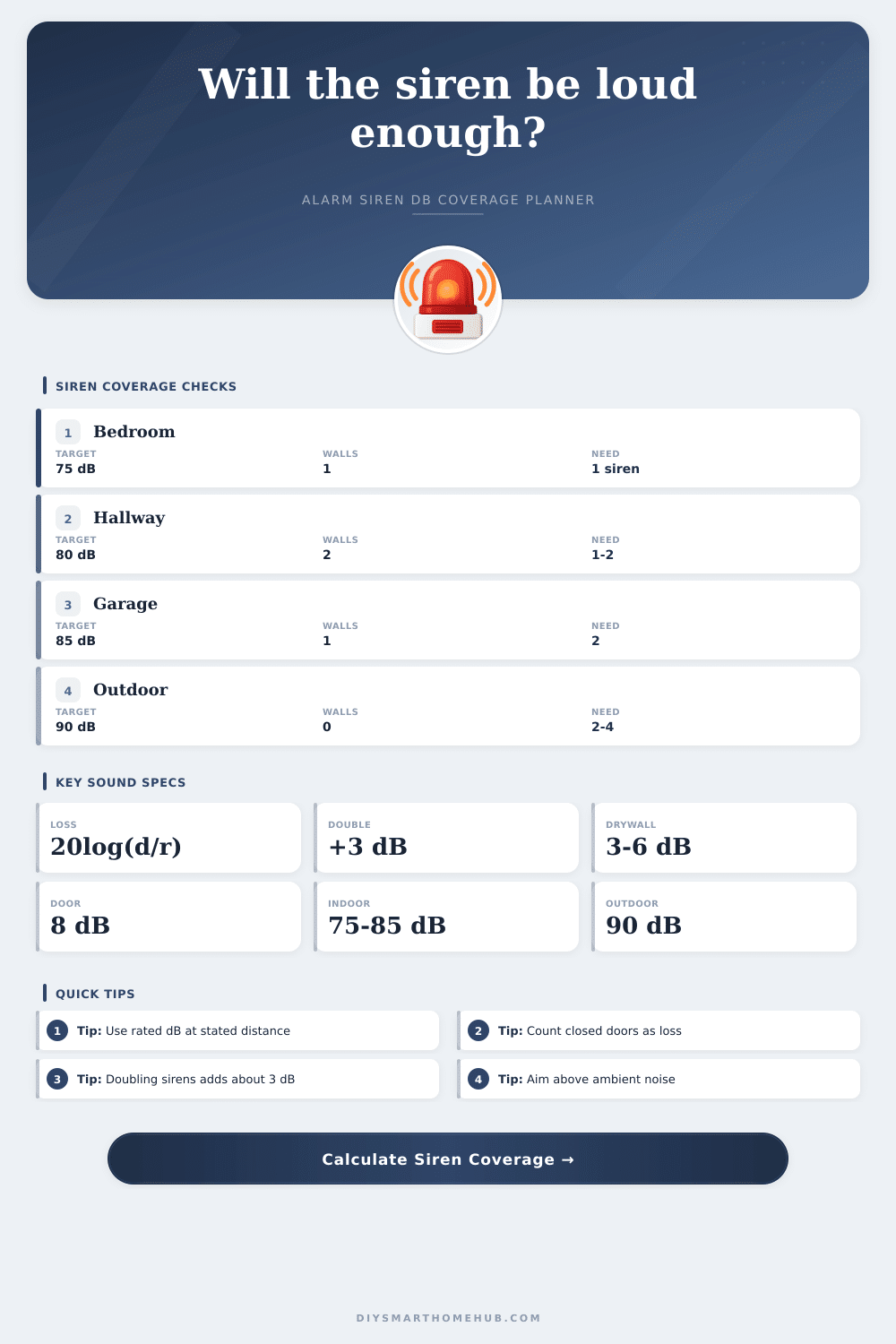
| Bedroom | 75 dB | Sleeping area | Audibility without extreme output |
| Living / open plan | 78 dB | Daily rooms | Moderate target for normal ambient |
| Hallway / entry | 80 dB | Escape path | Useful where doors may be closed |
| Garage / utility | 85 dB | Harder surfaces | Higher ambient and tool noise |
| Outdoor | 90 dB | Yard or patio | No room gain, more distance spread |
| Barrier | Loss per item | Use in calculator | Planning caution |
|---|---|---|---|
| Open sightline | 0 dB | No wall loss | Distance is the main loss |
| Interior drywall | 5 dB | Typical room partition | Varies with doors and gaps |
| Insulated stud wall | 8 dB | Bedroom or utility wall | Higher frequencies lose more |
| Masonry / concrete | 15 dB | Garage or basement wall | Use measured sound when possible |
| Closed interior door | 8 dB | Added separately | Solid doors may attenuate more |
| Rated siren | Reference | Good fit | Watch item |
|---|---|---|---|
| 85-95 dB | 1 m / 3.3 ft | Small room or hub | May fade quickly through walls |
| 100-105 dB | 1 m / 3.3 ft | Indoor smart siren | Check bedroom comfort |
| 110-115 dB | 1 m / 3.3 ft | Garage or whole home | May require careful placement |
| 120 dB+ | 1 m / 3.3 ft | Outdoor / industrial | Confirm code and local limits |
| Distance ratio | SPL loss | Formula | Example from 1 m |
|---|---|---|---|
| 2x farther | 6.0 dB | 20log10(2) | 2 m |
| 4x farther | 12.0 dB | 20log10(4) | 4 m |
| 8x farther | 18.1 dB | 20log10(8) | 8 m |
| 10x farther | 20.0 dB | 20log10(10) | 10 m |
This calculator is for planning alarm audibility, not code compliance or hearing-safety certification. Follow manufacturer instructions, local rules, and qualified alarm guidance for permanent systems.
It’s 3am. You hit the panic button on your smart alarm app. Nothing happens. Or rather, something happen in the kitchen where you are standing, but your bedroom remain suspiciously quiet. This isn’t typically a device issue. This is almost always an acoustical one. Sound behave in ways that people don’t think it does, particularly behind closed doors and through drywall.
Knowing how far to cover the area before installation ensure you don’t buy more sirens than necessary. It also prevents you from buying sirens that are too quiet or, even worse, not enough. Once you enter your room size and barriers into the calculator above, it do all of the math for you. It eliminates need to figure out those logarithmic decay equations.
Why Sound Planning Matters for Home Alarms
But when it comes to putting it into practice, that’s where it gets tricky. As a rule of thumb: Every time you double the distance away from sound source, it decrease about six decibels. That’s the inverse square law at play, which is why a one-meter-siren sounds much different on the other side of a big livig room. The tool takes that loss into account automatically without having to remember the equation yourself.
People frequently overlook all the things that block that sound. For example, a typical 5 dB reduction occur for every interior wall. Eight dB can be lost through an insulated stud wall. Even worse, closed doors can blocks eight dB (or more) by themselves. You’re fighting a losing battle if you have one unit and the bedroom door is closed at night.
Your alarm hub may be in the garage. Use the calculator to add up those losses and understand what really gets to listener. It’ll show you the reality of the path… Not just the raw power of speaker.
More sirens can help, though this isn’t what most homeowners imagine: adding twice as many of the same siren increases overall output by roughly three decibel. It sounds like a small change, but if you are fighting background noise like HVAC systems or traffic, it will push a sound that is hard to hear just above the level where you can notice it.
By spacing them out, you’re sacrificing volume for coverage area. Often a distributed system of somewhat-modest sirens will be better than one huge central-hallway siren which have trouble punching through multiple walls.
It’s not all about power, either. How and where the siren mounts will have an impact. For example, if you tuck your siren behind some furnitures or mount it in a cabinet, this will weaken the sound by several decibels, essentially muting it while leaving the settings unchanged. In these instances, you’re best off with open sight lines, which means distance become your nemesis.
The tables on the page list typical target levels according to space. For instance, they state that a minimum of 75-decibel sound is necessary in a sleeping area for reliable awakening. Outdoors, even greater output are required since there are no walls to bounce and boost it back to you.
Bottom line: Plan for silence, don’t react to it later. Think of the most distant point in your zone, not the average. A good sounding alarm next to you won’t do you any good if it can’t cut through a closed bathroom door at the end of the hall. Before drilling holes, use the tool to find those weak spots. It provides a confidence score based off the amount of headroom above your target levels and background noise. The result might look tight; better to add a unit then hope for the best.
You should of planned ahead. Sound physics doesn’t care about marketing claims or even your brand loyalty. Let the numbers drive the layout. Where you need it to be, you want it to come from there… and loudly enough to act upon immediatly.